
I am writing a book at the moment concerning important things those of us who are Christians were not told. One of the chapters is called Greater Than My Lot. It is a look back at church history, and at how much we owe to those who have gone before us.
The big lesson for me is a simple one. There are many lessons to learn from church history, particularly from some of the main players, particularly in the first three hundred years. I would like to introduce you to twelve of them, in the order in which they lived.
By three hundred years I mean from the beginning of the church, in about AD 30, to the conversion of Roman Emperor Constantine in about AD 312. That is the key turning point. Before Constantine, the empire was antagonistic towards and persecuted Christians. After Constantine, the empire became supportive of Christians. That changed everything, for good and for ill, and it is why these periods matter so much.
They came to be called the Church Fathers because they were looked upon as guiding lights for the church. They also wrote, and we still have their writings. Moreover, a lot was written about them, so we know their stories.
It is important to say this at the start. These men are not just the property of Catholics, Orthodox and High Anglicans. They are for all of us. We may not always agree with their theology, notably their ecclesiology or eschatology, and we should say that honestly. But there is so much that we can learn from them. We are poorer if we ignore them.
1. Clement of Rome (c. 35 to 99)
Clement was a leader in the church in Rome in the first century, not long after the apostles. The church in Corinth had fallen out and thrown out its leaders, and Clement wrote to them in about 96 to call them back to humility and order. He reminds us that the church has always had rows, and that the answer has always been the same: humble repentance and respect for those God has set over us.
2. Ignatius of Antioch (c. 35 to 107)
Ignatius was bishop of Antioch, and he was arrested and taken to Rome to be eaten by lions in about 107. On the way he wrote letters to the churches, begging them not to try to rescue him. He wanted to imitate Christ in his death, and he shows us what it means to love the Lord more than life itself. Ignatius made a big deal out of bishops, presbyters and deacons and out of the Eucharist, martyrdom, one Lord, one altar, one Eucharist and one people. He was definitely one of the good guys, and those of us from my background who do not hold to bishops, presbyters and deacons in the same way need to hear that this man did.
3. Polycarp of Smyrna (c. 69 to 155)
Polycarp had known the apostle John, and he was faithful for 86 years. When he was an old man they told him to deny Christ and go home, and he said, “86 years I have served Him and He has done me no wrong, how can I blaspheme my King?” He was burned at Smyrna in about 155, and he shows us that faithfulness is not a sprint, it is a lifetime.
4. Justin Martyr (c. 100 to 165)
Justin was a philosopher who tried every system of thought until he found Christ. He then tried to explain the faith reasonably to the emperor, and to show that Christians were not criminals. He was beheaded in about 165, and he reminds us that we can give a reason for our hope, and still have to suffer for it.
5. Irenaeus of Lyons (c. 130 to 202)
Irenaeus lived when clever heresies were pulling people away from the simple gospel. He fought the Gnostics, who said secret knowledge was more important than the cross. He held to the teaching of the apostles and to Scripture as the rule, and he shows us that truth matters, and error always costs souls.
6. Tertullian of Carthage (c. 155 to 220)
Tertullian was a sharp lawyer from Carthage, and he gave us words like Trinity to help us speak about God. He was fierce and brilliant in defence of the faith. He also had a deep yearning for holiness, and in pursuing it some say he lost the plot to some extent in later life joining a group that over emphasised spiritual gifts and end times prophecy. He reminds us that a longing to be holy is a good thing, but it needs to stay anchored to grace.
7. Origen of Alexandria (c. 185 to 253)
Origen had an enormous mind and an enormous devotion. He taught himself, he gave himself away, and he suffered greatly for the faith. He was not always right, and we must say that honestly, but he was very much into systematic theology, and we owe a lot to his way of doing that, of trying to think through the whole faith in an ordered way. He shows us what it is to give your whole mind to God.
8. Cyprian of Carthage (c. 200 to 258)
Cyprian was bishop of Carthage during plague and persecution, when many others fled. He stayed to nurse the sick and to bury the dead, Christian and pagan alike. He was beheaded in 258. He taught that we must stay together as the church, and he shows us that leadership is proved not in comfort, but in crisis.
9. Athanasius of Alexandria (c. 296 to 373)
Athanasius stood alone against the world for the deity of Christ, when most of the church had gone astray. He was exiled five times for refusing to bend. People said, “Athanasius against the world,” and he shows us that sometimes one man, with God, is the majority.
10. John Chrysostom (c. 349 to 407)
Chrysostom means golden mouth, and he earned it. He preached so plainly and so boldly in Constantinople that the empress had him exiled. He died in exile in 407. He preached to ordinary people in ordinary words, and he shows us that good preaching is not clever, it is clear and it is courageous.
11. Jerome (c. 347 to 420)
Jerome was a scholar who gave his life to translating the Bible into Latin, so that ordinary people could read it. He was grumpy and difficult, and he knew it. He died in Bethlehem in 420. He shows us that God uses awkward people, if they will use their gift for His people.
12. Augustine of Hippo (354 to 430)
Augustine (perhaps best known and honoured of the twelve) lived a wild youth, while his mother Monica prayed for him for years. He was converted in a garden in Milan when he heard a child say, “Take up and read,” and he opened Romans. He wrote his Confessions (appealing Protestants) and his City of God (appealing to Catholics) He shows us that no one is too far gone for grace. Protestants love Confessions, and the sense there of justification by faith. Catholics love the City of God, and what it says about how a whole society can be claimed for Christendom, and how Christians can live together with non-Christians in civic life and can make a difference. I have not read the City of God well enough yet to say how far his argument could be used to support Christian nationalism, but it is a question worth asking. Is he one of the good guys? A friend of mine says no, because of his determinism. Augustine had held to determinism as a philosophy before his conversion, and my friend believes it stayed with him for the rest of his life. Calvin certainly leaned heavily on Augustine. I have not read Augustine well enough to come to a settled view on that.
But the church was not made up only of men like these. Behind them were thousands we do not know. If Christians were thrown to the lions, we know one or two of them, but there are a lot we do not know. People who stood firm even though it would have been a simple thing to recant and deny the faith, as many did. They could have easily escaped but didn’t.
Perpetua
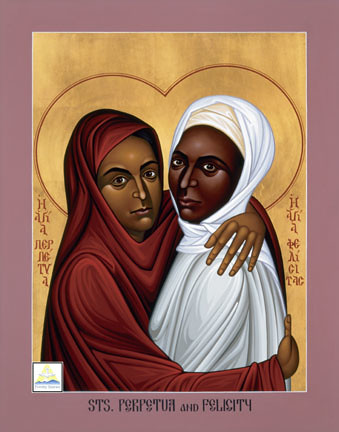
The church was made up of ordinary people who were prepared to pay the ultimate price. One in particular is worth mentioning, and not just her on her own, but her maid servant as well. I have left her to last on purpose, because she is the point of it all. Perpetua was a young mother, a noble woman, with a baby son she was still nursing. Felicity was her maid servant, her slave, and she was pregnant. They were put in prison in Carthage in the year 203, Felicity gave birth there, her baby was taken from her, and both women were killed for refusing to deny Christ. Perpetua wrote a diary in prison, one of the earliest writings we have by a Christian woman, and then she died for it. Perpetua and Felicity are the architects of and role models for the ordinary person. They show us that the faith was not just kept alive by clever men who wrote books. It was kept alive by ordinary mothers, and slaves, and old men, and young girls, who would not bend. That is why their stories matter now.
As we move into days when Christians are being persecuted around the world, and while it may not have come in the way of being killed for the faith in the West yet, it could well come down that way, we can take courage from these early examples. We can learn from how they dealt with attacks upon their faith, and with the pressure to renege on their beliefs. They faced the same choice we may face, and they stood firm. Many of them died for their faith, and we may well be called to do so as well. Are we prepared for that challenge?

