
The following is an extract from my forthcoming book, titled: “It’s Not What We Were told”. It is from the chapter that is to do with church history and the importance of learning lessons from it. This relates to some key figures between AD 100 and AD 500:
“This period also produced some of the great apologists and defenders of the faith. To tell the story fully would require far more time, resources and ability than I have. I remain greatly indebted to those historians who have dug deep into this period on our behalf. As for my list:
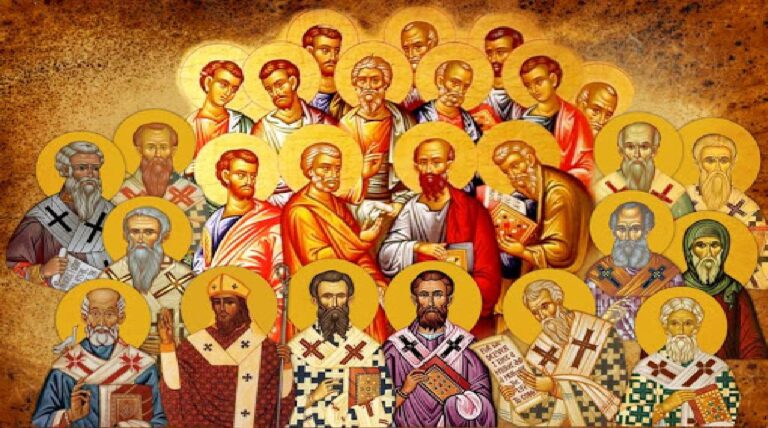
- Clement of Rome, bishop of Rome in the late first century, whose letter to the Corinthians, usually dated around AD 96, is among our earliest Christian writings outside the New Testament.
- Ignatius, bishop of Antioch, whose seven letters written while travelling to his martyrdom in Rome around AD 108 are among our earliest Christian writings.
- Polycarp, bishop of Smyrna, a disciple of John, whose letter to the Philippians and whose martyrdom around AD 155 link us directly to the apostolic age.
- Justin Martyr, philosopher in Rome, whose Apologies in the mid second century defended the faith to the emperors and explained Christian worship to the pagan world.
- Irenaeus, bishop of Lyons, who fought Gnosticism in the second century and stressed the unity of Old and New Testaments.
- Tertullian, in Carthage, who coined much of our Latin theological language, including the word Trinity.
- Origen, in Alexandria and Caesarea, who shaped biblical scholarship and first attempted a systematic theology.
- Athanasius, bishop of Alexandria, who stood almost alone against Arianism and secured belief in the full deity of Christ.
- Gregory of Nyssa, who secured Nicene orthodoxy by defending the full deity of the Holy Spirit at Constantinople in AD 381.
- Chrysostom, preacher in Antioch and Constantinople, called Golden Mouthed for his powerful preaching on Scripture and justice.
- Jerome, who translated the Bible into Latin as the Vulgate, the Bible of the Western church for a thousand years.
- Augustine, bishop in North Africa, whose Confessions and City of God shaped Western theology for over a thousand years.”
It seemed to me that despite coming to faith in a section of the church, the Plymouth Brethren, that typically ignored church history from the end of New Testament times to when they started out (around 1830), this was a major omission. They tended to dismiss the early Fathers as too Catholic or too Orthodox to have much that is useful such that we can learn from them. Yet as I did my deep dive into church history, it became obvious to me that the Fathers had to define the faith before we had the widely accepted creeds, and to defend the faithful. What they came up with was mostly sound and many lived out their faith, even unto martyrdom.
That has been in my mind again this past week. After reading an article in the Church Times, titled: “Unite against tide of division” that began with the statement “Racial justice is a test of national identity. Is the C of E failing it” it first seemed to me the article made some good points. It also made some bad ones like having a pop at the recent “Unite the Kingdom rally” and so-called Christian nationalism. I told my friend who posted a link to the article on his Facebook page that this failure to understand the anger felt by certain Christians concerning what is going on in my beloved land was partly egged on by influential “apostate clergy” who teach error. My friend graciously took me to task for using that phrase. I should stress that it wasn’t meant as a personal attack and I can see why my robustly expressed antipathy would have stung.
I was also stirred to write having watched a video presentation by Aaron Edwards, titled “The Patristic Fathers”. He covered many of the Fathers from my list and more besides, going a lot deeper than I had, bringing out many relevant points. An important point he made was that the early Fathers had to be forthright, and that this matters now. In the first three centuries of the Christian era, there was no settled New Testament canon as we know it and no Nicene Creed to appeal to. The task of the Fathers was to put the fences in, not just to graze inside them. If they did not say clearly who Christ is, there would be no Church left to be nice in, which is what church leaders who should know better say the likes of me ought to be doing.
The main battles were clear enough, variations of which we face today, and here is my brief take on some of the important ones. Gnosticism taught that matter is evil and spirit is good, so salvation and particular insight came by special knowledge that only a few had. One of its offshoots, Docetism, said Christ only “seemed” to have a body. At the opposite extreme, Ebionitism said He was merely a man who kept the Law. Marcion said the God of the Old Testament was a different, lesser God, and cut the Old Testament right out. What came later, and has lasted much longer, was a softer version of the same instinct, that God has finished with Israel and the Church now replaces Israel. That view owes more to Augustine and to Greek ways of reading Scripture than to Marcion, but Marcion shows where the instinct begins. Montanism claimed new prophecies beyond the apostles, and Monarchianism tried to protect monotheism by saying Father, Son and Spirit are just three masks of one person, or that Jesus was a man given power. Arianism arose in the fourth century and taught that Jesus was created and not eternally God. Pelagianism in the fifth century claimed that we can manage without grace, which Augustine answered, and which later fed into the Arminianism (free will) versus Calvinism (predestination) debate that came to divide Christians much later.
That brings me to three words we now use loosely. Heterodoxy is a different opinion within orthodoxy. Heresy is serious error that undermines the gospel itself, like denying the incarnation or the atonement. Apostasy, from the Greek apostasia, meaning a standing away from, a revolt, is a deliberate, public abandonment of the apostolic faith by those who once professed it, and leading others that way. 1 Timothy 4:1 warns that “in later times some will depart from the faith”, and Hebrews speaks of wilful turning away. When I wrote “apostate clergy” I meant this third category, teaching that departs from what we confess in the creeds and ancient tradition. We are entreated to “earnestly contend for the faith” (Jude 1:3). Apostates need to be called out, just as the likes of John the Baptist, the Patristic Fathers and Jesus himself did.
Irenaeus writing “Against Heresies” about 180 AD calls Gnosticism “the abyss of impiety”. Tertullian calls Marcion “the Pontic mouse who nibbled away the Scriptures”. It sounds impolite now. For them it was pastoral and essential. Error was spiritual poison, and love required clear boundaries. As Augustine put it: “Error has no rights, but persons do”. They could be severe about the teaching and still tender about the person, hoping for repentance.
If you lose the Old Testament, you lose the God who keeps covenant with Abraham, and you end up reinventing Marcionism. Much of the current talk that wants to cut Israel out of the story, and much of the talk that labels any Christian voice in public life as “Christian nationalism” or “far right”, finds its roots in ancient heresies, whether the apostate clergy knows it (and they should) or not. And if you think we can be good without grace, you reinvent Pelagianism.
I have no desire to fall out with friends in social media or anywhere else, but if we don’t call out error the wolves will do their worst (as we can see is already happening) to sheep that need good under-shepherds to lead them. Putting our heads above the parapet is necessary. Unity around niceness is a false unity. Unity around apostolic truth is a true one. That is what the early Fathers teach us, and why their stance on apostasy still matters. There are other lessons we can learn from them, and these are discussed in my book.

