
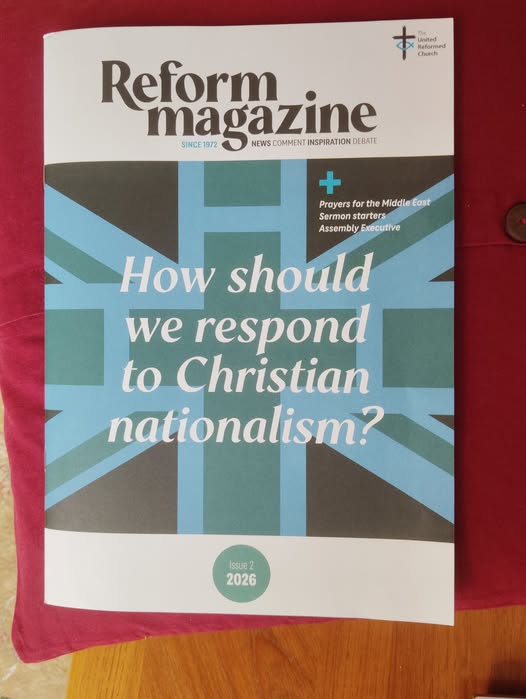
I was recently alerted by a friend, a URC minister, concerning a magazine his denomination publishes and in particular an article in its latest edition, on Christian Nationalism. As the article is not online and I need to refer to it, I will provide a link to it at the end of this blog.
As always, I am keen to establish definitions to avoid misunderstanding and, as often happens these days, I asked Meta AI for one, and as is usually the case, it delivered:
“Christian nationalism is a complex and multifaceted ideology that seeks to fuse Christianity with national identity, often advocating for a country’s laws, culture, and institutions to reflect Christian values. It’s not just about personal faith, but about shaping the nation’s identity and policies according to Christian principles.
Key aspects of Christian nationalism:
– Belief that a nation is divinely chosen or has a special role in God’s plan
– Desire to establish Christianity as a dominant or official religion
– Often linked to conservative or right-wing politics
– Can be associated with exclusionary or supremacist ideologies
Is it a good thing or a bad thing?
That’s a subjective question, and opinions vary widely. Some see Christian nationalism as a way to preserve traditional values and promote moral governance. Others view it as a threat to democracy, pluralism, and individual freedoms, potentially leading to exclusionary policies and discrimination against minorities.
Today’s Christian Nationalists:
– In the US, figures like Donald Trump, Mike Johnson, and Marjorie Taylor Greene have been associated with Christian nationalist ideologies.
– In the UK, politicians like Danny Kruger have expressed support for Christian nationalist ideas.
– Globally, leaders like Hungary’s Viktor Orbán and Poland’s Law and Justice party have been linked to Christian nationalist movements”.
I prefer nationalism to globalism as two blogs that I posted six years ago (here and here) argued. While I recognise there may/is be a sinister side to Christian Nationalism, I also see it as a reaction to the unholy alliance between the Islamism and the cultural Marxism taking over a nation, away from the mainly Christian consensus I believe was more in line with the British national identity of my childhood and set of values, now being undermined and replaced by Labour, with the Greens with a similar set of harmful ideas set to replace them in terms of popular support. But if AI is correct, I can’t go along with all of what Christian Nationalism wants, e.g. “Can be associated with exclusionary or supremacist ideologies”.
Since Danny Kruger is mentioned, I thought the following was helpful in my understanding:
Danny Kruger is calling on Britain to boldly reclaim its Christian heritage as the foundation of national identity.
As the UK becomes increasingly secular and religiously diverse, with Islam growing rapidly, some argue that sidelining Christianity risks moral confusion and leaves a spiritual vacuum.
Supporters say that without confidently standing on its biblical roots, Britain may allow other faiths to shape its future values and identity. Kruger emphasizes that Christianity should not be treated as merely one option among many — it should be embraced unapologetically as the guiding truth of the nation.
My own social media feed is full of discussion of late on the merits or otherwise of Christian Nationalism. One post on the pro side begins:
Some questions I like to ask Christians who loathe the idea of Christian Nationalism:
1. Assuming you are not happy with a (Christianly) qualified form of nationalism, are you happy with the present socio-political order of secular globalist liberalism, with all its inevitable effects?
2. Why do you see secular globalist liberalism as more Christian (or “less un-Christian”) than Christian nationalism? On what basis is it a better state of affairs, knowing all that you know about the state of modern western society?
3. If secular liberalism was not the norm in the West, and we had instead, say, the England of the early 19th century (or equivalents), would you be unhappy? Would you be outraged and feel the need to campaign vigorously for secular liberalism if it did not exist?
4. If, on the other hand, you are not content with secular liberalism, what do you believe to be a better alternative as a socio-political posture for Christian mission which recognises the importance of nations and works within and for their ultimate good?
Strangely related to what I want to say and picking up on some of the people supposedly pushing Christian Nationalism, e.g. Trump, one Christian friend today writes: “Trump is an arch-manipulator. He has been a master of controlling a narrative so strong that his continual lies do not rebound on him as with other politicians. Deceit is reframed as strength. Criticism is recast as ‘derangement’. Loyalty is elevated far above integrity. Rudeness is celebrated. Trump represents a key moment in the death of public truth”. Also today, someone who I don’t know, writes: “A Georgia pastor has gone viral after a sermon in which he urged Christians to pray for Donald Trump, saying he believes God is “using” the president in ways that may be difficult for people to understand. Otha L Turnbough, pastor of Lionheart Church in Georgia, told congregants not to speak negatively about the president, but instead to pray for him, emphasizing that God often works through unexpected and controversial figures. “God is using that man outside your understanding,” Turnbough said. He encouraged listeners to look to the Old Testament, where God used unlikely leaders and prophets to confront evil and carry out judgment, arguing that similar biblical patterns can be seen today. Turnbough suggested that while some of Trump’s actions provoke strong reactions, they should be viewed through a spiritual lens rather than an emotional one. He told the congregation that when God moves to judge evil, the individuals He uses are often misunderstood or viewed as unconventional”.
Relevant here, (imho) my arse about face Christian friend seriously doesn’t GET IT and the Georgia pastor does – not that I am here to endorse Trump, who has his faults, like anyone else, that could/should be called out, BUT he is the best hope we have atm, both humanly speaking and divinely too, since the Almighty is adept at using flawed characters with balls, given the dangerous direction my beloved country is going under Starmer and would under Polanski, at addressing some of the concerns that get many who are labelled “Christian Nationalist”, raising national flags in the streets or attending Tommy Robinson carol concerts or chanting Christian slogans or calling out two tier justice that seems to be so evident, or the gay and transgender agendas being imposed on our children, or the increasing curtailment of free speech, or allowing immigration especially by illegals or those who disrespect this country, or the appeasing of certain Islamists, including worst of all Muslim rape gangs or pushers of Shariah Law, so as not to upset them, assorted wokeism etc., etc., so worked up, who end up forthrightly telling their “Christian” critics where they can go and adding to the angst.
The pastor of my own non-woke, Strict Baptist church recently shared that he had been to two conferences and, in each one, one of the speakers spoke about Christian Nationalism (regrettably, I don’t have the transcript of what was said). But it did alert me to the fact that Christian Nationalism is a big deal, not just for those “my lot” might be tempted to dismiss as wishy-washy Christians, but also one that “my lot” should be and indeed are considering.
But back to the question posed in the title, the article my friend thoughtfully shared, my critique of said article and what (imho) should be the right approach to Christian Nationalism. I will start with the article titled: “How should we respond to Christian Nationalism” and then onto my response to each of the responders, after first checking out and weighing up what each had to say, and finally by way of wrapping up I would like to give my own answer to the question found from the title:
Responder 1 – Helen Paynter: (the most helpful response of the four). While like the other three she doesn’t address the concerns of those who identify as Christian Nationalist, she raises important questions that in my past life as a community activist I sought to address and sadly overlooked by many – thus giving rise to the playing out of the Devils “divide and rule” strategy.
Responder 2 – Wale Hudson: (the least helpful response of the four). Experience tells me that anything containing the words “Stephen Yaxley-Lennon” and “far-right demonstration” in the first sentence followed by a series of cliches and platitudes is unlikely to be sympathetic to the sort of concerns raised above.
Responder 3 – Al Barrett: Not quite as bad as the previous one but its failure to understand why so-called Christian Nationalists act in the way they do is more than disappointing.
Responder 4 – Michael Hopkins: As a history nerd whose specialist subjects back in the day included the rise and fall of the Third Reich, I was interested to read about the 1934 German Evangelical Church Barnham Declaration and what happened next, but to intimate or more that certain Christian Nationalists may be our modern-day Nazi equivalent fails to understand what is truly at stake.
I know none of the above persons, who I have little doubt mean well and have their own followings, and I would love to have a respectful discourse with them if that were possible. Sadly, my overall response is, if this is the URC position, then God help us!
As for how “Christian” is “Christian Nationalsim”, it is a mixture of yes and no. I told my friend who shared this article that I follow the example of the late David Pawson: the only “isms” I am into are BaptISM and EvangelISM. Even so, my nation is in dire straits. While the Christian Nationalists among us are asking some of the right questions and their detractors are coming up with many of the wrong answers, our only hope is in God Almighty.
 JRB Publications
Those who do not learn from history are bound to repeat it. Which were the Christian Nationalist nations in the thirties and forties? They were Germany, Italy, Portugal and Spain. All had the same or similar slogans “God, country and family”! All were authoritarian states…