
Our church pastor has been running a series of Bible studies on the Psalms of Asaph. This got me thinking …
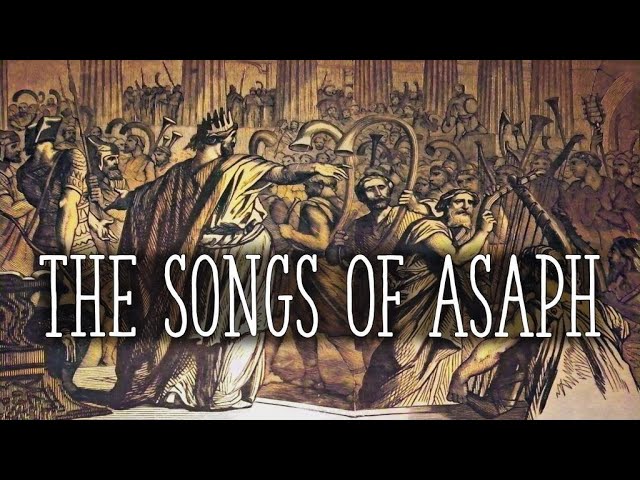
When we think ‘Psalms’ we think David. And rightly so – he gives us the language of the individual heart crying out to God. But right alongside David’s songs are 12 psalms attributed to Asaph and his guild. They give us something different and equally vital: the language of the covenant people, in worship, in crisis, in memory.
Asaph wasn’t a freelance poet. He was appointed by David and his role continued for centuries. He was Chief Worship Leader – “David appointed Asaph to be in charge of thanksgiving and praise” 1 Chronicles 16:5 – standing at the head of singers and musicians when the Ark came to Jerusalem. He was also recognised as a Prophet / Seer – “Hezekiah the king and the officials commanded the Levites to sing praises to the Lord with the words of David and of Asaph the seer” 2 Chronicles 29:30.
That means his songs were not just music. They carried inspired proclamation. And he was the Head of a Guild — “David and the chiefs of the service set apart for the service the sons of Asaph, and of Heman, and of Jeduthun, who prophesied with lyres, with harps, and with cymbals” 1 Chronicles 25:1. Those ‘sons of Asaph’ were still leading worship after the exile: “The singers, the sons of Asaph, were at their stations” Nehemiah 11:22. For over 400 years this family taught Israel’s story through song.
So how do Asaph’s psalms fit with the rest of the Psalter, which is dominated by David? David gives us ‘I / me / my’ – personal lament, personal trust, personal sin and forgiveness. Asaph gives us ‘we / Israel / nations’ – corporate lament, corporate history, corporate justice. If David shows us how to pray in the cave, Asaph shows us how to worship as a people in exile. Most of Asaph’s psalms sit in Book 3 of the Psalter – Psalms 73–83, with Psalm 50 in Book 2. It’s the darkest book, full of the question: ‘Has God rejected us forever?’ And Asaph’s answer is always to pull the people back to who God is and what He has done.
Here are the 12 Psalms of Asaph with a brief synopsis of each:
1. Psalm 50 – God Himself puts His people on trial. True worship is not empty sacrifice but “Offer to God a sacrifice of thanksgiving” Psalm 50:14.
2. Psalm 73 – The problem of the prosperity of the wicked. Asaph almost stumbled Psalm 73:2, until he went “into the sanctuary of God” Psalm 73:17 and saw their end.
3. Psalm 74 – A communal lament after the temple is destroyed. “Remember your congregation, which you have purchased of old” Psalm 74:2.
4. Psalm 75 – God is the judge who lifts up and brings down. “For it is God who executes judgment” Psalm 75:7.
5. Psalm 76 – A hymn of God’s majesty in Zion. “God is known in Judah; his name is great in Israel” Psalm 76:1.
6. Psalm 77 – Personal distress turned to hope by remembering God’s deeds. “I will remember the deeds of the Lord” Psalm 77:11.
7. Psalm 78 – A long teaching psalm of Israel’s history. “He established a testimony in Jacob” Psalm 78:5, so “the next generation might know” Psalm 78:6.
8. Psalm 79 – Lament after Jerusalem is laid waste. “Help us, O God of our salvation” Psalm 79:9.
9. Psalm 80 – The cry of a vineyard. “Restore us, O God; let your face shine, that we may be saved” Psalm 80:3.
10. Psalm 81 – A festival call to obedience. “Oh, that my people would listen to me” Psalm 81:13.
11. Psalm 82 – God stands in the divine council and judges unjust rulers. “Give justice to the weak and the fatherless” Psalm 82:3.
12. Psalm 83 – Prayer against a coalition of nations. “That they may know that you alone, whose name is the Lord, are the Most High over all the earth” Psalm 83:18.
Taken together, Asaph gives us worship, lament, history, and justice all held together in song. His job as worship leader was to do theology out loud so the people would remember, repent, and trust. He was a prophet. We really could use the prophetic voice today.
That’s why Asaph still matters. In seasons where everything feels like it’s falling apart, we need more than personal devotion. We need the corporate memory of God, a reminder of who He is, what He has done and His promises. We need songs that tell the story again, from creation, to Exodus, to David, to the cross, and call us back to the God who judges justly, saves completely and is ever faithful.
It is a lesson that today’s worship leaders do well to heed as they seek to draw a church that is having to deal with its own form of exile, living in and coming to terms with a world that is increasingly hostile toward Him, helping them be closer to Him and as it seeks to carry out the Great Commission, just as Jesus instructed.

