
Dear George
I am pleased to learn of your intentions to write a book and I am happy to pass on tips / suggestions in order to help you be more productive in your writing endeavours …
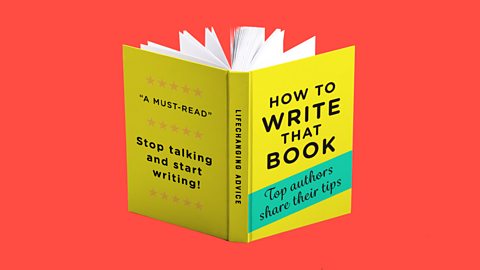
The best I can do for now though is to share my own experiences, recognising that every author is different, when it comes to his/her approach and attitude toward writing. I am assuming in your case (as it was in mine for the most part) the book will be part of a genre loosely referred to as “Christian”, you will be going down the self-publishing route, the task will be undertaken at a financial loss, and the subject is one you are passionate and know about with contents relating to things you feel people want or need to know, albeit putting aside delusions of grandeur that lots of people will read what you write, despite your best efforts. I should add, when looking for an Internet meme for book writing tips (see above), I was inundated, making me realise there is a lot of wisdom out there on the subject!
I suppose, in my case, my interest in writing began at a very young age. I recall my English teacher at school praising me on one hand because what I wrote was interesting while on the other reproving me for my clumsiness in my use of the English language. I think that observation could apply even to this day and is something I bear in mind when I write. As I look back, I had a particular thing about wanting to write down my thoughts, unlike many of my peers, but my first book came out around the turn of the millennium, and there have been a number since then, all on subjects that interested me (along with my blogging) but I would like to focus on my personal experience in writing my two most recent books, which you are familiar and have indeed had involvement with, “Prophets of the Bible” (see here) and “Priests of the Bible (see here).
Both those books were written during my retirement. While this did not mean I stopped being active but, due to my no longer having contracted duties through paid employment, along with an understanding wife, it did mean I could pick and choose what I did and when (e.g. writing books). The luxury of having free reign when to write may not apply in the case of those in paid employment or having to work with a publisher and those with fixed views on the final content. I tended to find that I was most alert first thing in the day and often full of ideas from the days before. I then might pick up again at the end of the day and wrote then too. You need to adopt a routine that suits you but it does require discipline and avoiding distractions. Given a lot of what I wrote required me to research carefully my subject, it was helped a lot by picking up on what others have said on the subject, “phoning a friend” and thanks these days to Internet availability. I made sure that is what I did before putting finger to keyboard although I often found I was continually revisiting what I had written as new thoughts came into my head.
I found early on, the way to go was to self-publish (I discovered that suitable publishers did not exist). I was able to balance the disadvantages e.g. no help in marketing the book with the freedom to write exactly what I wanted, included selecting the house style that I liked. While writing was a solo effort, I was grateful for any help I could get, including what had been posted on the Internet. I did need a proof reader and once the book was proof read, a type setter, to help me produce a book a printer could print or made available for buying online (I availed myself with both avenues and I have found my relationship with Ingram for selling online and a local printer who printed to order was more than satisfactory – I still get modest royalties from Ingram from sales, who also passes books to the likes of Amazon, so people anywhere can buy online). I have also made my books freely downloadable from my website.
I was fortunate in that my proof reader and type setter both were excellent. While I wanted to pay them a decent amount for their efforts (and did), with both of them it was a labour of love. Early on, I agreed with them what my house style should be (realising I needed to be consistent when adopting such), which was important to avoid time wasting and misunderstanding. The one thing that I could not overlook was the need to use correct English, including removing or explaining anything that could be construed as ambiguous or was repetitive. I found with my proof reader that having a routine where I pass on a section of what I had written for review and, while waiting for the result of the earlier proof reading, go onto the next section, to be helpful. I was thankful that my proof reader would proof read the corrected version, helpful in my case with my propensity to tinker with what I had written earlier. After that it was off to the type setter, who also helped with cover design and various practicalities, e.g. obtain ISBN, all of which was needed before submitting the final draft to Ingram and/or my printer.
So that’s it. While writing my books has meant hours of painstaking effort and some financial outlay, which along with my hours would never be recovered by book sales, it was worth it. I see the results of my efforts as being my party piece in trying to pass on something for others that can be construed worthwhile. When I wrote my last book, “Priests of the Bible”, I called it my “last hurrah” project. So far, other than write papers and articles for posting on my website, I have no plans to write another book although, if I could wind the clock back, I can think of several subjects that I might want to cover. As for marketing my book, it has been mainly by word of mouth and in terms of people buying or being gifted the book, numbers passed on have been modest. With people reading less, the non availability of traditional outlets to pass on books, the subject of marketability is a pertinent one and one I confess to not having cracked. But I was undeterred, for I knew from past experience that this would be the case. All that is left now is for me to wish you every success in your writing efforts and that what comes out of them may bless others.
 JRB Publications