
My latest deep dive into the Bible has been on the subject of Christ in the Psalms. For some relevant background to what I am about to share, check out my recent “The Bible revisited” blog (see here) and my “Christ in the Psalms (1)” blog (see here), where the aim, besides providing an introduction to the Messianic Psalms, was to reflect on one of the best-known ones – Psalm 22.
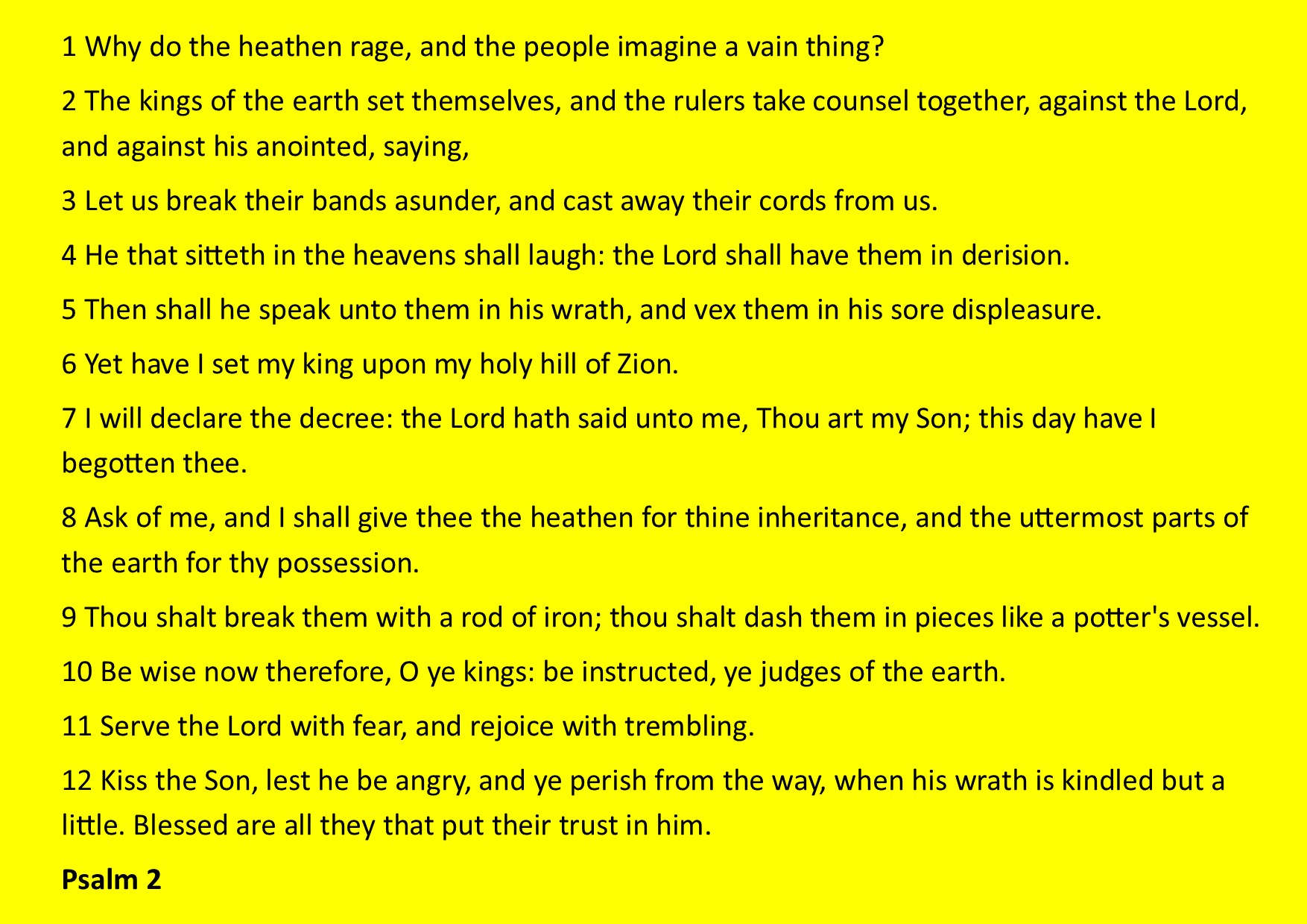
In this reflection, I want to concentrate on another Messianic Psalm – Psalm 2 (covering Jesus’ First and Second Comings). Psalm 2 is identified as one of the Psalms of David, and like many of those Psalms can be approached on two levels. Firstly, it can be seen as talking about the then “here and now”, in particular relating to the Kings of Israel (in this case, including David himself – it is worth noting that David saw the king he replaced, Saul, as the Lord’s anointed) who were specially appointed and anointed by God. Secondly, and how it was understood by the New Testament writers, it can be seen as referring to the future Messiah; in the NT case – Jesus. A lot has been said or spoken about Psalm 2, much of it helpful, and often accessible via the Internet. While I have checked out a fair number of these thoughts, many I found helpful, coming from those who have commentated on this Psalm, I decided for the purpose of this meditation, while taking these into account, to focus on my own thoughts and have done so via the ESV, as it helpfully divides the twelve verses into four sections, each containing three verses, and cross relate to New Testament fulfilment …
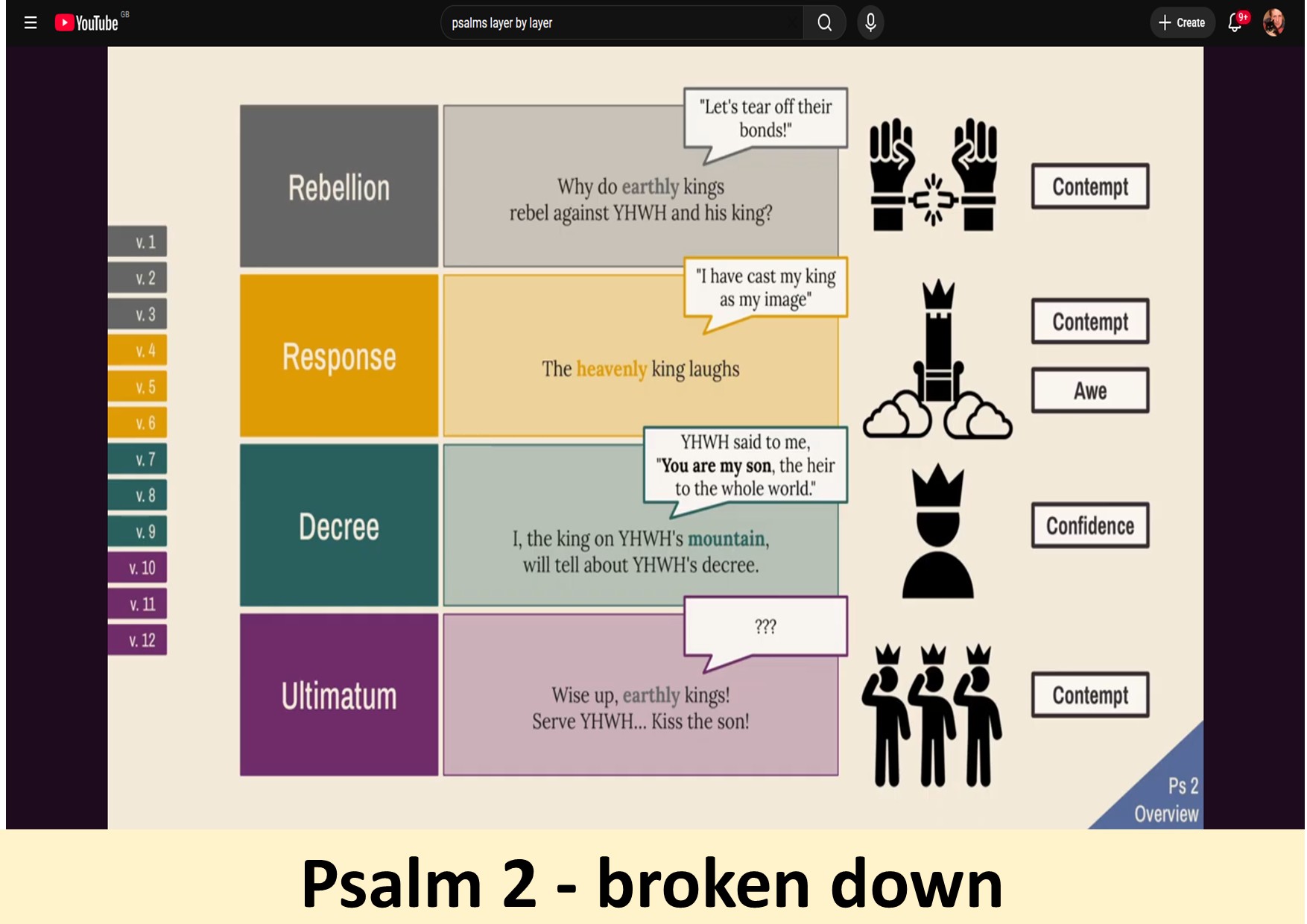
Rebellion – The nations raging
1 Why do the nations rage and the peoples plot in vain?
2 The kings of the earth set themselves, and the rulers take counsel together, against the Lord and against his Anointed, saying,
3 “Let us burst their bonds apart and cast away their cords from us.”
As I watch on my wall at what is going on, right across the world, I can see many examples of the nations raging and people plotting in vain and can identify with the Psalmist asking his question why? No doubt, if indeed the New Testament writers were right and that psalmist was indeed King David, who we know faced threats from the surrounding nations, it would have been a pertinent question. What the Psalmist saw was a conspiratorial threat against YHWH (God) and his anointed one (the Messiah), which Christians identify as Jesus Christ. The vanity, of course, is given that God is all powerful all plots will turn out to be in vain, despite whatever short term successes. We see examples of this happening in texts, such as: “Then the chief priests and the elders of the people gathered in the palace of the high priest, whose name was Caiaphas, and plotted together in order to arrest Jesus by stealth and kill him” Matthew 26:3-4 and “The Pharisees went out and immediately held counsel with the Herodians against him, how to destroy him” Mark 3:6. What we see in verse 3 is their vain attempt to “burst their bonds apart and cast away their cords”, as what is attempted in that rebellion. Concerning verses 1-2, we see how the early Christians interpreted these words, having been forbidden to preach by the religious authorities, we read: “And when they heard it, they lifted their voices together to God and said, “Sovereign Lord, who made the heaven and the earth and the sea and everything in them, who through the mouth of our father David, your servant, said by the Holy Spirit, “‘Why did the Gentiles rage, and the peoples plot in vain? The kings of the earth set themselves, and the rulers were gathered together, against the Lord and against his Anointed’” Acts 4:24-26. As far as the Psalmist and these New Testament Christians were concerned, they were resisting God and would not prevail.
Response – The Lord laughing
4 He who sits in the heavens laughs; the Lord holds them in derision.
5 Then he will speak to them in his wrath, and terrify them in his fury, saying,
6 “As for me, I have set my King on Zion, my holy hill.”
God’s response to this rebellion is to laugh, knowing that they will ultimately fail, despite their plotting and raging, and will eventually experience His wrath and fury. As for “I have set my King on Zion” that is Jesus, the very one who was welcomed into the City of Zion on that first Palm Sunday: “So they took branches of palm trees and went out to meet him, crying out, “Hosanna! Blessed is he who comes in the name of the Lord, even the King of Israel!”” John 12:13, and within a week had been put to death on a cross. The expectation, as stated throughout both Old and New Testaments, was that this Messiah, who Christians identify as Jesus, will come and reign, having taken His rightful place, in heaven, and will do so on earth, with complete fulfilment still to happen. We read, for example: “Therefore God has highly exalted him and bestowed on him the name that is above every name, so that at the name of Jesus every knee should bow, in heaven and on earth and under the earth, and every tongue confess that Jesus Christ is Lord, to the glory of God the Father” Philippians 2:9-11. Also: “And she brought forth a man child, who was to rule all nations with a rod of iron: and her child was caught up unto God, and to his throne” Revelation 12:5, and has God’s full backing, just as Israel’s kings had whenever God was honoured. Another word for Zion is Jerusalem, and while contemporary Christianity might want to spiritualise its usage, the understanding of the Psalmist and the Hebrew prophets was the Messiah will reign in actual, physical Jerusalem.
Decree – The begotten Son
7 I will tell of the decree: The Lord said to me, “You are my Son; today I have begotten you.
8 Ask of me, and I will make the nations your heritage, and the ends of the earth your possession.
9 You shall break them with a rod of iron and dash them in pieces like a potter’s vessel.”
Concerning “You are my Son; today I have begotten you” (verse 7), this “sonship” language emphasizes the special relationship between God and Israel’s kings, highlighting their divine appointment and authority. It is a royal adoption formula, signifying the king’s role as God’s representative (although sadly most of Israel’s kings failed to so what God required and missed the full blessing, unlike this coming Messiah, who will receive the promises spoken of in verses 8 and 9). We find God promising David: “I will be his father, and he shall be my son” (regarding Solomon) 2 Samuel 7:14. This verse (2:7) is referenced in the New Testament in three places: Paul quotes it at the synagogue in Antioch, applying it to Jesus’ resurrection (Acts 13:33). In Hebrews 1:5 the author quotes it to emphasize Jesus’ divine sonship and superiority over angels and in Hebrews 5:5 to highlight Jesus’ priestly role and divine appointment. At Jesus’ baptism, we read of God the Father using similar words: “You are my beloved Son, with whom I am well pleased” (Matthew 3:17, Mark 1:11, Luke 3:22) and at Jesus’ Transfiguration (Matthew 17:5, Mark 9:7, Luke 9:35). Concerning “Ask of me, and I will make the nations your heritage, and the ends of the earth your possession” (verse 8), we see a New Testament fulfilment: “All authority in heaven and on earth has been given to me” Matthew 28:18 and “he has spoken to us by his Son, whom he appointed the heir of all things, through whom also he created the world” Hebrews 1:2. Concerning “You shall break them with a rod of iron and dash them in pieces like a potter’s vessel” (verse 9), the New Testament fulfilment can be seen in Christ’s future reign, where He will rule nations with an iron scepter, shattering opposition like fragile pottery, as referenced in Revelation 2:27, 12:5, and 19:15, highlighting Jesus’ authority over nations and His decisive judgment on rebellion. In Revelation 2:27, Jesus says He will give authority to believers who overcome, allowing them to rule nations with an iron rod, just as He received authority from His Father. This symbolizes unyielding, absolute authority, where Jesus’ rule is both just and powerful, and will involve His followers.
Ultimatum – Kiss the Son
10 Now therefore, O kings, be wise; be warned, O rulers of the earth.
11 Serve the Lord with fear, and rejoice with trembling.
12 Kiss the Son, lest he be angry, and you perish in the way, for his wrath is quickly kindled. Blessed are all who take refuge in him.
We come to the finale of this Psalm, aimed at kings and rulers, yet might well apply to all of us. Instead of raging or plotting, one needs to be wise and heed a warning. A choice needs to be made, we either “serve the Lord with fear, and rejoice with trembling” (verse 11) or we don’t. Phrases like “fear and trembling” tend not to be used much today, even among sincere Christians, preferring to emphasise “grace and love”, but the lack of such may be a good reason why often one is found in a predicament. Just as fear and trembling go together so does serve (with fear) and rejoice (with trembling). God provides an opportunity for all to turn away from being a recipient of His anger and enjoy His blessings instead. Verse 12 entreats all who hear these words to “Kiss the Son”, and it is the sort of kiss one might give to a ruler when it comes to paying him due homage. We learn, for example that “the Father judges no one, but has given all judgment to the Son, that all may honor the Son, just as they honor the Father. Whoever does not honor the Son does not honor the Father who sent him” John 5:22-23. Concerning the rest of verse 12 and its New Testament fulfilment, we might consider the fate of those who do not honor the Son, for example: “Whoever believes in the Son has eternal life; whoever does not obey the Son shall not see life, but the wrath of God remains on him” John 3:36. We end Psalm 2 with a wonderful promise: “Blessed are all who take refuge in him”. This thought of being blessed and what is needed to enjoy the blessing God wants to give us has parallels with how the Book of Psalms begins: “Blessed is the man who walks not in the counsel of the wicked, nor stands in the way of sinners, nor sits in the seat of scoffers; but his delight is in the law of the Lord, and on his law he meditates day and night” Psalm 1:1-2. The future is a glorious one for those who are so blessed. But again there is warning that we don’t perish in the way, for his wrath is quickly kindled, which is what happen when these rebellious rulers don’t repent and kiss the Son. When Jesus returns, He will rule over the nations and establish His righteous kingdom (Revelation 2:26-27, 12:5, 19:15). We too can be a part in it. This is something to look forward to and prepare for.
Where Next?

As for my “Christ in the Psalms” reflecting, there is a long way still to go. Psalm 22 and Psalm 2 are both incredible Psalms when it comes to meditating on YHWH’s Mashiach (מָשִׁיחַ), known in history as Jesus of Nazareth and to Christians as the Lord Jesus Christ. There is lot more still to come. One lesson I learned on this journey is as tempting as it is to move swiftly through the Psalms, it would not be doing our quest to discover Christ in the Psalms full justice. My next deep dive will be in Psalm 69, and thereafter, who knows? Watch this space and discover more about the Christ of the Psalms. Be encouraged as you study them, doing what has been commonly recognised by God seekers ever since Psalms appeared 3000 years ago: being helped to worship and praise, pray and lament and to give thanks, as well as to gain Wisdom and receive Teaching.
 JRB Publications
Excellent article. Psalm 2 is well explained.