
The latest installment of my “Priests of the Bible” project concerns the the 400-year period between Old and New Testaments as it relates to the Priesthood, Priests and a Priestly people.
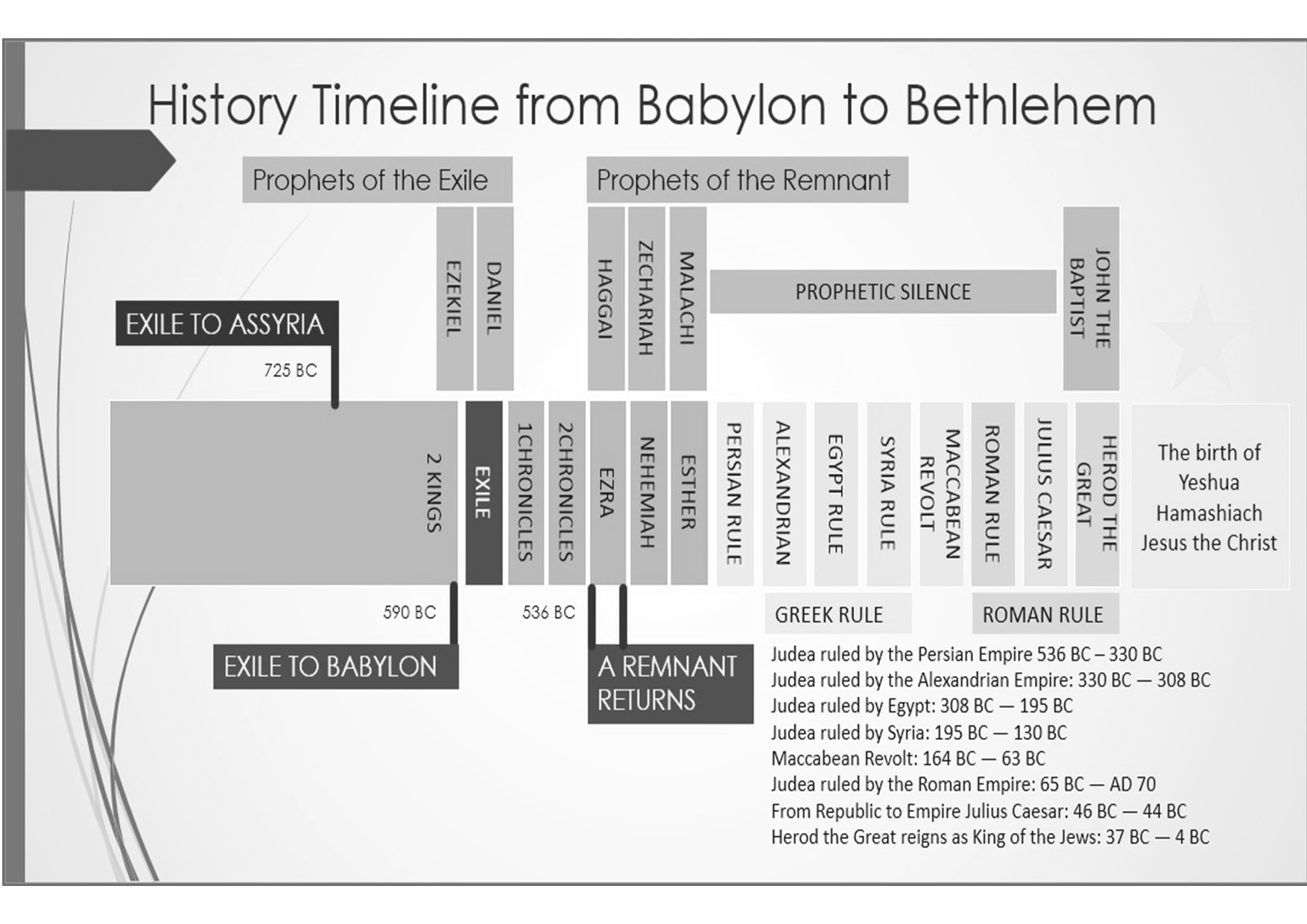
Figure aa – From Babylon to Bethlehem
Given this book is about Priests of the Bible, we might be tempted to overlook a 400-year period that according to Protestant tradition is not covered by the Bible, although in the Catholic tradition it is, i.e. in the Apocrypha (see Figure bb). Given our argument in Chapter 2, however, that for a proper understanding of a subject such as Priests this requires one digging deep into the context and background of whatever our subject is, we need to study this Inter-Testament period for reasons that include our better understanding the New Testament set-up for priests. Having knowledge of the priesthood and religious environment in which Jesus and the Apostles operated, understanding why thus was significantly different to how we left it under the newly returned exiles from Babylon under the likes of Ezra and Nehemiah, is achieved partly as a result of studying “the Silent years”. The events of these periods along with how these impacted the Jewish people give us important insights in what Jesus was up against and why His priesthood was far superior to what preceded it.
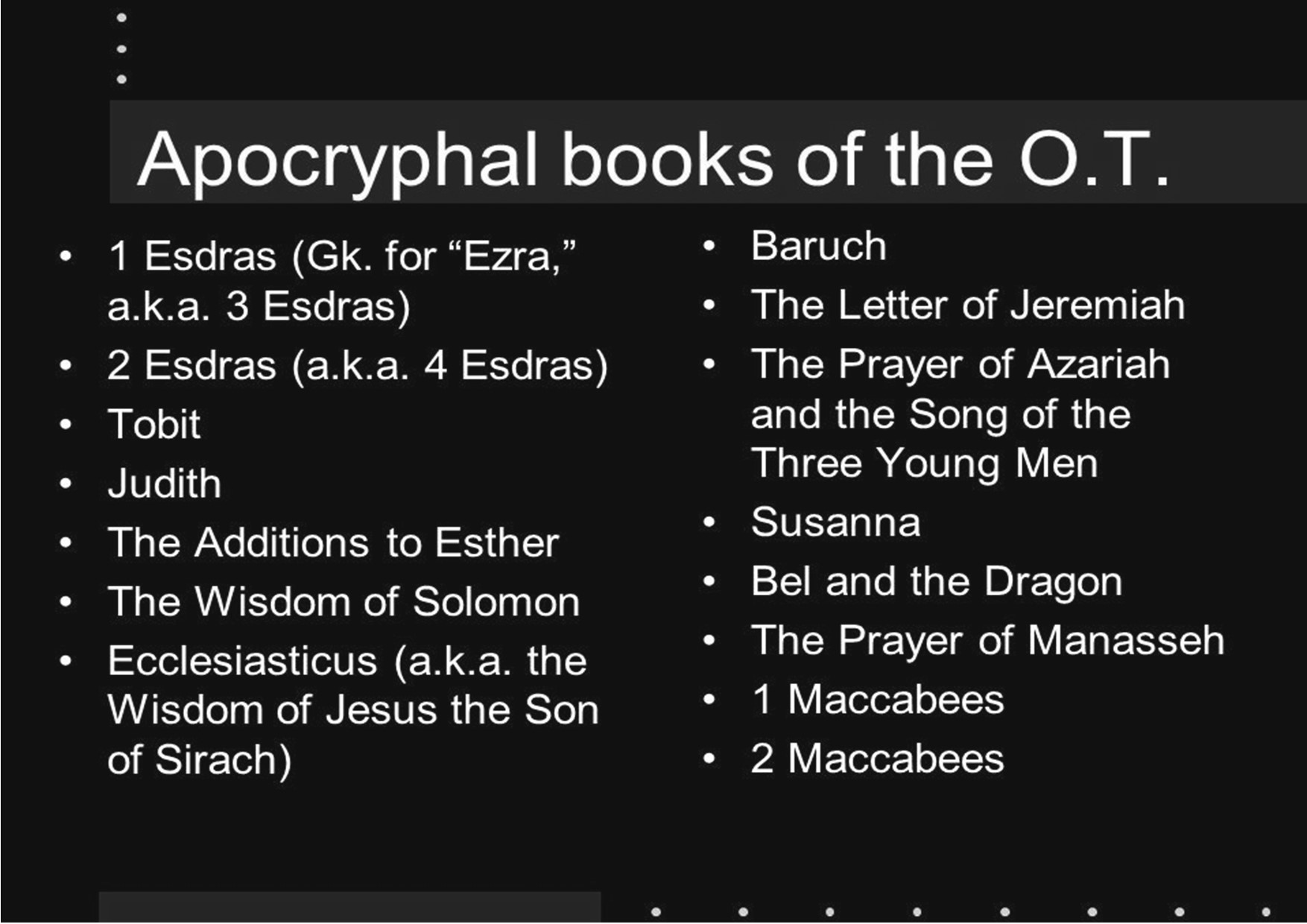
Figure bb – the Apocrypha
While this period is often referred to as the silent years, given there was no prophet after the last Old Testament prophet, Malachi, until the prophet Malachi prophesied was to come, that in the New Testament is identified as John the Baptist, much was happening in the world, e.g. with the rise and fall of great empires: Persian, Greek and Roman. The last book of the Bible contains some sorry reading pertaining to what the situation was and should be from God’s perspective. While there had been some mini-revivals among the returnees from exile, it was far from enough and the general trajectory as far as devotion to God went was a downhill spiral and also most Jews did not return.
“Isn’t it true that a son honors his father and a worker his master? So if I’m your Father, where’s the honor? If I’m your Master, where’s the respect?” God-of-the-Angel-Armies is calling you on the carpet: “You priests despise me! “You say, ‘Not so! How do we despise you?’ “By your shoddy, sloppy, defiling worship. “You ask, ‘What do you mean, “defiling”? What’s defiling about it?’ “When you say, ‘The altar of God is not important anymore; worship of God is no longer a priority,’ that’s defiling. And when you offer worthless animals for sacrifices in worship, animals that you’re trying to get rid of—blind and sick and crippled animals—isn’t that defiling? Try a trick like that with your banker or your senator—how far do you think it will get you?” God-of-the-Angel-Armies asks you. “Get on your knees and pray that I will be gracious to you. You priests have gotten everyone in rouble. With this kind of conduct, do you think I’ll pay attention to you?” God-of-the-Angel-Armies asks you. “Why doesn’t one of you just shut the Temple doors and lock them? Then none of you can get in and play at religion with this silly, empty-headed worship. I am not pleased. The God-of-the-Angel-Armies is not pleased. And I don’t want any more of this so-called worship!” Malachi 1:6-10.
An important factor not to overlook is the expectation of the promised Messiah to restore Israel’s fortunes, but before things got better they seemed to first get a whole lot worse and, as it turned out, God’s response (the coming of Jesus) at the end of these silent years, while welcomed by some Jews, was not welcomed by most, although it did wonderfully bring the Gentiles into the equation.
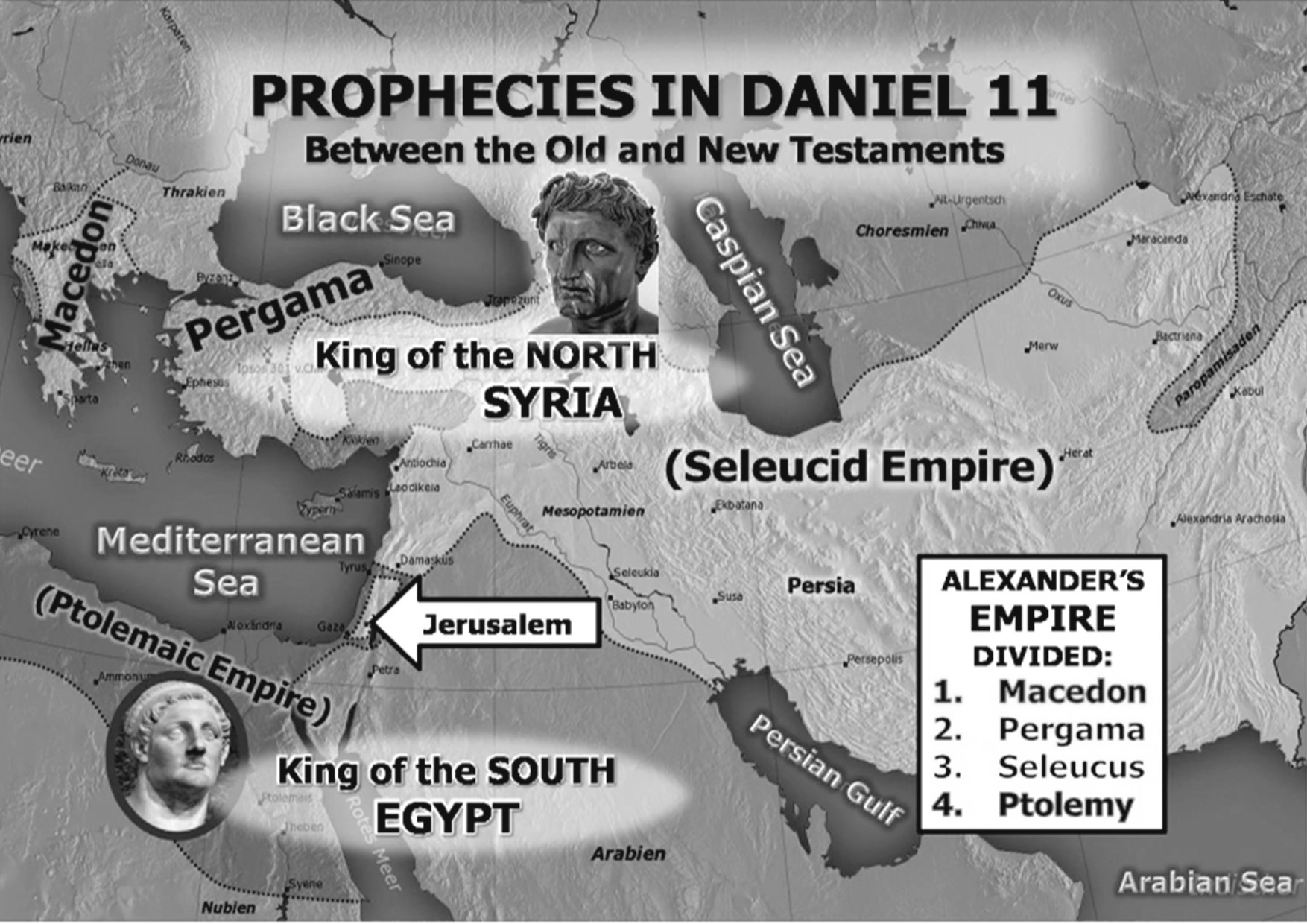
Figure cc – Prophecies in Daniel
A study of what took place during the Inter-Testament period is fascinating and in preparing this section the author was spoilt for choice when it came to what to check out, prioritising that which is more applicable to Priests of the Bible. With reference to Figure aa, we are reminded of the Books of the Bible that detail the Exile of the Northern Kingdom of Israel by the Assyrians, later followed by the Southern Kingdom of Judah into Exile by the Babylonians. Then there are accounts of what occurred following the Exile in books like Ezra, Nehemiah and Esther along with that of the three prophets: Haggai, Zechariah and Malachi. And there the Hebrew Bible ends with the more spiritually awake Jews looking forward to the coming its Messiah of the lineage of its greatest king, David.
Of particular interest from a scripture perspective is besides the Apocrypha, regarded by most of the theologians the author has had most to do with, as non-canonical and often to be ignored, is the Book of Daniel, in particular chapters 2 and 7-12. Here, including in Chapter 11, with reference to Figure cc, is a prophetic account, much of it giving great detail, of some of the important happenings in this period. Following the, on the whole, benevolent Persian rule, was that of the Greeks under Alexander the Great, who was taught by perhaps the greatest philosopher of his time, Aristotle. Alexander managed to conquer those areas including as shown in Figure cc, which as is indicated on the map was divided into four areas under four of his generals, upon Alexander’s death. Israel, being strategically placed in the crossroads of the world first came under the “Egyptian” rule under Ptolemy and his successors and then under “Syrian” rule, under Seleucus and his successors.
One of the significant things the Greek rule did was to impose Greek culture, which while considered superior by Alexander and those who followed him, clashed with the Hebrew culture in several ways and has ramifications to this day in the way Christianity is perceived by its adherents. It is notable that the Hebrew Bible was translated into Greek (the Septuagint) in this period and was the version referred to by New Testament writers. This culture clash came to a head under Antiochus IV Epiphanes whose notable achievement was to cruelly subjugate the Jewish people and antagonise them by imposing pagan worship, often on pain of death if they did not comply. Again, Daniel has a lot to say in advance on these matters (although many liberal scholars argue these predictions were added with the benefit of hindsight). Daniel was also looking far into the future, including the yet to happen Second Coming of Jesus. Some of this is covered in the author’s book Prophets of the Bible but, even so, there is much more that could be usefully said concerning “Daniel’s prophecies”.
This brings us to the Maccabean revolt, a Jewish rebellion led by the Maccabees (the father was a priest and he had had five sons, one notably was Judas, a brilliant military strategist and a freedom fighter – whose attitude toward Judaism might be seen as “fundamentalist” given his ruthless zeal), against the Seleucid Empire and against the Hellenistic influence on Jewish life and its attempts to impose a false worship on the Jewish people. The main phase of the revolt lasted from 167–160 BCE and while ended with the Seleucids in control of Judea, but the conflict between the Maccabees, Hellenized Jews, and the Seleucids continued until 134 BCE, with the Maccabees eventually attaining independence. That independence was relatively short lived as one great empire (the Greeks) was overtaken by another one (the Romans) around 65 BCE, which brings us to the time of Jesus. This short-lived independence gained won against huge odds is celebrated to this day each year by Jews at Hanukkah or the Festival of Lights, concerning details of which, we must refer back to Chapter 11.
Before we turn our attention to the New Testament situation, there is much worth pointing out that is pertinent to the main themes of this book, and strangely resonate with issues and attitudes we can see today, often causing difference of opinions and approaches, even among Christians, e.g. most groups celebrating Christmas and Easter but some preferring to keep to the Jewish feasts.
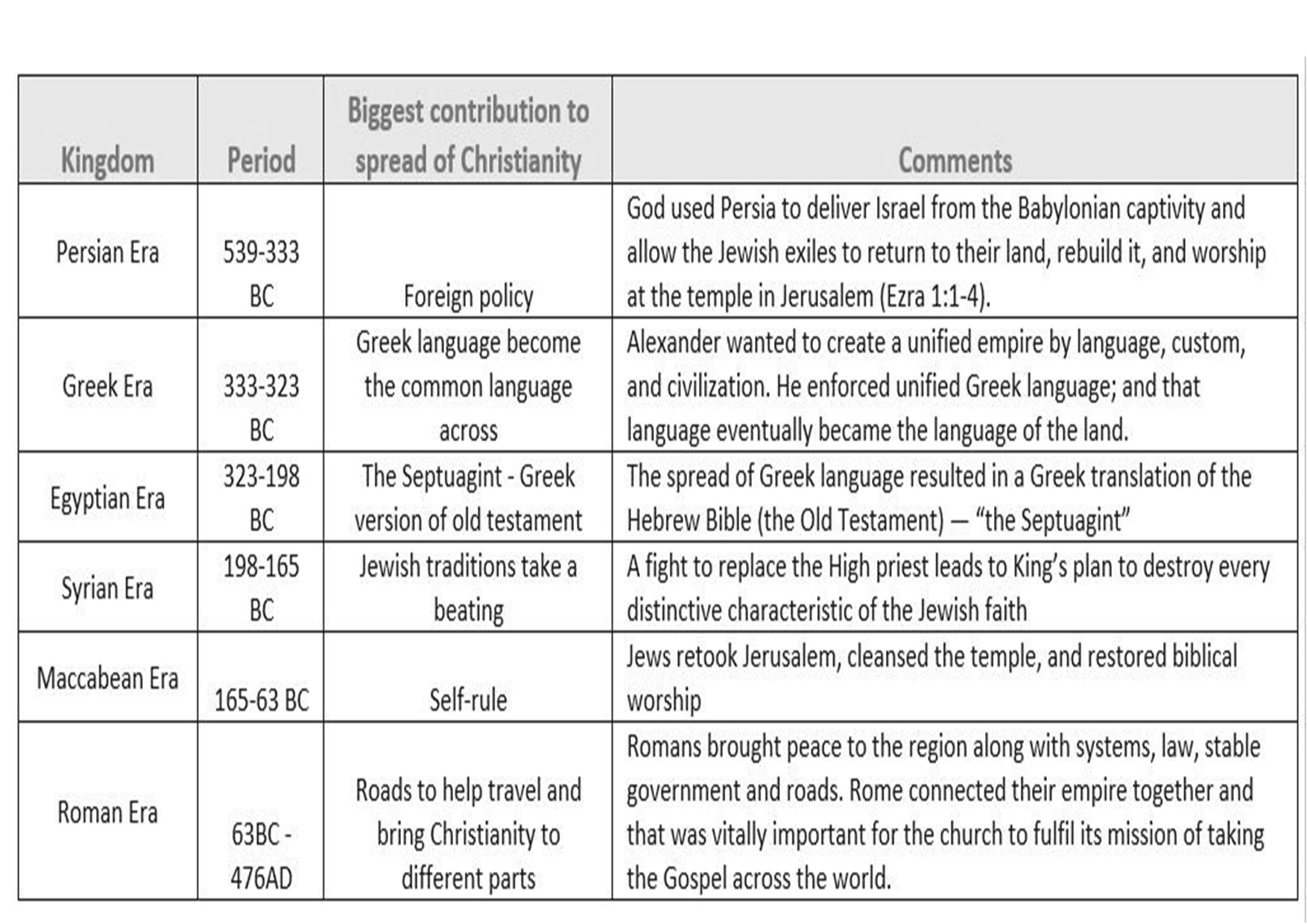
Figure dd – Happenings and the Inter-Testament period
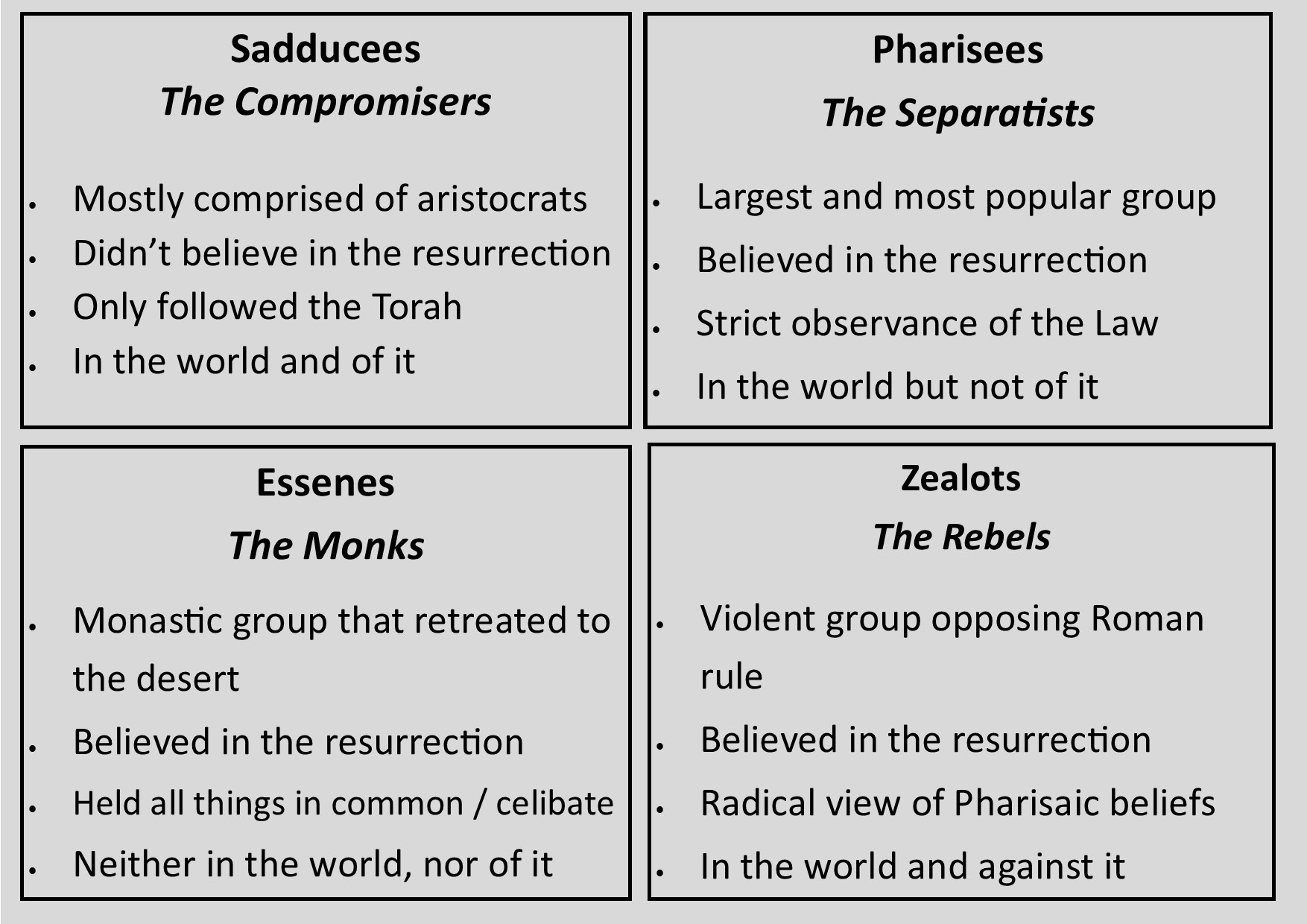
Figure ee – Major religious groupings
- While we are talking about the 400 “silent years”, with the promised Messiah tarrying his coming in order to liberate his people and set up His kingdom, much was happening that was highly significant but, as always, the Almighty bides His time for when the time is right.
- While there was resistance among the priests to their new rulers, notably from the Maccabees, there is every indication that many priests initially welcomed their new Greek and Roman masters and made compromises in order not to incur their displeasure. There was considerable divergence in the way different priests accommodated their new rulers.
- While the Aaronic priesthood was to continue, as demonstrated in Part 3 of this book, much adaptation could be seen, including priests being appointed by the new rulers on the basis of their willingness to tow the official line rather than their spiritual and hereditary credentials.
- While the Greeks brought in a culture that was in conflict to Judaism and the teaching of the Law, and the Romans imposed a rule that was often harsh, both did things that was later to be of benefit in the spreading of the Christian Gospel (as indicated in Figure dd).
- One of the defining factors of Judaism was a mindset that was meant to be more in tune with that of YHWH God than that of the nations around Israel. While Jews have remarkably maintained their unique identity, we see in this process, especially with the forced spreading of Greek culture, this being challenged during the period, and having a long term effect, including the challenge faced by this author of having been indoctrinated by Greek thinking.
- We see during this period the importance attached to the office of scribe and paying more attention to the rules (often over and above that set out in the Torah), the significance of the Jewish council, referred to as the Sanhedrin, the emergence of the Pharisees and Sadducees, often clashing with Jesus and mentioned by New Testament writers, as well as Zealots and Essenes as important religious groups (Figure ee) to emerge at the end of this period, the spread of synagogue worship to surpass that of the Temple for religious practice, the Samaritans while mentioned in the Old Testament achieving new significance by Jesus in the New, the beginnings of the puppets of Rome, Herodian dynasty, replacing Zerubbabel’s Temple with that built by Herod. All these topics we will consider further in Chapter 17 but all featured during the Inter-Testament period as being significant.
As we move from between the Testaments toward the New Testament and the coming into the world of Jesus, Israel’s Messiah, it seems appropriate to end with an Advent hymn.
1 O come, O come, Immanuel,
and ransom captive Israel
that mourns in lonely exile here
until the Son of God appear.
Refrain:
Rejoice! Rejoice! Immanuel
shall come to you, O Israel.
2 O come, O Wisdom from on high,
who ordered all things mightily;
to us the path of knowledge show
and teach us in its ways to go. Refrain
3 O come, O come, great Lord of might,
who to your tribes on Sinai’s height
in ancient times did give the law
in cloud and majesty and awe. Refrain
4 O come, O Branch of Jesse’s stem,
unto your own and rescue them!
From depths of hell your people save,
and give them victory o’er the grave. Refrain
5 O come, O Key of David, come
and open wide our heavenly home.
Make safe for us the heavenward road
and bar the way to death’s abode. Refrain
6 O come, O Bright and Morning Star,
and bring us comfort from afar!
Dispel the shadows of the night
and turn our darkness into light. Refrain
7 O come, O King of nations, bind
in one the hearts of all mankind.
Bid all our sad divisions cease
and be yourself our King of Peace. Refrain
 JRB Publications
Well researched, helpful and interesting. But why, oh why , the Message?