
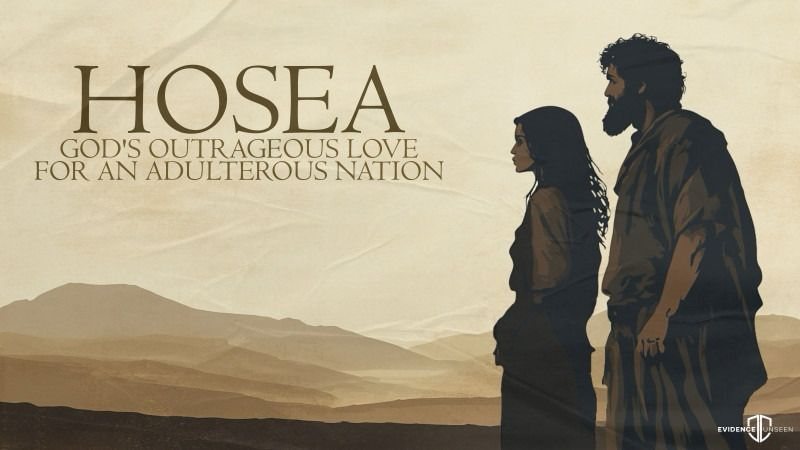
The following are notes accompanying a Bible Study on the Book of Hosea, held at my church 25/03/26.
Recap on our series “Christ in the Old Testament” starting on the Emmaus Road …
Christ in the Law; the Prophets (Major); the Psalms; the Prophets (Minor); et al (x39)
Examples of reference to Christ from each of the 12 minor prophets (see below)
Reading Chapters 1 thru 3 (Hosea is a book of poetry – neither KJV nor NIV does it justice)
My school teaching anecdote (class 3L) – the Prophet and the Prostitute
Background: Divided kingdom, Elijah/Elisha, Amos/Micah, Jeroboam II, Assyrian conquest, time of prosperity, typical gripes of God toward an unfaithful people, future restoration
The unfaithful wife and the faithful husband (Chapters 1-3)
The unfaithful nation and the faithful God (Chapters 4-14)
– Chesed (חֶסֶד): Often translated as “love,” but it encompasses kindness, loyalty, faithfulness, and covenant love. It’s God’s steadfast, unwavering commitment to His people (e.g., Genesis 24:27, Exodus 20:6, Psalm 136).
– Yada (יָדַע): Translated as “knowledge,” but it implies intimate, experiential knowledge, often with relational or sexual connotations (e.g., Genesis 4:1, Isaiah 1:3, Hosea 2:20).
Reveals God’s character and His desire for a deep, covenantal relationship with humanity.
Examples:
– Chesed: Micah 6:8 highlights God’s expectations: “to do justice, love mercy (chesed), and walk humbly with God.”
– Yada: Proverbs 2:5 connects yada to wisdom and understanding God’s ways.
The concepts are woven throughout the Old Testament, emphasizing God’s loyal love (chesed) and desire for relational knowledge (yada).
Hosea’s three children:
– Jezreel (יִזְרְעֵאל): This name means “God sows” and refers to the Valley of Jezreel, a place of bloodshed. It foretells God’s punishment on the house of Jehu for their bloody actions.
– Lo-Ruhamah (לֹא רֻחָמָה): This name translates to “Not Loved” or “No Mercy,” signifying God’s withdrawal of compassion and mercy from Israel due to persistent sin and rebellion.
– Lo-Ammi (לֹא עַמִּי): This name means “Not My People,” indicating the severing of the covenant relationship between God and Israel, highlighting the gravity of their apostasy.
Expound chapters 1 – 3 and then cover (briefly, snippets only) chapters 4 – 14:
“For the children of Israel shall abide many days without a king, and without a prince, and without a sacrifice, and without an image, and without an ephod, and without teraphim: Afterward shall the children of Israel return, and seek the Lord their God, and David their king; and shall fear the Lord and his goodness in the latter days” Hosea 3:4,5.
“Hear the word of the Lord, ye children of Israel: for the Lord hath a controversy with the inhabitants of the land, because there is no truth, nor mercy, nor knowledge of God in the land. By swearing, and lying, and killing, and stealing, and committing adultery, they break out, and blood toucheth blood. Therefore shall the land mourn, and every one that dwelleth therein shall languish, with the beasts of the field, and with the fowls of heaven; yea, the fishes of the sea also shall be taken away … My people are destroyed for lack of knowledge: because thou hast rejected knowledge, I will also reject thee, that thou shalt be no priest to me: seeing thou hast forgotten the law of thy God, I will forget thy children.” Hosea 4:1-3,6.
“For they have sown the wind, and they shall reap the whirlwind” Hosea 8:7a.
“Sow to yourselves in righteousness, reap in mercy; break up your fallow ground: for it is time to seek the Lord, till he come and rain righteousness upon you” Hosea 10:12.
Christ in each of the 12 Minor Prophets
1. Hosea – Christ is implicit in the theme of God’s unending love and redemption (Hosea 11:1-4, echoed in Matthew 2:15).
2. Joel – “Day of the Lord” (Joel 2:28-32) points to Christ’s return (Acts 2:28-32).
3. Amos – “Fallen booth of David” (Amos 9:11) refers to Christ’s restoration (Acts 15:16-17).
4. Obadiah – The “deliverers” (Obadiah 1:21) point to Christ’s salvation.
5. Jonah – Jonah’s resurrection (Jonah 2:2-10) foreshadows Christ’s (Matthew 12:40).
6. Micah – The “ruler from Bethlehem” (Micah 5:2) is Christ (Matthew 2:6).
7. Nahum – God’s comforting “rod” (Nahum 1:13) points to Christ’s rule.
8. Habakkuk – “The righteous will live by faith” (Habakkuk 2:4) is echoed in Romans 1:17, Galatians 3:11, and Hebrews 10:38, pointing to Christ.
9. Zephaniah – The “king” (Zephaniah 3:15-17) is Christ, bringing joy and peace.
10. Haggai – The “desired of all nations” (Haggai 2:7) is Christ (Luke 2:10-14).
11. Zechariah – The “Pierced One” (Zechariah 12:10) is Christ (John 19:37, Revelation 1:7).
12. Malachi – The “Sun of Righteousness” (Malachi 4:2) is Christ (Luke 1:78-79).
Finally, let’s turn to Chapter 14:1-8, and a lesson for us here today: “Who is wise, and he shall understand these things? prudent, and he shall know them? for the ways of the Lord are right, and the just shall walk in them: but the transgressors shall fall therein” Hosea 14:9.
 JRB Publications