
What is Church/church and the parts we play?
Church and churches
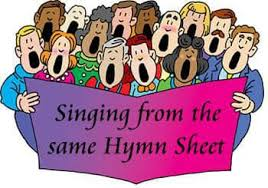
According to AI: “Singing from the same hymn sheet” is a British idiom meaning people are on the same page, sharing the same goals, values, or message. It originates from church services where everyone sings from the same hymnbook.
I was alerted to the fact that churches (comprising those who belong to an institution and/or attend services in a building, both referred to as “church”) do NOT sing from the same hymn sheet, right from the outset of my Christian journey and while there have been encouraging signs since then of Christians singing from the same hymn sheet when it mattered, especially if in the true Church (that which comprises true believers in Jesus), disunity is often the case.
I was both alerted to many important truths as well as sometimes misled when I joined a fairly traditional Open Brethren assembly (they preferred “assembly” (Greek: ekklesia) to “church” as they rightly saw usage of the word church as misleading) soon after I became a Christian as a fifteen-year-old. My assembly was definitely in the “Evangelical” camp given that they emphasized things like personal conversion, biblical authority, and spreading the Gospel. But their attitude to other Evangelicals was often ambivalent, citing reasons such as doctrinal dodginess. Concerning Catholics (who added to the Bible) and Liberals (who took from the Bible) they were often dismissive, doubting many even were real Christians.
Things began to change by the time I finished school and I went to university. Just before I joined, I volunteered in a mission called “Operation Mobilisation”, as part of its summer crusade, and met young Christians from all over the world and many different denominations, working together in evangelistic endeavour. It was an eye opener, especially discovering that a true follower of Jesus was one who did so wholeheartedly. My awakening as to what was the true Church and that which I ought to associate with continued when I joined the college Christian Union, led mainly by Anglicans! I began to throw of my Brethren shackles (even though maintaining varying degrees of involvement with the Brethren ever since) and began asking questions, leading me to modify and sometimes dismiss many of my Brethren beliefs.
When at college, I associated with Christians from all sorts of church backgrounds and attended Christian gatherings that weren’t Brethren. It was during that time I became aware of and was influenced by the Charismatic and Reformed movements (which I discuss in Chapter 15). A stand-out memory was attending Sunday night student services at St. Helen’s, Bishopsgate and being drawn by its emphasis on sound doctrine (something I had been told was very important) and meeting girls! I also began to read books. Those by C.S.Lewis, John Stott, Jim Packer, David Watson and Michael Green stood out. All were well-known, highly-respected Anglicans and articulate communicators. Another author I discovered was Francis Schaeffer, already mentioned by Paul and myself. His interest in and approach to Christian apologetics and philosophy is one that I have adopted ever since.
As important as those thoughts were, it was his thinking on Christian unity that made the most lasting impression. One of his most notable works was “The Mark of the Christian”, which explores the importance of Christian love and unity, and in which he quotes two sets of verses from John’s Gospel: “A new commandment I give unto you, that ye love one another; as I have loved you, that ye also love one another. By this shall all men know that ye are my disciples, if ye have love one to another” (13:34,35) and “Neither pray I for these alone, but for them also which shall believe on me through their word; That they all may be one; as thou, Father, art in me, and I in thee, that they also may be one in us: that the world may believe that thou hast sent me” (17:20,21). Schaeffer emphasized that the love and unity among Christians is the ultimate apologetic, making the gospel attractive to unbelievers. He argued that, when Christians demonstrated genuine love for one another, it showcased the transformative power of the gospel and it drew people to Jesus.
This thought has continued to make an impression and influences my view on church. Two sets of verses that were drawn to my attention in those early days and I continue to cite as being important when it comes to church involvement are: “And they continued stedfastly in the apostles’ doctrine and fellowship, and in breaking of bread, and in prayers” (Acts 2:42) and “And let us consider one another to provoke unto love and to good works: Not forsaking the assembling of ourselves together, as the manner of some is; but exhorting one another: and so much the more, as ye see the day approaching” (Hebrews 10:24,25).
In my sixty years as a Christian, I have been involved with many different churches, usually at the low, non-woke end of the ecclesiological spectrum, and have never stopped “going to church” even when feeling “out of it” or finding doing so to be problematic. But, as indicated in Chapter 1, most of that time was spent with one PB church (where I began) and one SB church (where I am now). While still reticent when it comes to Liberals and Catholics, I have come to see signs of Christ likeness in both. I like it when Liberals go out of their way to uplift the poor and marginalised and Catholics draw me closer to deep mysteries of the Faith. As for getting involved in church, I have been influenced by what the New Testament teaches about the Bride, the Body and the (spiritual) Building.
I should add that the views on church by each of PBs and SBs are not only different (albeit much less so compared to other denominations) but are not always right. While the PBs understood the teaching of the priesthood of ALL believers better than most, the way they chose to have little to do with those outside their stable due to minor doctrinal differences etc. was wrong. When it came to joining my current SB church, being the nerd I am, I decided to carefully study their Statement of Faith. Where I had qualms was not over its Calvinist leanings but rather its ideas about the local church which it equated with themselves, unlike that of St. Paul as being Christians living in centres such as Corinth, Ephesus, Colossae etc. (Happily, when I told the Pastor I couldn’t sign up to that belief, he told me that was ok!)
As I look back over sixty years of church involvement, while there were periods of not settling in a church for one reason or another and, now looking back I can see times that I was not in a good place spiritually, it was generally my intention to do so, both to give and to receive, in the light of what the Bible teaches, and for most of that time I succeeded. I tried to recognise that there were other churches out there I should be encouraging etc., mindful of the real Lord’s Prayer of John 17. Regarding my own City, with these days over 100 church congregations, I recall how, in the mid 1980’s, returning after years living away, looking unsuccessfully for a church to join and finally opting to return to the church where I began and then staying for the next 25 years until it closed. Then, as a family, we were faced with deciding where to join next. After weighing our options, we ended up with a short list of one – the church we are now at. There have been bumps in the road and times when we have not seen eye to eye, but rather than leave over some point of difference, we stayed!
I find there are many that claim to be real Christians that do not go to church regularly and, if they do, their involvement stops at attending services. Bearing in mind points already made about belonging to a local church assists spiritual growth, these days I ponder why this is so and what can be done about it. I have discovered that while non church going may be a sign of a backsliding, often it isn’t. Indeed, some non-church going Christians are more switched onto God than those who aren’t. Reasons include inevitable fall outs, especially with those in leadership or positions of power or the church adopting teachings, power-plays and attitudes that are harmful and wrong. Then, after looking for alternatives, they find there aren’t any and stop looking. Without wanting to be over simplistic, one church going (or not) strategy, is to remember that it is not about me, you or them but rather HIM, even though, as happens, churches do that is unacceptable or are led by hireling shepherds. We must ever seek true fellowship with those of like (Christ’s) mind and maintain a good relationship with God.
When it comes to joining a particular congregation, attending meetings and finding ways to serve, I get why doctrinal soundness, at least in the basics, as aligned to the EA Statement of Faith that Paul discussed in Chapter 2, is essential. But then there are issues that could be put in the inessential category that we may agree on as well as, including with me and my current church, we may disagree with. We could compose a list of the questions, like below, scoring and weighing on issues we consider important, joining the church scoring the highest:
- Does it preach the Gospel on matters such as sin, righteousness and judgment?
- To what extent do members practice faithfulness, godliness and kindness?
- Do they practice what is preached?
- How well is the Bible (all of it) taught?
- How well are children’s needs catered for?
- How well does it look after the elderly?
- Should members err, are they subjected to godly discipline mixed with grace?
- What is its approach toward those with disabilities, including around mental health?
- To what extent is God worshipped in Spirit and Truth?
- What are the qualities of those leading, irrespective of type of church government?
- What is its approach to and beliefs concerning Baptism and Communion?
- What is its position on women in leadership?
- How does it respond to today’s woke, diversity and inclusion, e.g. LBGT, agendas?
- What is its attitude toward Israel and Jews?
- What is its attitude toward Islam and Muslims?
- How does it relate to other Christians and churches?
- What is its approach to mission, home and overseas?
- How awake is it to what is happening in the world?
- Is it pushing secular agendas, e.g. political and ideological?
- How well does it serve the wider community, e.g. regarding poverty?
- Does it go outside the church in order to evangelise?
- What is its position on stewardship, money and tithing?
- What is its response if I dissent on points of church beliefs and practices?
- Would I find real fellowship and opportunities to serve God and others?
Tantalisingly, as much as I would have liked, I did not elaborate, otherwise I would have exceeded my word allocation. I am prepared to accept that, when a potentially to be joined church scores low, or crosses some red line concerning any of my questions, it is therefore ruled out. Yet, as I seek God’s guidance on the matter, recognising there is no such thing as the perfect church, at least this side of eternity, I might still give such churches my allegiance, whilst seeking real fellowship with like-minded believers, irrespective of church affiliation, accepting that while I may not jump, I could be pushed given my stance on truth. If you can (and maybe you can’t), join a church, albeit with all its faults, contribute and serve God in it.
There is so much more that could be said concerning Church/church, Christian unity and singing from the same hymn sheet, and as I end this chapter, the best I can do is offer my final, profound and salient (imo) thoughts on what matters. I begin by quoting: “Behold, how good and how pleasant it is for brethren to dwell together in unity! It is like the precious ointment upon the head, that ran down upon the beard, even Aaron’s beard: that went down to the skirts of his garments; As the dew of Hermon, and as the dew that descended upon the mountains of Zion: for there the Lord commanded the blessing, even life for evermore” (Psalm 133:1-3) in order to make a point concerning the true Church, that group of believers who remain faithful to God’s truth and purposes in context of widespread apostasy and spiritual decline, including in churches, that I refer to as a motley band of misfits who God chooses (the foolish things of the world shaming the wise, etc. (1 Corinthians 1:27,28)).
We read in Matthew 16:13-20 of Jesus asking His disciples: “Who do you say I am?” and Peter responding “You are the Messiah, the Son of the living God” and Jesus replying, “You are Peter (Greek: Petros), and on this rock (Greek: petra) I will build my church and the gates of hell shall not prevail against it...”. The conversation took place in Caesarea Philippi, near Mount Hermon, which was associated with Baal worship in ancient times (e.g. Judges 3:3) and was even then seen as the gates of hell. I am also inclined to the view it was where the Transfiguration took place. The Book of Enoch mentions Mount Hermon where the fallen angels (the Watchers) descended (Enoch 6:1-6). These were likely the same sons of God that mated with beautiful women, giving rise to the Nephilim, prior to the Great Flood, about which is described in Genesis 6 onward. Additionally, there is the startling contrast between Mount Hermon and Mount Zion, from where Jesus reigns when He returns to planet Earth.
I am not trying to be a “clever clog” by telling you stuff you may not hear in church. We are now living in the Days of Noah and we need to be prepared. Persecution we see the world over will spread to the West, with the Remnant Church driven underground, yet experiencing revival. This may well turn out to be the Church’s finest hour, before it is raptured! St. Paul connects “mystery” and “church”: “which in other ages was not made known unto the sons of men … That the Gentiles should be fellow heirs, and of the same body, and partakers of his promise in Christ by the gospel” (Ephesians 3:5-6) and “This is a great mystery: but I speak concerning Christ and the church” (Ephesians 5:32). We are in a ginormous spiritual war and, as I delve deep into my Bible, I find that the remnant (minority) Church, as opposed the apostate (majority) church, is God’s primary instrument for fighting in that war, a theme I intend to pick up later, and is a good reason for us to be singing from the same hymn sheet.
 JRB Publications