
I count myself blessed that from a very early age I was taught to revere the content of the 66 books of the Christian Bible, but not so blessed when I did not obey some of its teachings.
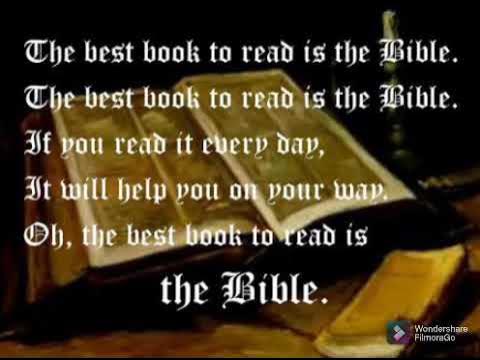
When I was around seven years of age, my parents, who weren’t particularly devout, sent me and my sister along to the Sunday School, held at the nearby school I attended on week days and led by a formidable lady, a headmistress, Miss Rafan, helped by her band of mainly spinster assistants. One of my early memories was singing the chorus included in the above image. What was taught was strongly Bible based from a free evangelical perspective. Later, as a thirteen-year-old, I attended a nearby Covenanter class, that was led by an ex-WW2 army sergeant, Bryn Jones, where along with games we were taught from the Bible. It was through this I later became a real Christian and attended the strongly Bible based church that hosted the class. From that point on, I became an avid Bible student, reading the whole Bible several times, preached and taught on Bible based subjects, and have written a number of Bible based books.
The belief installed in me from an early age was that, unlike other books, the Bible is divinely inspired, and that alone makes it the best book to read. Another good reason is to do so is it provides guidance on how to live our lives amidst many challenges. There are many, often contradictory views on how to interpret and apply its contents, including among those that can be found in the Evangelical camp to which I have broadly aligned ever since my conversion, as well as the important matter that we can know and believe one thing, i.e. the teachings of the Bible, but not live our lives accordingly, about which I sadly confess has sometimes or often, maybe, been the case with me. This should not detract from the importance of reading the Bible and come to a proper understanding and to live accordingly.
There are many questions concerning Bible reading that could and should be asked, especially when one is starting out on one’s studies. There is much value in reading widely and learning from others especially on Bible based themes but studying the Bible for ourselves must come first and if you can memorise some of it, even better. I won’t discuss how we arrived at the 66 books that make up the Bible that we now recognise (the Catholics might also add the books of the Apocrypha), noting that down the ages people have argued for certain text to be included or excluded from the Bible we now have. What makes up the Bible we do have is sufficient for guiding us through life and knowing God’s purposes etc., with each book being important and deserving attention. But I would like to turn to how I would counsel any wanting to know more about the Bible and how to go about studying it, bearing in mind that we are all different when it comes to our God given assignments, personalities, abilities and needs etc., and where we are on our respective faith journeys:
- To begin with, I suggest read one of the four gospels, maybe Mark, the shortest and perhaps easiest to understand.
- Having done that, read another, maybe John, to provide another view on the life and ministry of Jesus.
- Then go to the beginning of the Bible, i.e. Genesis, and discover the roots of Hebrew and Christian faith, and read through to Exodus up the point where the Ten Commandments are given.
- Then return to the New Testament, and read the Book of Acts.
- In the meantime, you can start to go through the Books of Psalms and Proverbs in order to become wise and worship God.
- Then read the rest of the Bible. Taking a year would be great but try to read it all in three years. After which – begin again.
- When you read, do so prayerfully; ask the Lord for understanding and His help to apply what you learn.
- There are many versions to choose from. While I am a fan of the KJV, it may be better to go for a modern translation e.g. the ESV but I won’t rule out a paraphrase version – and maybe both.
- Studying the Bible in context is important, e.g. compare scripture with scripture, read what is written prior to and after the passage you are studying. If need be, look at the original language (Hebrew OT, Greek NT) to understand the words you are reading.
- There are many excellent Bible reading aids out there to help your understanding, including on the Internet – a discussion of which would require a separate article.
- It is good to set aside a regular slot each day to read the Bible and pray (including concerning what we have read).
- Recognise that even real Christians often interpret or apply the message of the Bible differently. Don’t be deterred. Be prepared to agree to disagree on inessentials but NOT on essentials.
Now that I am in my dotage, I continue with the habit of regular Bible reading, including family prayer times where we usually read a passage from the Bible, noting that it is not enough to read the Bible and listen to it preached, but we need to apply its teaching. I am blessed to attend a church that highly honours the Bible as the Word of God, seeking to teach sound doctrine. Some reading this are not so blessed. While I get there are many churches one may not wish to attend because, among other things, these waiver from the truth, but do try to fellowship with like minded believers as we need to be encouraged as well as to use the gifts God has given us to encourage others. Remember no church is perfect and even good churches may not be correct in all its understanding and application of the Bible, so it would be well to make allowances for this whilst not sacrificing on our integrity or our own endeavours at studying of the Bible.
Increasingly, I find that as I study the Bible, invariably new and fresh insights are given and I realise how little I know. As I read it, the more I question my beliefs as to how I should live my life, what is assumed to be correct belief by my peers and how to respond to what is happening in the world. But more importantly, as I study and meditate on the words of the Bible, with the intention to know the truth, the more I come to appreciate and trust God and do what my old Sunday School chorus invites us – to be helped on our way.
 JRB Publications