
Today, I asked AI: “What can you tell me about the origins, rationale and current use of the Advent hymn: O come, O come Emmanuel?” and got the following helpful answer:

“”O Come, O Come, Emmanuel” is a traditional Advent hymn with roots dating back to the 8th century. The original Latin text, “Veni, Veni, Emmanuel,” is believed to have been written by medieval monks, possibly in France or Germany.
Origins:
The hymn is based on the “O” Antiphons, a series of seven antiphons (short prayers) sung during the Advent season, each beginning with “O” and addressing a different title of Christ (e.g., “O Wisdom,” “O Adonai”). These antiphons were likely composed in the 7th or 8th century.
Rationale:
The hymn’s lyrics are a plea for the coming of Emmanuel (Jesus Christ), expressing longing and anticipation for the Messiah. The original Latin text had seven stanzas, each corresponding to one of the “O” Antiphons.
Current Use:
The hymn has been translated into English and is widely used in Christian worship, particularly during Advent. The most common translation is by John Mason Neale (1851). The hymn is often sung in a minor key, adding to its somber, reflective tone.
Structure:
The hymn typically has five stanzas, with the refrain “Rejoice! Rejoice! Emmanuel shall come to thee, O Israel” (or similar). Each stanza addresses a different title of Christ, such as “Emmanuel” (1st stanza) and “Jesse’s Rod” (2nd stanza).
“O Come, O Come, Emmanuel” is a beloved Advent hymn, evoking a sense of longing and preparation for Christ’s coming. Its rich history and poetic language make it a staple in many Christian traditions.”
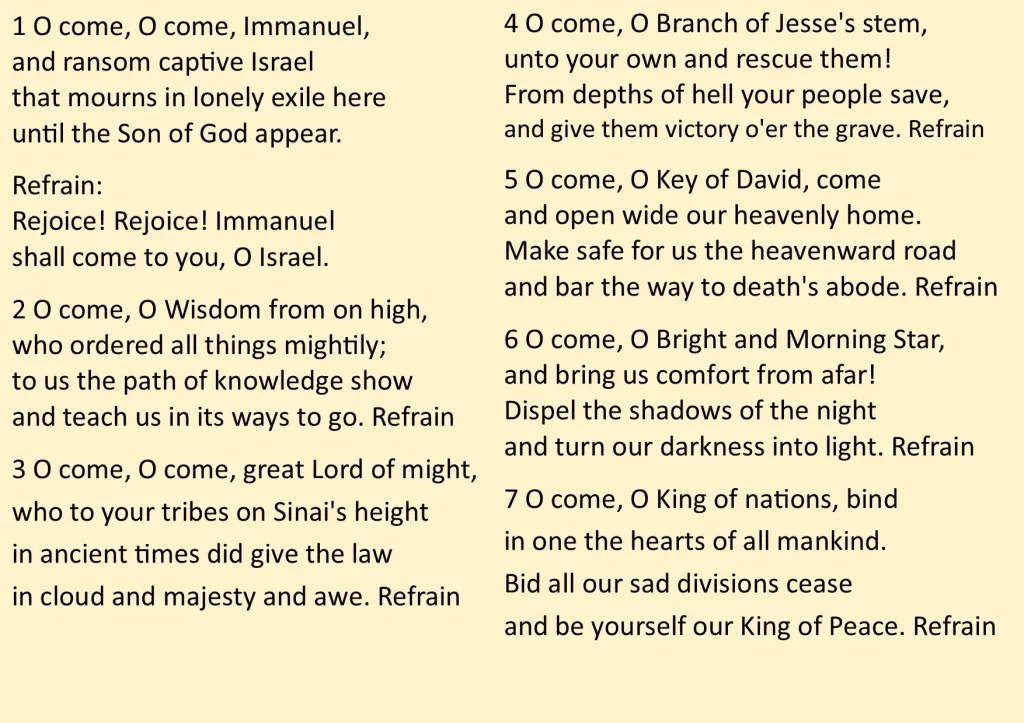
Concerning the hymn (see here for a musical rendition and one I often play in my regular devotions), it has been probably my favourite in recent years amidst many great Christmas hymns, despite being one at the “not keen” end of the “keen to not keen about Christmas” spectrum. It may also come as a surprise to find that this is my third Christmas related blog in less than two weeks, my earlier two being “Advent 2025 – a reflection” (see here) and “Why has “Put Christ back into Christmas” suddenly become so contentious?” (see here).
It happens that my main Bible focus these past few months has been on “Christ in the Old Testament” when the plan was to seek out all references to what then was the foretelling of the coming Christ as found in the Hebrew Bible (some of my findings, I have shared in some of the postings on my blog). It all begun on the day Jesus rose from the dead – when on two occasions He explained that what had just happened, was foretold in the various scriptures. Exactly what scriptures He quoted from, we cannot say. Neither can we say if there was a breakdown between His time on earth in First Century Palestine and when He returns to earth to set up His Kingdom – a pertinent consideration as the main Christian view (as opposed to the Jewish one) is that these same scriptures can make reference to either coming and often fail to distinguish between the two.

Concerning the first of my Christmas shares, I was inspired to write it because of what the Preacher said when he spoke at my church on the First day of Advent. To quote from my blog: “He included in his talk yet another Advent revelation by pointing out that while churches today which celebrate Advent tended to focus on the message of hope, peace, joy, love and were looking forward to Christ’s First Coming (i.e. that which we celebrate on Christmas day), in the early days of the church, the focus was more on things like death, judgment, heaven, hell and when the main focus was on one preparing for Christ’s Second Coming”.
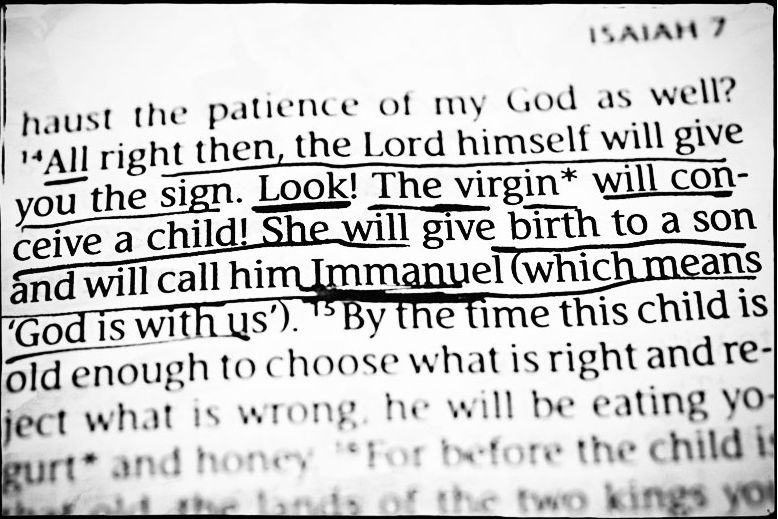
What the preacher said helpfully got me thinking about the reason for the season and why if I were into celebrating seasons I would include Advent, but in the light of the ancient tradition of not just focusing on Jesus’ First Coming, as those who put Christ back into Christmas typically do, but also on His Second. “O Come, O Come Emmanuel” helps me think about both comings and does so in a way that invariably moves me as I contemplate the hidden and sublime depths that are behind the lyrics, and is why that without hesitation I say it is my favourite Christmas / Advent hymn.
 JRB Publications