
I suppose most of those reading this would have known people, some of whom were close to them, and even among their family and friends, who have taken their own lives.

“Sad” and “tragic” are perhaps two words that sum up how many of us feel, not just at the time we learned the news but also now given those sentiments of grief remain. I have known a number who fall into this category and while I wished it were not so and in some cases done more to stop someone dear taking his/her own life, there is nothing I can now do other than honour their memory and just maybe be a guiding light for others feeling suicidal, with a message that how ever bad things seem, their life is worth living, hoping when our time comes we can die with dignity and also leave a legacy.
I have had a lifelong history of depression, rarely seeking help, and there have been many times that I wished my life would have ended. The main reason for not ending my life is my Christian faith and a belief that the Almighty alone should decide when one’s life is to be ended (inside and outside of the womb)! Meanwhile our job down here is to do His bidding and with His help. Of course, not all share my Christian faith! What about those who are terminally ill, having to endure physical pain and, if death were a merciful release, why shouldn’t help be given to make that happen if it is sought?
A further factor in my more recent history is I have a debilitating illness that could be put in the terminally ill category, which apply to all those with a disease or condition that is incurable and that will ultimately lead to their death. This life-limiting illness is progressive and will unlikely get better. I have found it significantly affects my quality of life, feelings of usefulness and my ability to contribute to society in a way I would like and once did. Together with depression, in my darker moments, I have wished for death along with a way to make dying easier and to tie up my affairs. I realise, I am better off than many, with a loving family and friends and ways I can contribute to society still, and have come to a view suicide (assisted or not) should not be an option as it contributes to a culture of death rather than life, where palliative care ought to play a crucial part.
This brings me to Kim Leadbeater’s “Terminally Ill Adults (End of Life) Bill” that has passed its Second Reading in the House of Commons and is now going through the Committee stage that is meant to scrutinise and improve on proposed legislation, including providing (in this case) necessary safeguards. The decisive Third Reading taking place on 16th May. Importantly, given this is a Private Members Bill, MPs are given a free vote by their parties. If passed, the main hurdle to the Bill being enacted will have been overcome, although it still has to be passed by the Lords. According to the UK Parliament website, this is “a bill to allow adults who are terminally ill, subject to safeguards and protections, to request and be provided with assistance to end their own life”.
Those who follow my blogs will know I have many concerns regarding the deliberations of our MPs and while tempted to engage with my MP on several matters of concern, by giving my views, I tend not to do, partly in fear that my efforts will be in vain. But here I make an exception based on several criteria. Deep down, I feel the move to assisted dying is yet one more in the wrong direction my country is going. Where this has happened in other countries, I believe the effects, although originally may be well intended i.e. to help people who want to end their lives to do so in dignity, have not been so and has created a culture where people feel that their lives have become burdens to themselves and others, and that suicide is the only way out of this uncomfortable conundrum. Then there are agencies like Dignity in dying, who declare “We believe assisted dying for terminally ill, mentally competent adults should be legal in the UK”, alongside the Christian Institute who seek the opposite. Both are urging their readers to contact their MPs with messages of support (DinD) or to oppose (CI) the Bill, along with providing helpful words that one can use giving reasons for doing so.
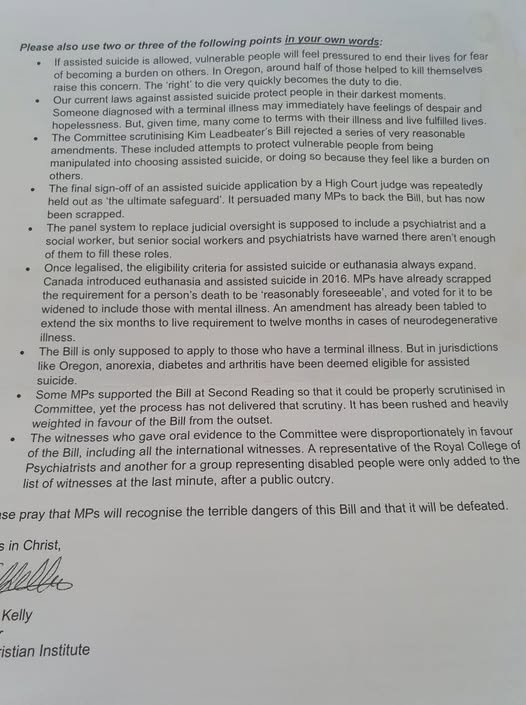
I took a snapshot of a briefing paper the Christian Institute sent to me (above) and am persuaded by their arguments and have decided to write to my own MP, David Burton-Sampson, who happened to vote FOR the Second Reading, but also had previously sent me and others a meaningful reply when I and they did engage with him prior to that and a further update as we approach the crucial Third Reading of the Bill. This is what I wrote to him in reply …
Dear David
I really appreciate your response (giving reasons) to my previous letter in which I urged you to vote against the passing of the Assisted Suicide Bill and also to your recent update.
You will soon be voting on the Third Reading and you have not indicated how you will vote while expressing concerns, e.g. “I do however share similar concerns as others do about this Bill, the first being the definition of Mental Capacity and how this could be interpreted and the safeguards that would be in place to ensure that an individual is not being coerced into assisted dying. I want to see these addressed as part of the remaining stages of scrutiny. I am concerned about the proposed requirement to remove the High Court Judge review and to change this to a professional panel review. Currently I believe this weakens the Bill and I will need to be satisfied as to the protections this will afford if I am to continue to support the Bill moving forward. I also want assurances there are sufficient safeguards to prevent the slippery slope scenario which many people have been discussing where the Bill could be extended to cover further end of life scenarios in the future”.
According to my feedback, these and other concerns have not been addressed. I attach a copy of a briefing paper from the Christian Institute raising these concerns, which as a Christian yourself, I imagine ought to carry weight. I also wrote an article expressing my own personal thoughts and include some of my own story as one who has suffered a lifetime of depression and now could be put in the terminally ill category. I provide a link to this article at the end of this letter. I ought to say a word concerning my wife. Obviously, I cannot give details for confidentiality reasons. She is a Lung Cancer Nurse Specialist and all her patients fall into the terminally ill category. Often, she has to advise patients on their options as they approach end of life and sometimes this entails intrusive treatments that merely prolong life for what is often a short period. Given her own Christian beliefs, if she and others like her were forced to add Assisted Suicide to the list of options, that will be intolerable. If we were to add to their options, why not better palliative care facilities?
Again, thanks for getting back to me on this important matter and making yourself accountable to the members of your constituency who you have pledged to serve.
Yours sincerely
John Barber
Update 05/05/24
It often happens that following writing something profound, more profound thoughts come my way, as is the case with this subject and, in particular, my own story, which may resonate with some. Today, I have yet again been reminded of the restrictions in what I can now do, which only a short time ago I could do easily, that could have caused frustration and resentment if I had let it. But something else has happened, which could be argued as being even more than adequate compensation. Firstly, I am becoming more appreciative of what I can do and for the importance of the little things of life that in the past I gave little thought to. Secondly, I can see that some of those things I attached a great deal of store to when I was young, fit and active (and dare I say, foolish) don’t really matter now and they shouldn’t have then. While it would be presumptuous of me to say I now know that which does truly matter, my standing back from my past pre-occupations, including feeling/being made to feel surplus to requirements as a new generation with their quite different ways of approaching things take over, gives me perspectives as to what really matters that I would not have otherwise had. Maybe, I can pass some of these onto to the generation that does follow, to their benefit, as long as I can exemplify dignity in my living along with playing whatever hand of cards have been dealt me, and without murmur, until my time is up, and it then becomes dignity in dying.
 JRB Publications