
Sometimes in my blogging I come across a subject (whether in my “political” or in my “religious” blogs) that cries out for a deeper understanding than one I possess, yet is so important and relevant to today’s situation that it is something worth discussing despite gaps in my knowledge. In this case, it is to do with a word that often crops up in the Old Testament that is also one rich in meaning.
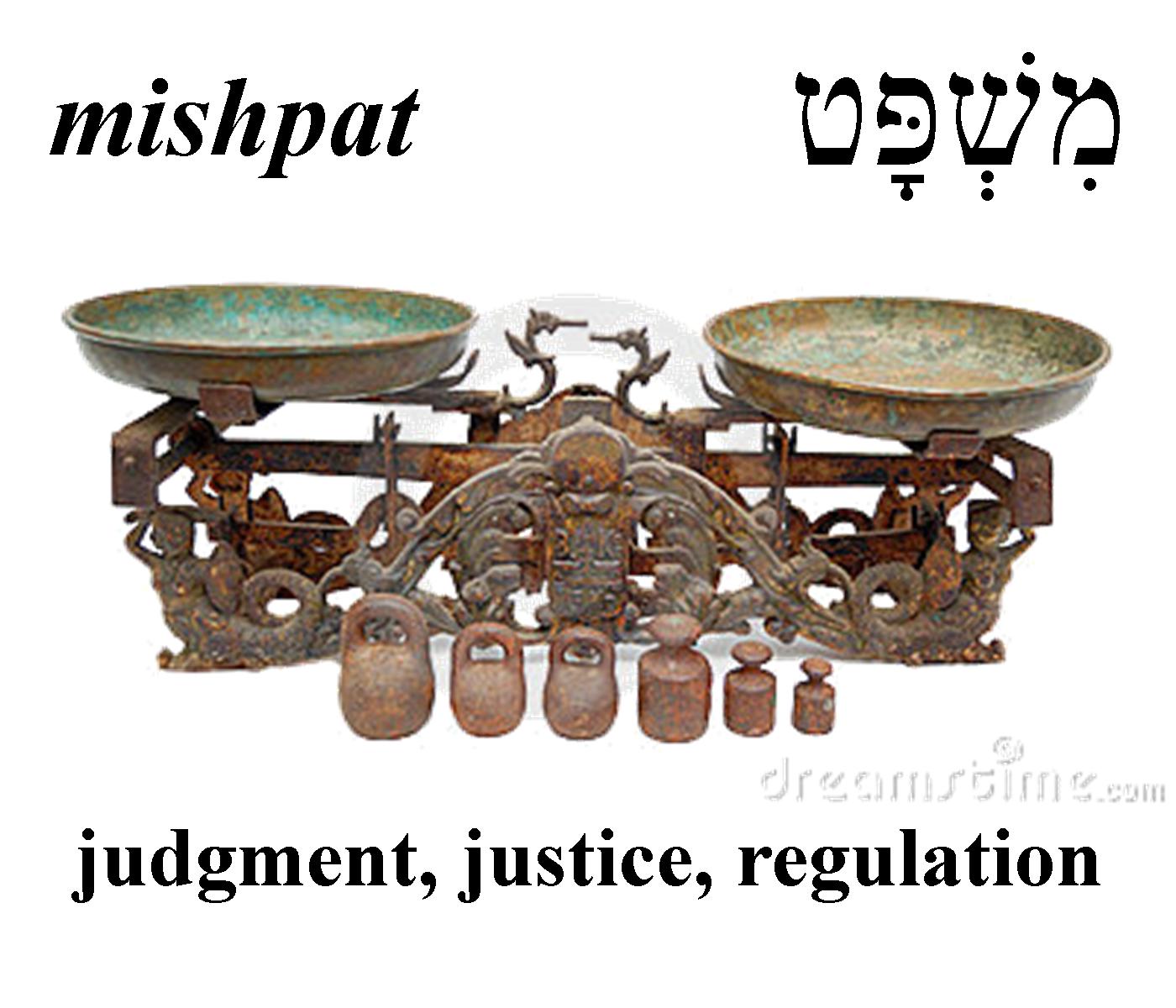
This particular subject that is up for consideration concerns the usage of the word “Mishpat” in the Bible, that is loosely translated as “judgment, justice, ordinance” (Strong’s Number H4941 matching the Hebrew מִשְׁפָּט (mišpāṭ)), which occurs 422 times in 406 verses in the Hebrew Bible (Old Testament) and in the KJV Bible it is translated 296 times as “judgment”. Often when the word is used it is done alongside the word “righteousness”, typically “Tsadaq” in the Hebrew (Strong’s Number H6663), loosely translated as to be and do right and, like “Mishpat”, it is concerned with justice, but in a way that is wider and deeper than how most today understand justice, who are unfamiliar with the Hebrew usage. Another word that is related is “Tsedaqah” (Strong’s Number H6666), that is loosely translated as: righteousness, justice, rightness.
In my blogging, I am conscious of detractors, whether concerning my political views or my religious ones. Politically, there are many who object to my take on world events and the best way forward, even when I attempt to leave God out of the solution. On the religious side, I come up across objectors to my emphasis on preaching the Gospel that requires a recognition of our sin and judgment to come, the need to repent and actively follow Jesus, rather than that of a loving God who downplays the importance of such matters and rather that we emphasise the need to do good to other people, especially the victims of societal ills, intolerance and inequalities and its need and also ours to exercise social justice. It seems to me that practising Mishpat could/should appeal to both sets of distractors as well as to those who share my political and religious views on how we need to function in this world.
The challenge for any seeking enlightenment on an unfamiliar subject is finding where to look to satisfy one’s desire to transition from darkness to light. We are semi blessed these days by having the Internet, which in my case often involves Google and YouTube searches. The clever clog stuff I come up with earlier is as a result of one Google hit (see here) with more that is to come when I consider some of the 422 Mishpat references. Others operating as I often do, do well to heed a warning I give to those who may want to follow my example. On one hand, we learn pertinent stuff we would not have otherwise known but on the other we can pick up and latch onto the flawed opinions and prejudices of those we check out. Notwithstanding, I share the links to two sources that I have found particularly helpful, and do so without further comment:

- On Justice and Righteousness (mishpat & tsadaq)—Strong’s 4941 & 6663 (see here)
- Mishpat | Mishpat is Kingdom Oriented // Derek Morphew (see here)
Back to the 422 Hebrew Bible “Mishpat” references. There were many that struck me that touched on a range of important truths, but here are sixteen that particularly blew me away as I reflected on the thought that biblical justice is far more wonderful, relevant and all embracing than most would realise:
“Therefore thou shalt love the Lord thy God, and keep his charge, and his statutes, and his judgments, (H4941) and his commandments, always” Deuteronomy 11:1.
“He is the Rock, his work is perfect: for all his ways are judgment: (H4941) a God of truth and without iniquity, just and right is he” Deuteronomy 32:4.
“For Ezra had prepared his heart to seek the law of the Lord, and to do it, and to teach in Israel statutes and judgments (H4941)” Ezra 7:10.
“The fear of the Lord is clean, enduring for ever: the judgments (H4941) of the Lord are true and righteous altogether” Psalm 19:9.
“He loveth righteousness and judgment: (H4941) the earth is full of the goodness of the Lord” Psalm 33:5.
“Justice and judgment (H4941) are the habitation of thy throne: mercy and truth shall go before thy face” Psalm 89:14.
“Let my soul live, and it shall praise thee; and let thy judgments (H4941) help me” Psalm 119:176.
“To do justice and judgment (H4941) is more acceptable to the Lord than sacrifice” Proverbs 21:3.
“Learn to do well; seek judgment, (H4941) relieve the oppressed, judge the fatherless, plead for the widow” Isaiah 1:17.
“Behold, a king shall reign in righteousness, and princes shall rule in judgment (H4941)” Isaiah 32:1.
“The Lord is exalted; for he dwelleth on high: he hath filled Zion with judgment (H4941) and righteousness” Isaiah 33:5.
“Thus saith the Lord; Execute ye judgment (H4941) and righteousness, and deliver the spoiled out of the hand of the oppressor: and do no wrong, do no violence to the stranger, the fatherless, nor the widow, neither shed innocent blood in this place” Jeremiah 22:3.
“In those days, and at that time, will I cause the Branch of righteousness to grow up unto David; and he shall execute judgment (H4941) and righteousness in the land” Jeremiah 33:15.
“He hath shewed thee, O man, what is good; and what doth the Lord require of thee, but to do justly, (H4941) and to love mercy, and to walk humbly with thy God” Micah 6:8.
“Seek ye the Lord, all ye meek of the earth, which have wrought his judgment; (H4941) seek righteousness, seek meekness: it may be ye shall be hid in the day of the Lord’s anger” Zephaniah 2:3.
“Remember ye the law of Moses my servant, which I commanded unto him in Horeb for all Israel, with the statutes and judgments (H4941)” Malachi 4:4.
We end our Mishpat related Bible quoting with one further, more lengthy, quote that covers a range of thoughts, all based around the Mishpat idea. “Praise ye the Lord. Praise the Lord, O my soul. While I live will I praise the Lord: I will sing praises unto my God while I have any being. Put not your trust in princes, nor in the son of man, in whom there is no help. His breath goeth forth, he returneth to his earth; in that very day his thoughts perish. Happy is he that hath the God of Jacob for his help, whose hope is in the Lord his God: Which made heaven, and earth, the sea, and all that therein is: which keepeth truth for ever: Which executeth judgment for the oppressed: which giveth food to the hungry. The Lord looseth the prisoners: The Lord openeth the eyes of the blind: the Lord raiseth them that are bowed down: the Lord loveth the righteous: The Lord preserveth the strangers; he relieveth the fatherless and widow: but the way of the wicked he turneth upside down. The Lord shall reign for ever, even thy God, O Zion, unto all generations. Praise ye the Lord” Psalm 146:1-10.
Things we learn from the above texts and the other 422 Mishpat references begin with God being the God of justice, that He hates injustice, He wants to see justice released to the world and delights in those who practice justice. His chosen people (Israel) were expected to exercise justice and as such to be exemplars of justice in action in every aspect of their lives and that of national Israel when settled in the Land that God gave them. It went far beyond punishing the wrong doers and remedying grievances. It included restorative and redemptive aspects, restoring to those who had been wronged by others or even having fallen on hard times, maybe as a result of things happening over which they had little control, giving back to them what is lost as a result of injustice, assisting beyond the basic requirements of the Law and includes remedying societal failings and Israelite making other peoples’ problems their own.
While Mishpat is an Old Testament word, the “Mishpat principle” also applies to His New Testament people, those who have been made right by virtue Jesus’ atoning death (the Church), doing right. It is a core principle of God’s Kingdom and while Christians differ to what extent they can change a Fallen world when tackling societal injustice that is rife in so many different ways while living under the rule of those who may care little for justice and righteousness. When I alluded earlier to those who are both religious and those who are not, who each may disagree when it comes to identifying all that is just and unjust, I have little doubt that while we would agree on some things, we will disagree on others. For example, I do not see Climate Change as Mishpat priority but abortion is. In the final analysis, I would imagine me and my detractors would welcome Mishpat or similar as something we would all agree is desirable.

Mishpat will be a core governing principle of “Thy Kingdom Come”, to be ruled over by the soon to return King (of kings) (Jesus). In the meantime, those who are Christ followers are required to exercise justice and righteousness as far as it is in their power to do so, although the detail of how to go about doing so will depend both on our life’s circumstances etc. and is also a theological challenge in which to rise to, noting for every Christian this may differ. I am undecided concerning how I need to get involved, especially now in my disabled dotage, perhaps taking a behind the scenes role and encouraging others, e.g. by writing this blog, but when it comes to practically helping the poor (in my own recent history, it has included those with mental health and addiction issues, the homeless and newly arrived immigrants) we all need to apply the Great command found in both Testaments: “Love Thy Neighbour”.
Always, we must follow the example of Jesus, who at the beginning of His ministry read from the Prophet Isaiah: “The Spirit of the Lord God is upon me; because the Lord hath anointed me to preach good tidings unto the meek; he hath sent me to bind up the brokenhearted, to proclaim liberty to the captives, and the opening of the prison to them that are bound; To proclaim the acceptable year of the Lord, and the day of vengeance of our God; to comfort all that mourn; To appoint unto them that mourn in Zion, to give unto them beauty for ashes, the oil of joy for mourning, the garment of praise for the spirit of heaviness; that they might be called trees of righteousness, the planting of the Lord, that he might be glorified” Isaiah 61:3. He applied that prophecy to Himself and for the next three years, before being put to death, carried out what Isaiah foretold, as we will discover when reading the Four Gospels.

Update 01/04/2025
One friend aptly commented after reading the above: “I think it highlights the fact that whereas many see God’s love and God’s justice as ‘balancing’ aspects of His character – in a kind of ‘tension’ with one another, in fact, they are much more like the two sides of the same coin. In fact, He expresses His love BY his justice. And of course, He also expresses His love by His forgiveness. We human beings have difficulty with grasping all this“. As I indicated at the outset, while I know a lot more about Mishpat now compared with a week ago, say, there are further depths than can be usefully explored and I pray some reading this will do so. An aspect I need to better come to terms with is, in a world that cries out for Mishpat, to what extent should the people of God be politically and community (outside the church) active in bringing this about and how this ties in with our God given mandate to faithfully preach the Gospel?

 JRB Publications