
In Part 1 of our “Olivet Discourse series” (see here) we reflected on Jesus’ words concerning “The Destruction of the Temple and Signs of the End Times” and ended reflecting that given the nature of His “Fig Tree Generation” prophecy that those living at this time could be part of that generation. We continue in this Part 2, and consider “The Day and Hour Unknown and the Days of Noah” along with three parables concerning how we might prepare.
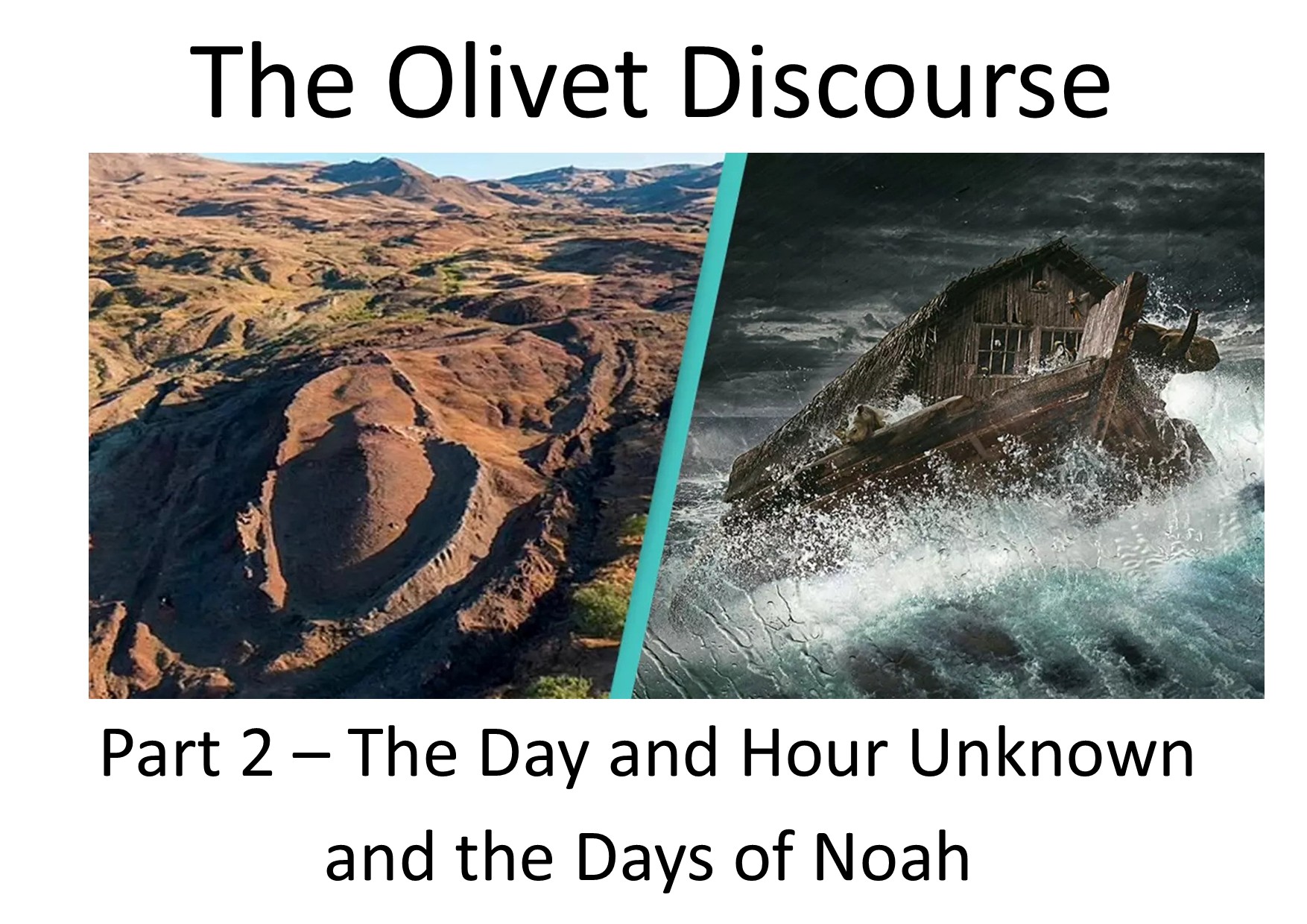
According to Got Questions (see here) “The biblical account of Noah begins in Genesis 6. Approximately 1,600 years had passed since the creation of Adam and Eve (Genesis 1:26–27). As the earth’s population exploded in number, it also exploded with evil. Long forgotten was the righteous sacrifice of Abel (Genesis 4:4) as “the Lord saw that the wickedness of man was great in the earth, and that every intention of the thoughts of his heart was only evil continually” (Genesis 6:5). Verses 11 and 12 say, “Now the earth was corrupt in God’s sight, and the earth was filled with violence. And God saw the earth, and behold, it was corrupt, for all flesh had corrupted their way on the earth.” However, “Noah found favor in the eyes of the Lord” (verse 8). When Jesus described the events that will surround His second coming, He said, “Just as it was in the days of Noah, so will it be in the days of the Son of Man. They were eating and drinking and marrying and being given in marriage, until the day when Noah entered the ark, and the flood came and destroyed them all” (Luke 17:26–27). Jesus was pointing out that, although the people of Noah’s day were totally depraved, they were not the least bit concerned about it. They were carrying on the events of their lives without a single thought of the judgment of God. Noah is described as a “preacher of righteousness” (2 Peter 2:5), meaning he had spent years warning his friends and neighbors what the Holy God was about to do. No one listened”.
Just as the Fig Tree coming to life as summer is approaching is indicative of it soon coming, the various happenings Jesus said would take place actually taking place, perhaps in ways not previously seen, may be an indication that His return is about to happen. Before we consider a paradigm that is similar to the days of Noah, also indicating Jesus is about to return, let us consider the rest of Matthew 24 and the important statement no-one knows when this will happen, including Jesus Himself, and one that has often been overlooked down the ages, including among Jesus first disciples that believed His coming would be imminent, and measurable in terms of months, rather than at least two millennia. While I can see pieces of the jigsaw coming into place in my own generation, likely more than the one of my own spiritual mentors who understood prophecy better than me, and before that, it would be rather presumptuous, in terms of giving dates, to say anything other than “I don’t know”, yet given the teaching of Matthew 24 and especially Matthew 25, it is something we must prepare for.
““But about that day or hour no one knows, not even the angels in heaven, nor the Son, but only the Father. As it was in the days of Noah, so it will be at the coming of the Son of Man. For in the days before the flood, people were eating and drinking, marrying and giving in marriage, up to the day Noah entered the ark; and they knew nothing about what would happen until the flood came and took them all away. That is how it will be at the coming of the Son of Man. Two men will be in the field; one will be taken and the other left. Two women will be grinding with a hand mill; one will be taken and the other left. “Therefore keep watch, because you do not know on what day your Lord will come. But understand this: If the owner of the house had known at what time of night the thief was coming, he would have kept watch and would not have let his house be broken into. So you also must be ready, because the Son of Man will come at an hour when you do not expect him. “Who then is the faithful and wise servant, whom the master has put in charge of the servants in his household to give them their food at the proper time? It will be good for that servant whose master finds him doing so when he returns. Truly I tell you, he will put him in charge of all his possessions. But suppose that servant is wicked and says to himself, ‘My master is staying away a long time,’ and he then begins to beat his fellow servants and to eat and drink with drunkards. The master of that servant will come on a day when he does not expect him and at an hour he is not aware of. He will cut him to pieces and assign him a place with the hypocrites, where there will be weeping and gnashing of teeth” (Matthew 24:36-51).
One of the bones of contention among those scholars seeking to interpret Jesus’ future predictions is when, that just as with the events relating to the Fig Tree so the Days of Noah could apply at different times following His speaking these words, for example in Jesus own words to do with marrying and giving in marriage, suggesting a degree of normality and people oblivious of the pending judgement. As for the description of how it was in the days of Noah, e.g. the wickedness and violence, picked up by Got Questions, there have been many examples throughout history. What it did not mention, and something I see as particularly important, despite many commentators playing down the notion, concerns how “sons of God” (who I believe are angelic beings, now waiting judgment – see 2 Peter 2:4-5, Jude 1:6-7) mating with human women to create a hybrid race of giants, and to get rid of this particular perversion was as much a reason for the global flood as anything other. “The sons of God saw the beautiful women and took any they wanted as their wives … In those days, and for some time after, giant Nephilites lived on the earth, for whenever the sons of God had intercourse with women, they gave birth to children who became the heroes and famous warriors of ancient times” (Genesis 6:2,4).
In recent years, there has been much discussion concerning the Nephilim and according to some this is connected with the evil that their descendants have been pushing, at least following the building of the Tower of Babel in Genesis 11, and which may be considered as activities of a hidden, satanic cabal behind much evil in the world today. There is also talk of an alien invasion, I see as not creatures from outer space but rather the result of Nephilim related activity, which continued following the Flood. It is a subject I have reflected on (see here). Something else that we are seeing to a much greater extent than previous generations is the abortion of babies. In addition, there are the transhuman and transgender agendas that have significantly infiltrated many societies in the world today. All of these aspects lead me to the view that the days we live in might well be the Days of Noah in a way that previous days were not.
The important thing for all of us is knowing how to respond. Jesus was clear that His coming would be both sudden and with as much devastation accompanying the Flood, which is why preachers who fail to warn are being derelict in their duties. Interestingly, Noah began His preaching ministry the best part of a century before the Flood came and people were given ample opportunity to turn from their wickedness, although in the end only eight people were saved as a result of entering the Ark. Incidentally, recent archaeological discoveries (see photo above) suggest we may have located the remains of that Ark. Something else that has cropped up in my recent research concerns the Noahide Laws (that will be for another blog). I have found it interesting to note that as a one world religion is being pushed along with the coming Antichrist; these (found in the Talmud but not set out in Bible) laws are also being pushed.
In the final verses of Chapter 24, we are reminded that we who do take heed of Jesus words need to operate as faithful servants that are doing what the Master (He, Jesus) requires when He returns unexpectedly. The consequences for not doing so are dire. This thought is elaborated in the three parables of Matthew 25. We should be like the wise virgins with our lamps ever trimmed. We should be like the servant that uses the talents with which he is entrusted. We should be a sheep rather than a goat (which when He comes, He will separate). And while those of a more conservative ilk may rightly emphasise the need for sound doctrine and moral righteousness, these words of Jesus should be a challenge to us all:
“But when the Son of Man comes in his glory, and all the angels with him, then he will sit upon his glorious throne. All the nations will be gathered in his presence, and he will separate the people as a shepherd separates the sheep from the goats. He will place the sheep at his right hand and the goats at his left. “Then the King will say to those on his right, ‘Come, you who are blessed by my Father, inherit the Kingdom prepared for you from the creation of the world. For I was hungry, and you fed me. I was thirsty, and you gave me a drink. I was a stranger, and you invited me into your home. I was naked, and you gave me clothing. I was sick, and you cared for me. I was in prison, and you visited me.’ “Then these righteous ones will reply, ‘Lord, when did we ever see you hungry and feed you? Or thirsty and give you something to drink? Or a stranger and show you hospitality? Or naked and give you clothing? When did we ever see you sick or in prison and visit you?’ “And the King will say, ‘I tell you the truth, when you did it to one of the least of these my brothers and sisters, you were doing it to me!’” (Matthew 25:31-40 NLT).
 JRB Publications