
We come to the final episode of our “Daniel’s Four Visions” series. Rather than going over old ground to establish the context and background, besides pointing out Daniel’s ministry overlapped that of the later part of Jeremiah’s and all of Ezekiel’s (who refers to Daniel in glowing terms (Ezekiel 14:14,20)), might I suggest readers check out the previous four episodes for the story so far:
- Daniel’s Four Visions – An Introduction
- Daniel’s Four Visions – Vision 1: (Daniel 7) Daniel’s Dream of Four Beasts
- Daniel’s Four Visions – Vision 2: (Daniel 8) Daniel’s Vision of the Ram and the Goat
- Daniel’s Four Visions – Vision 3: (Daniel 9) Daniel’s Seventy Weeks

Just as with Daniel’s first three visions, the substance of his fourth vision can be found in a single chapter (here it is Chapter 11). But in this article we are also going to cover chapters 10 and 12 too because these provide the context and consequences of that fourth vision that continues up to the very end of time and if the first three visions are remarkable this fourth vision is even more so given that it takes us through the empires that were to come (Persian, Greece and Rome) until even past our own time (2024 CE). While there is a lot of consensus among Daniel scholars concerning the BCE events that is not the case with the CE ones. My intention is not to set myself up above any of the Daniel commentators (several I have checked out), offering various perspectives, some I do not share, but rather I want to put myself in the shoes of and support ordinary people who want to know what the Bible actually teaches and apply that teaching, including the more difficult to understand parts, such as that which found in the second half of the Book of Daniel concerning his four visions and also relate these to what is going on in the world now.

Our section begins: “In the third year of the reign of King Cyrus of Persia, Daniel (also known as Belteshazzar) had another vision. He understood that the vision concerned events certain to happen in the future—times of war and great hardship” (10:1 NLT). Even before we get to the more contentious verses, from 11:36, we are faced with dating this vision and it makes sense that it is circa 536 BCE if we read it as the third year following Cyrus / Darius conquering Babylon (also tying in with 11:1 which talks about the third year of Darius the Mede and noting his third vision was in the first year of Darius and so by now Daniel was in his late 80’s).

Before we get to the vision that pertains to the Kings of the North and the Kings of the South, there is the vision of a man, a visitation by a heavenly being who appears in human form, and before that Daniel had been in mourning, including fasting for 3 weeks, as he had been prior to receiving his third vision, which we find in Daniel 9 (discussed previously), two years earlier. We don’t know for sure what were the reasons for Daniel’s distress, but we can make a good guess. In the two years that had elapsed since his last vision, the Cyrus edict had happened and that had meant that not only were the Jews invited to return from exile to their homeland but that is what had begun to happen. But things were not going well – check out the books of Ezra, Haggai and Zechariah for the back story. And that is when this extraordinary being appeared – three weeks later.

The description of the human/divine being is reminiscent of what John saw in Revelation 1 and in that case the being was identified as Jesus Christ. We cannot make that same connection in Daniel’s case but cannot rule out the possibility. It was an awesome sight and, while along with his companions there was a reaction of terror, only Daniel saw the vision. The man sought to reassure him with messages of peace and an encouragement to be strong. Besides reinforcing the lesson that prayer is important, indeed vital, there is much else we can learn about this encounter before we Daniel’s vision of the kings. We learn Daniel had sought God with a humble heart, seeking true understanding, and God had responded, doing so right from the outset of his praying. If there had been a delay in answering (in this case it was three weeks) it was because of an unseen spiritual battle going on in heavenly realms that included Michael, the Prince of Israel and other princes including that of Persia and Greece, who seemed to be more on the side of darkness and the devil than that of light and God. It is good to be reminded of this as we pray concerning alarming happenings in the world, that we are in a spiritual war. Again, it is worth mentioning that Daniel’s people (Israel) were at the centre of what happens in the future.
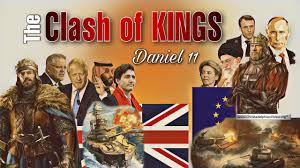
Before we address the title of this Daniel episode and consider the kings of the North and South vision in Chapter 11 and that concerning the (very) end times in Chapter 12, it is worth our revisiting some points discussed in earlier episodes. Firstly, there are many who have weighed in with their interpretation of this as well as Daniel’s other visions. They may be better Christians than me and may know about the subject more than me and yet I disagree with them or do not accept entirely the points they make. My purpose is not one of one upmanship but rather it is to encourage ordinary Christians (and non come to that) to study the Book of Daniel in what could well be the End Times when Daniel was told all will be revealed. I discount those who can’t come to terms with the supernatural and that those future events right up to the end of the BCE era were not predicted by Daniel and not written by those who were wise after the event. Neither do I go along with those who take the view that everything in Daniel, except maybe bits of Chapter 12, were fulfilled by the time the canon of the New Testament was completed, at the end of the first century CE, albeit this was not formally recognised until the fourth century CE.
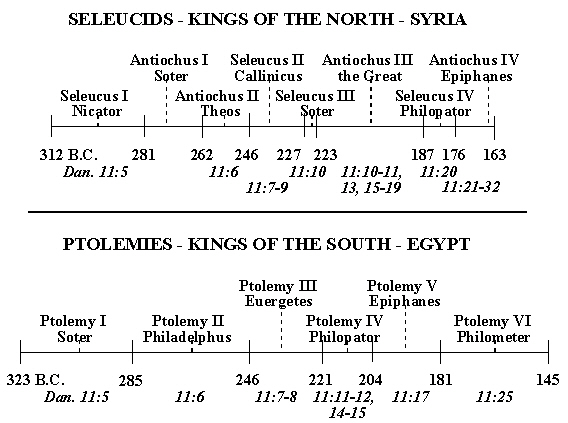
I am not going to give a verse by verse breakdown, although tempting to do so concerning Chapter 11, considered by many scholars that much of it has not only having taken place in the course of the next 400 years but have been, demonstrably so. This chapter alone shows how remarkable the Bible is given that so many prophecies have been fulfilled, down to fine detail. I have checked out commentators from many different theological persuasions concerning their understanding and other aspects of the final three chapters of Daniel and few if any I agree 100% (sometimes, it goes onto the growing pile in my to be checked out basket) but I have found David Pawson helpful on the matter (see here). Like Pawson, I hold to the view of 11:2-35 being fulfilled during the time of the Persian, Greek and early Roman empire and 11:36-45 as yet to take place, culminating in the time of the New Testament Antichrist (see here) and the Battle of Armageddon (see here) after which the Christ that the Antichrist had sought to usurp returns to planet earth. But I find whenever I feel had cracked it when it comes to intepretation, something comes my way to show I that haven’t (for example, see here regarding this vision).
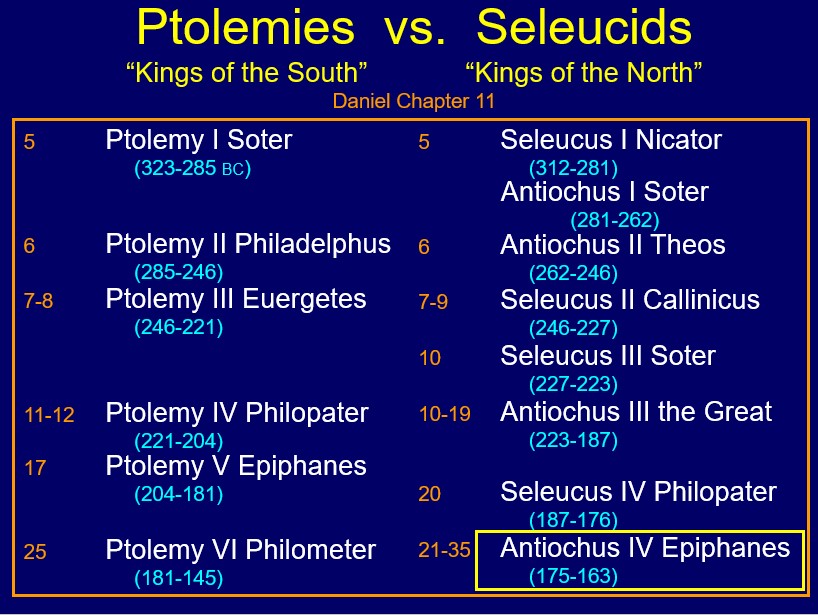
Daniel 11 describes Daniel’s fourth vision concerning the future, including the rise and fall of kingdoms, wars, and the desecration of the Temple. We get a glimpse of the Persian and Grecian kings and what they were up to in Chapter 8, culminating in the time of the cruel and wicked king, Antiochus Epiphanes IV, 175–164 BCE, whose evil deeds included oppressing and killing the people of God, especially those deemed as threats. Chapter 11 delves deeper and fills in some gaps and key personalities after Alexander the Great, who reigned 336–323 BCE. But firstly, Chapter 11 begins with the prediction that four kings will arise in Persia, with the last one making war on Greece. The fourth king was likely the Persian king Xerxes (Ahasuerus, ref. Ezra 4, Esther 1), who ruled from 485–464 BCE, although the Persian empire would not be conquered by the Greek empire until more than 130 years later, which was then split in four parts following Alexander’s death.

The chapter describes wars and marriages between the kings of the South and the North, which were the rulers of the Ptolemaic dynasty in Egypt and the Seleucid dynasty in Syria. The king of the North desecrates the Temple and sets up “the abomination that causes desolation” (11:31), which we discussed in our previous instalment. It should also be borne in mind that in the latter period of the divided Greek empire, there was the emergence of the Roman empire, and there was conflict between the kings of the North and Antiochus Epiphanes IV and Rome. The Roman Republic finally conquered Greece in 146 BCE after the Battle of Corinth. While our focus is on Daniel’s visions, what we are seeing concerns Babylon, recently replaced by Persia, with Greece and then Rome to follow and this was the fulfilment of Nebuchadnezzar’s dream of a statue comprising four parts representing these kingdoms and one to come associated with the fourth kingdom (Daniel 2) (involving ten kings which commentators associate with the rule of the Antichrist from which he emerges), and ends with the prediction of the coming Messiah and His Kingdom: “The whole statue was crushed into small pieces of iron, clay, bronze, silver, and gold. Then the wind blew them away without a trace, like chaff on a threshing floor. But the rock that knocked the statue down became a great mountain that covered the whole earth” (2:35).

This brings us to the King who exalts himself (Daniel 11:36-45). There is debate whether this is the same Antiochus Epiphanes IV that is at the centre in 11:21-35 or if this relates to the future Antichrist. One reason for thinking this are the words “then at the time of the end” (11:40a); another is that unlike in the earlier verses of Chapter 11, there has been no apparent historical fulfilment. Then there is the thought that there is a case for prophecy to be partly fulfilled but fully fulfilled at a later date. Much is written in 11:31-35 as well as 11:36-45 that fits the bill for the future Antichrist, such as the occurrence of deceit, flattery and betrayal and those righteous folk who warn others but will suffer severe persecution when this king is in power. As for the Antichrist, whether the OT or the NT version, despite appearing unconquerable given his victory over many, he is opposed (see also Revelation 16:12-16, 19:11-20). Just as his rise was meteoric so was his fall. His end is sudden, decisive and emphatic “He will stop between the glorious holy mountain and the sea and will pitch his royal tents. But while he is there, his time will suddenly run out, and no one will help him” (11:45).

We now come to the final chapter (12) which is a continuation of the vision that began in Chapter 10 and as we have established in our previous paragraph is now relating to the time at the yet to occur end and not just what took place in 175–164 BCE. “And at that time shall Michael stand up, the great prince which standeth for the children of thy people: and there shall be a time of trouble, such as never was since there was a nation even to that same time: and at that time thy people shall be delivered, every one that shall be found written in the book” (12:1). It is a time of great tribulation and relates particularly to “the children of thy people” (Israel). It continues some of the thoughts discussed in Daniel’s third vision and pertains to the final part of that period (3½ years) and again Michael is mentioned, the guardian angel of Daniel’s people and raising the neglected thought in Protestant circles concerning the important ministry of guardian angels. The question might also be asked – what about the church? Got Questions again gives helpful explanation of this End Times Tribulation, citing many scriptures (see here), and like many commentators who take a futurist view of end times also takes the view (not one that I subscribe to, btw) that the church had been raptured, thus escaping the Great Tribulation, the time when Israel appears to take centre stage.
It is worth mentioning here concerning elements of today’s Israel that could be at the heart of this final short (12 verses) chapter. It is a contentious matter even among Christians one might ascribe the sound and godly labels and the very “hot” as far as current newsworthy coverage goes, as following the war taking place in Gaza and likely to spread there is the fall of Syria with various factions involved, including Israel making territorial claims. Where Israel (especially the leadership and with the very people one imagines may make a pact with this false Christ) stands in the good-bad spectrum is a major cause of contention and is one I cover in my other writings without standing with those at either end, while noting what they say. What is interesting, is that Daniel is told to seal up the words until the time at the end that not only was a long time away in Daniel’s day (2560 years ago) but still is today – or is it? Even the two (men or angels) who stood either side of the river couldn’t figure this out and wanted to know (12:5-7). How events in the world are shaping up to this final set of Israel related world events described in Daniel’s fourth vision before the true Messiah returns and in doing so brings to the end the counterfeit one, it is possible to make a case with the way things are currently, rapidly unravelling, it could happen in the near future, but whether or not or how it does, we should be like the five wise virgins, with their lamps trimmed, ready for the coming bridegroom (Matthew 25).
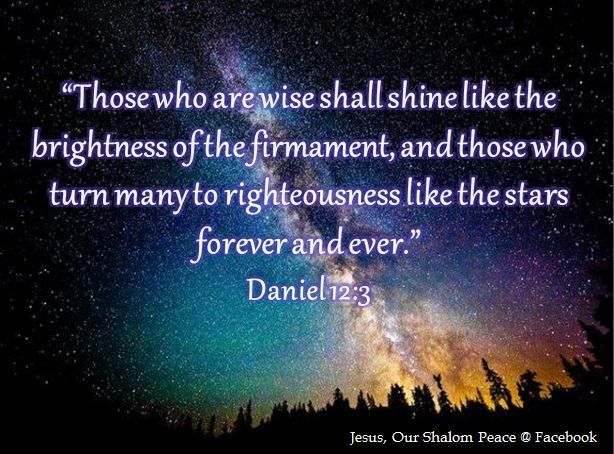
Back to the beginning of our chapter and “thy people shall be delivered, every one that shall be found written in the book”, we are now looking at the final resurrection where what is happening is stated in stark terms and cannot be ignored by the Church with its commission to preach the gospel to all nations: “And many of them that sleep in the dust of the earth shall awake, some to everlasting life, and some to shame and everlasting contempt. And they that be wise shall shine as the brightness of the firmament; and they that turn many to righteousness as the stars for ever and ever” (12:2-3). The question is begged, dear reader, whether Jew or Gentile: will you be among the wise that “shall shine as the brightness of the firmament” and is a challenge to all of us who take seriously these words along with the imperative to “turn many to righteousness”?
It is worth also revisiting the thought that the Books of Daniel and Revelation (arguably the two that top the list of containing content that is argued over among Bible students) wonderfully complement each other and the more one studies the two prophecies, the more this can be seen. The Antichrist (the Beast) in Revelation is introduced as the rider on a white horse (representing his claim to be a man of peace) in Revelation 6:2. He is the first beast – the one from the sea, in Revelation 13. This beast receives power from the dragon (Satan) and speaks “proud words and blasphemies” (13:5) and wages war against the saints (13:7). The Antichrist, along with his false prophet, will be thrown into the lake of fire, where they will spend eternity (Revelation 19:20; 20:10). Again, Revelation 6-19 seems to focus on the Jews, begging the question: where is the church? Yet it should be noted that Revelation was written to the seven churches of Asia Minor with a major theme being that they prepare for tribulation and it would be followed by triumph.

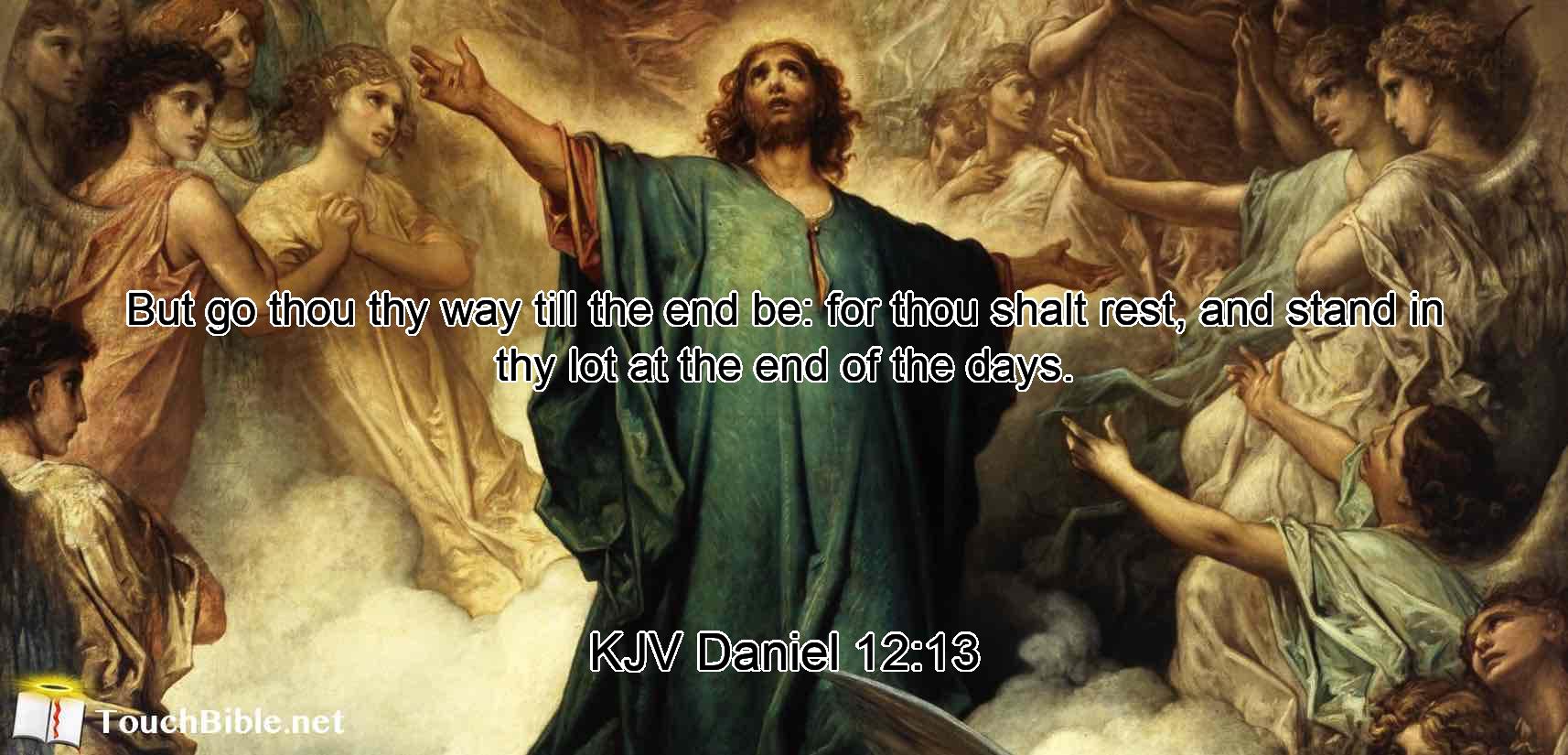
The fourth vision (and the Book of Daniel) ends with Daniel asking (again) the poignant question and receiving an incredible response: “I heard what he said, but I did not understand what he meant. So I asked, “How will all this finally end, my lord?” But he said, “Go now, Daniel, for what I have said is kept secret and sealed until the time of the end. Many will be purified, cleansed, and refined by these trials. But the wicked will continue in their wickedness, and none of them will understand. Only those who are wise will know what it means. “From the time the daily sacrifice is stopped and the sacrilegious object that causes desecration is set up to be worshiped, there will be 1,290 days. And blessed are those who wait and remain until the end of the 1,335 days! “As for you, go your way until the end. You will rest, and then at the end of the days, you will rise again to receive the inheritance set aside for you” Daniel 12:8-13 (NLT)”. What a prospect is in store for Daniel (who I hope to meet), and us too (as well as an exhortation) if as I hope we are to be found among the wise (followers of the Christ).
 JRB Publications