
Having introduced my latest Bible focused project (see here), which is to write about Daniel’s four visions, then turning our attention to the first of these (see here) and the second of these visions (see here), we turn to his third vision concerning “the Seventy Weeks”, following his amazing prayer.
The Chapter 9 prayer, which was promptly followed by his vision / visitation, took place in the first year of Darius the Mede’s reign (538 BCE), right toward the end of the Judaean exile (607-537 BCE). Daniel was part of the first bunch of exiles, which included members of the royal court, making him an old man, aged around 85, at this time. The invitation given to return back to the Promised land, as a result of the Cyrus edict, would take place around a year later.
While this series is meant to focus on Daniel’s visions, this prayer is significant as it would lead to the return visit of Gabriel, giving what would seem to be an unusual and unlikely yet timely response to Daniel’s prayer, which in turn was a response to Daniel’s study of the scriptures, in this case the prophecies of Jeremiah concerning the Exile, why it happened and how long before those who were exiled were allowed to go home (Jeremiah 25:11-12, 29:10). It could also be noted that this was “to fulfil the word of the Lord by the mouth of Jeremiah, until the land had enjoyed her sabbaths: for as long as she lay desolate she kept sabbath, to fulfil threescore and ten years” 2 Chronicles 36:21 and that seventy sabbath years are 470 years the exact time to undo Israel’s disobedience to this law . This is one of the great prayers of the Bible. While our situation is different to Daniel’s, it is a good example of how we can pray. Given Israel’s current situation it is one they would also do well to follow.

It is notable that Daniel praying was accompanied by him fasting. It involved confession of sin (and in doing so Daniel identifies himself with the sin of the people) and worship in a spirit of reverence and awe along with an acknowledgement of who God really is. The central theme of the prayer was the sorry state of Daniel’s people and while he recognises God is one who keeps His covenant (i.e. that made with Abraham and later Israel) he also recognises that they have disobeyed the Covenant and deserve that which had befallen them. While Daniel pleads for mercy, he is also concerned for the honour of God’s name and for Him to act accordingly. This is the main reason given when pleading with God on behalf of his people, according to the word God had given to Jeremiah those years before.
While Daniel’s second vision may be considered as relatively straightforward when it comes to interpretation, his third vision concerning the “seventy” weeks and especially the seventieth week is much less so. This is evidenced by my checking out what those who know their Bibles have had to say regarding Chapter 9:24-27 (and especially 9:26-27), for there is a wide range of interpretations and applications. One reason for this is where people stand with their views on unfulfilled prophecy (preterist or futurist) and how they view modern Israel (replaced by the church or not). My views are futurist and non-replacement but, unlike some who agree on these points, I do not believe the church will be raptured before the period that includes the Great Tribulation, viewed by many as a time of great distress and one that I believe is yet to take place (9:27).
Before all this, Gabriel, by now a familiar figure, tells Daniel he is greatly beloved and that he (Gabriel) is going to give him (Daniel) understanding as to what is going to happen (9:20-23). Rather than focusing on the return from exile, soon to happen, he sets out what will happen in the future, the seventy weeks that is the subject of what Gabriel has to say, starting with a period of seven weeks, followed by one of 62 weeks (9:24,25) and then the final week (9:26-27). It is worth bearing in mind the six things that are yet to happen, as these give rise to often quite different interpretations among modern pundits, especially when it comes to the 70th week.
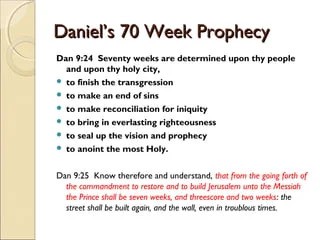
“A period of seventy sets of seven has been decreed for your people and your holy city to:
- finish their rebellion,
- to put an end to their sin,
- to atone for their guilt,
- to bring in everlasting righteousness,
- to confirm the prophetic vision,
- and to anoint the Most Holy Place” (9:24 NLT).
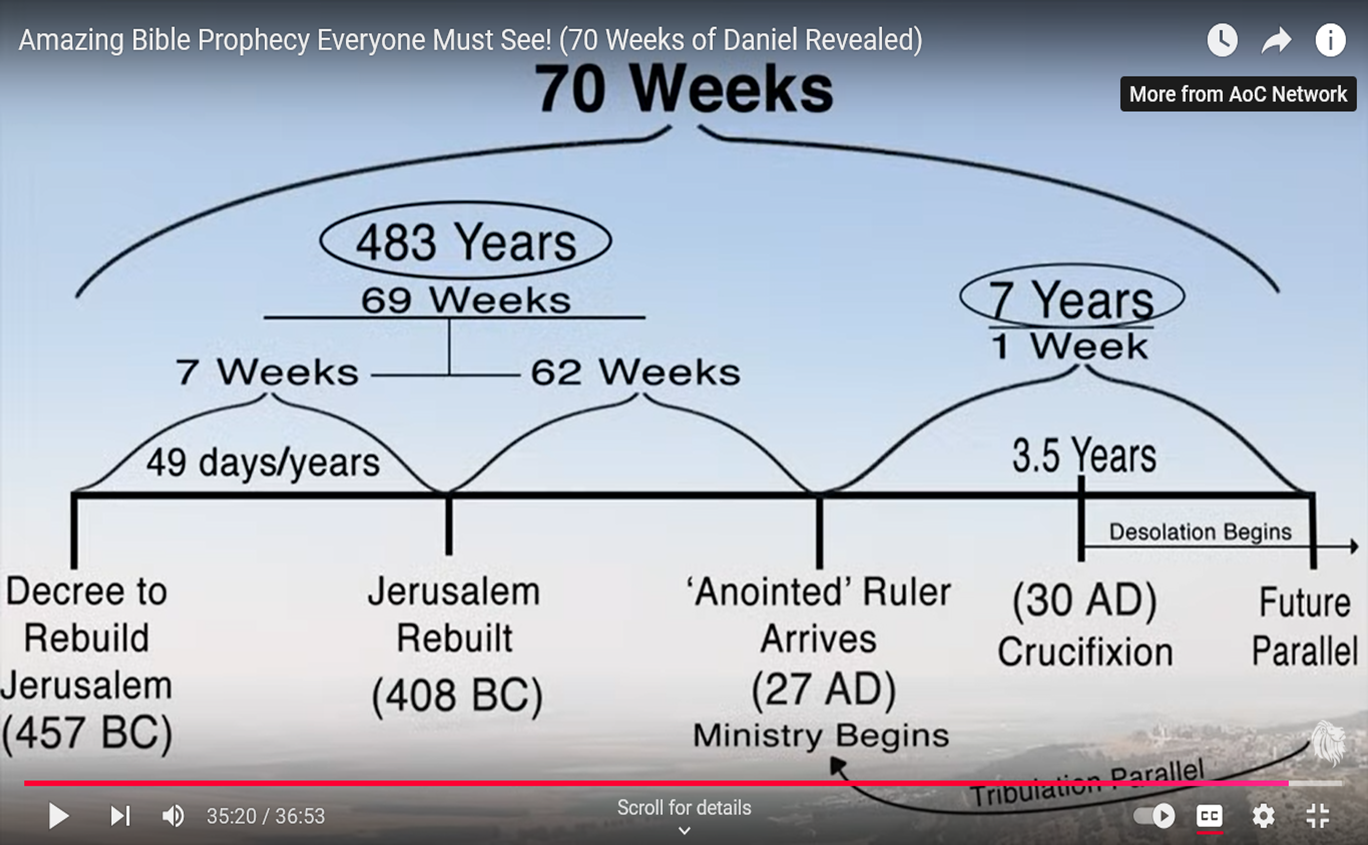
None of this had come to pass in the first 69 weeks, although that would have been the hope (in the light of Daniel’s prayer), and neither did it happen in the seventieth week. While all this might have happened and should have if Israel had accepted its Messiah, but given they rejected Him, it begs the question: if not during the period up to the destruction of the Temple in 70 CE, when (unless the seventieth week is sometime in the yet to take place future, after Jesus’ First Coming)? It is significant too that this entire chapter is about Israel and not anyone else and that it is likely Daniel had only very limited understanding regarding the Church (ekklesia). One remarkable consideration, given many question whether Daniel wrote the Book of Daniel, is how accurately future events were described, yet the content of the Book of Daniel was known before Jesus’ time, including predicting “the Anointed One will be killed, appearing to have accomplished nothing, and a ruler will arise whose armies will destroy the city and the Temple” (9:26a NLT).
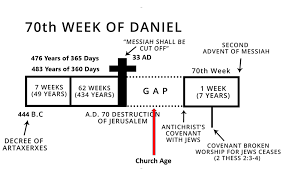
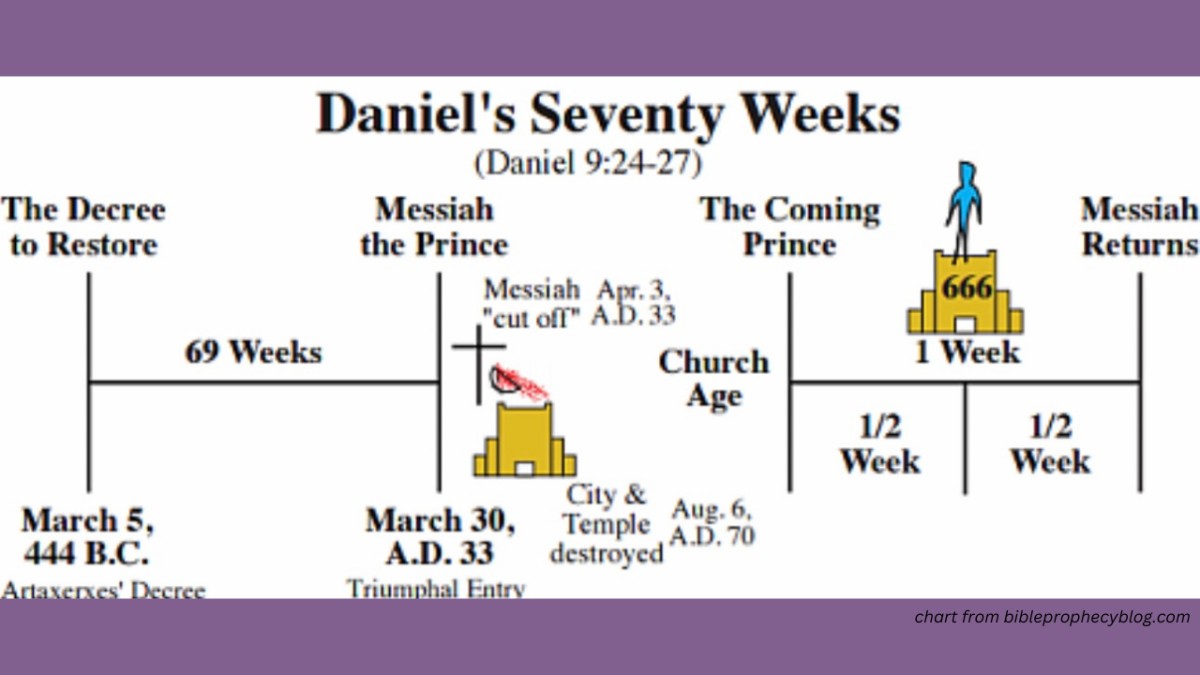
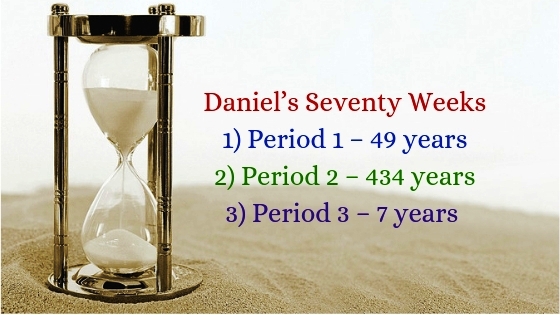
I offer two charts (above) incorporating a similar interpretation of the first seven-week period and the second 62-week period of Daniel’s seventy weeks but differing regarding the third one week period. Both argue with good reason that a week is seven years, making 69 weeks 483 years. If the time begins when King Artaxerxes issues his decree for the Jews to rebuild the City of Jerusalem (Ezra 7) then this ties in when the City was rebuilt and, moreover, 434 years later brings us to the time of Jesus ministry. As for the final seven years that is where scholars disagree but my futuristic understanding of Bible prophecy, complemented by 2 Thessalonians 2 and Revelation 13, is that this is covering the period often referred to as that of the Great Tribulation, especially concerning the final three and half years of that seven year period that begins with the New Testament fulfillment of the Abomination of Desolation Jesus speaks of in Matthew 24, which is a subject also touched on in Daniel’s other visions, e.g. Daniel 11:31, 12:11.

The Final Week is covered by the verses “The end will come with a flood, and war and its miseries are decreed from that time to the very end. The ruler will make a treaty with the people for a period of one set of seven, but after half this time, he will put an end to the sacrifices and offerings. And as a climax to all his terrible deeds, he will set up a sacrilegious object that causes desecration, until the fate decreed for this defiler is finally poured out on him.” (9:26a-27 NLT). I offer my understanding that this has a futuristic fulfilment not covered in the time up to the destruction of the Temple. It is about “The End” and it also relates to Daniel’s other visions.
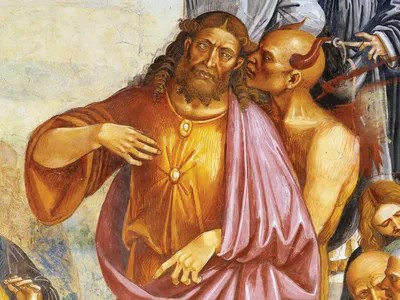
The most satisfactory explanation is that the ruler / defiler is the Antichrist who arises in the period immediately prior to the Second Coming of the “anointed one” (Messiah), mentioned in 9:25 and 9:26. This to be identified Antichrist figure appears in place of the true Christ, making a treaty with Israel for three and half years and then reneges, beginning with the Abomination of Desolation and making himself as God, exercising terrible power for a further three and a half years until the fate decreed for this defiler is finally poured out on him and then the true Christ comes back (Revelation 19), although part of the mystery is that this is not shown in this vision but is in other visions e.g. Daniel 7:27. That then is Gabriel’s unexpected “explanation” of what is to happen right up to the very end of the age, and all this was in response to Daniel’s prayer.

 JRB Publications