
In my previous two articles “Christian Unity and Hot Potatoes; how I see it and how to reconcile the two” and “When Christians stop going to church and some of the reasons why” my big concern was for dedicated Christians who know and live according to what the Bible teaches who typically once were active in church life but now no longer so since, for one reason or another, they had been put off from being actively being involved, and often stopping attending church altogether.

I was taken to task by one friend for not including women and what about gay folk in my discussion. My response was “Forgive my use of men rather than men and women which is cumbersome or people which doesn’t ring nicely but I still tend to operate in KJV mode which translated original Greek in terms that God wants all men to be saved and has always understood that to include women. If you read my earlier blog I identified the group I was particularly concerned about particularly as real Christians with traditional beliefs who for one reason or another stopped attending church with a small “c”. I am not ignoring those that fall outside that category including LGBT folk, who I have had dealings with and a deal of compassion for as they seek the truth which is found in Jesus. As I say, I intend to address this “other” group in a future blog as there will be other points to consider especially if like me and Stephen we cannot waver from what you call our fundamental beliefs without compromising our conscience. I am afraid I am uncomfortable with a Pride flag outside my church (and you will be pleased to note) as well as an Israel flag which are welcomed by different sets of Christians and are among the many things to consider when striving for Christian unity. Here I could give a plug for “my lot” the Open Brethren that chose only to have Bible texts adorning their Gospel Halls when they simply met with the simple aim of proclamation of the Gospel”. Another friend cited a gay couple who would feel excluded from my vision of how church should be yet showed true Christian (agape) love and could benefit from a supportive church family. My response was “thanks for your moving account. As I told our friend my focus in writing were pillar of the church, doctrinally sound, followers of Jesus (men and women lol) who have given up on church as most people know it. What you both wrote make important points that are the very spur I need to do a follow up aimed at everyone else”.
What I am about to do is to address the important question of reaching out to this “other” group, not so much to get them to attend to church but rather that they can be partakers in and beneficiaries of church life, including importantly becoming dedicated disciples of Jesus. In recent years the notion of seeker friendly churches concerned with things like inclusion, equality and diversity and involving and being more attractive to this “other” group has become more popular. Often activities are laid on to appeal to the unchurched. Much of this is well intended and at least on the surface is laudable if done for the right motives and not merely to boost church attendance. The danger is when I see many examples churches falling into this trap/deception and that the baby is thrown out with the bath water – the baby being what churches should be about; the bathwater is a plethora of inessential activities.
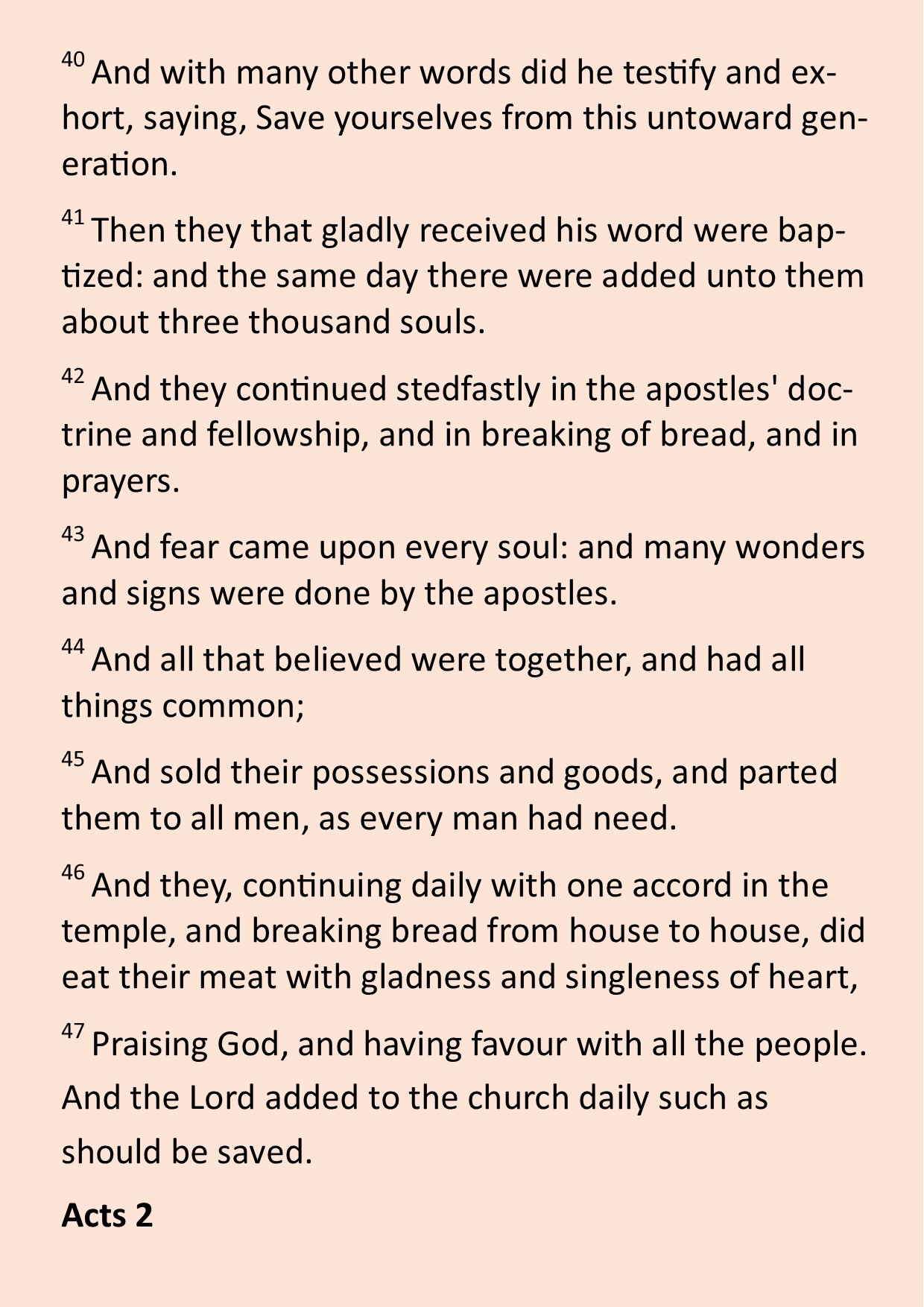
My own limited experience of church life has mostly been with free evangelical type churches (including some that people might deride as being fundamentalist in a negative sense). Often these are dying and some eventually close due to lack of attendees. Many began with good intentions and for one reason or another they lose their way, often gradually. I have had less experience with “seeker friendly” churches but I have found too often these fail to preach the full counsel of God and are more interested in appeasing the current culture status quo rather than pleasing God. No church is perfect, of course, and as I pointed out we may find many areas of disagreement while still being part of a church where we take issues with. I have suggested how to approach such a situation in my previous article. But if there is a model to base on concerning what church life should be about, I refer readers to Acts 2 and the very first church born on the Day of Pentecost after Jesus ascended.
42 All the believers devoted themselves to the apostles’ teaching, and to fellowship, and to sharing in meals (including the Lord’s Supper), and to prayer. 43 A deep sense of awe came over them all, and the apostles performed many miraculous signs and wonders. 44 And all the believers met together in one place and shared everything they had. 45 They sold their property and possessions and shared the money with those in need. 46 They worshiped together at the Temple each day, met in homes for the Lord’s Supper, and shared their meals with great joy and generosity 47 all the while praising God and enjoying the goodwill of all the people. And each day the Lord added to their fellowship those who were being saved (New Living Translation).
Of course, the challenge is how to apply this model to our own situation, especially with respect to the sort of people not in my pillar of the church, doctrinally sound, followers of Jesus category (which is most people). There are no hard and fast rules, but there are principles derived from passages in the Bible such as these:
If we are part of one of the many manifestations of church (and we should be), we should recognise there are also many other churches that could be seen in the alive category even if differing in their practices to our own. We should prioritise five important things that I have found in my dotage: worshipping God in a way that honours Him, taking care of others, especially the poor, weak and vulnerable (inside and outside of our congregation), preaching the Gospel (include inviting heterosexual and homosexual sinners to repent of their sin and turn to Christ to be saved), prioritising mission – home and abroad and as far as it is possible to reach out to this “other” group in a Christlike way, spurred on by His love for people.
Truth should be our guiding force, notably that found in the Bible, and we shouldn’t be afraid to declare it and we should preach the Gospel of the grace of God whenever opportunities allow, even if this is disapproved off by those inside or outside our church.
We should seek always to obey the two great commands to do with loving God and our neighbour and to practice five things that I have also come to see as being highly important: living in the fear of God, showing kindness to others, being faithful to God and in our people dealings, living godly lives and exercising meekness and humility.
My final point, is that while I have strong opinions as to how church should function, the most important factor is the Lord being among us and a desire to see His glory manifest. History tells us that this can and does happen in churches that are very different to how we may think churches should function. There is no magic wand solution to getting outsiders into church and while gimmickry etc. may yield results in the short term, this rarely lasts. If there is one thing you and I can do, it is to invite Jesus in first and truly mean it.
 JRB Publications
what would be your take on a gay couple who live together and are married but do not have sex? There are many older heterosexual couples who love each other, are affectionate to each other but whose sexual life is non-existent. There are plenty of older gay couples for whom the same is true. People often marry for companionship in later life…
I am in a fortunate position i.e. not a pastor etc. who needs to make judgements on how we receive people into fellowship who break the rules (the same question could apply to divorcees who remarry). I have no problem same sex couples living together that abstain from sex. I do have a problem calling it marriage and anything that falls out of the marriage requirement of Genesis 2:24. While I differ from my “affirming” Christian friends on how to come to terms with the notion of “equal marriage”, it bothers me that churches in my theological camp could be rightly accused of homophobia and putting barriers in the way of the group I call “the other” yet without compromising on Bible truths.