
After writing about the subject implied in the title, in my recently published book, “Priests of the Bible” (see here), I have had the privilege of talking about several of the kings mentioned in the Bible in our weekly church Bible studies. In these past three sessions, we have covered the kings of Babylon, notably Nebuchadnezzar, the kings of the Meden-Persian Empire, notably Cyrus, and the kings of the Greek Empire, and in particular: Alexander the Great and Antiochus Epiphanes IV, with reference to the Book of Daniel.

In our studies, we have considered what both historians and preachers, when referring to the historical record, have had to say (and here we are spoilt for choice), as well as what preachers have had to say concerning lessons to draw from the Bible text and how we can interpret that covered by prophecy, noting considerable difference of opinion, especially when it comes to Bible prophecy, concerning that which was at the time (and still is in several instances) future events. In doing so, while expressing a view that sometimes esteemed Bible scholars may not agree or identify with, I try to do so with humility given there are things we do not know for sure and that many disagreements should not be falling out matters. There are several books of the Hebrew Bible we can refer to. The one to stand out is that of Daniel. When it comes to the differences in interpreting text in the prophetic sections, this is on par with what is found in the Book Revelation, which remarkably complements it, and should be read in conjunction. But also we recognise many cults focus on these books and even sound Christians often fail to get true balance when majoring on end times prophecy. Even so, 27% of the Bible is prophetic and of the, arguably, 2500 prophecies contained therein, 500 are yet to be completely fulfilled, even though all the remaining 2000 prophecies have been fulfilled to the last detail.

There are many outstanding features concerning the Book of Daniel, starting with that of Daniel the man, who from a young teen lived as an exile in Babylon, right from the beginning, where he would still be living over seventy years later, at which time the exiles were allowed to return to their ancestral homes. He stood out for his uncompromising devotion to YHWH, yet whose winsome character, and especially his wisdom that came from God, endeared him to two Babylonian kings (Nebuchadnezzar and Belshazzar), and one Persian king (Darius the Mede), who promoted him to high office in their administrations. Then there were his remarkable prophecies, notably in chapters 7 to 12 (in his later life), especially those that related to the kingdom of Greece and end times. Before that there was the statue in Nebuchadnezzar’s dream that was about four kingdoms: most scholars agree were of Babylon, Persia, Greece and Rome – which brings us to the time of the first coming of Israel’s Messiah (Christians identify as Jesus; Jews believe is to come).

There is less agreement on the ten toes, that gets crushed and because of it the whole statue falls down, by an uncut rock that becomes a mountain filling the whole earth, which some see as the yet to be revealed revived Roman empire after being replaced by God’s triumphant kingdom where Christ will reign, a theme taken up by other Hebrew prophets. As with all the Hebrew prophets, they did not see the gap of 2000 years or more between Christ’s first coming and his second. Also there is wide variations in interpretation when it comes to chapters 7 to 12 especially, and how to apply this to one or other of these four kingdoms and to that which can only relate to end times. Often it is a matter of whether to apply to past or future events, and, in certain cases, both. What is remarkable is the exactness and attention to detail of much of what Daniel prophesied, some later fulfilled and some not.

We begin with Nebuchadnezzar, the most significant of the Babylonian kings. Prior to Babylon coming to power, Egypt and Assyria were the main empires of power with Babylon taking over through conquest. While half of the 59 Bible references by name of King Nebuchadnezzar, are to be found in the Book of Daniel, and is where we can find out most about him, in the remaining references, notably in the Book of Jeremiah, we read about someone who is God’s instrument of judgement concerning the Kingdom of Judah, who does what the prophet prophesies what he would happen, which was to take the people of Judah into exile in Babylon. While he could be cruel in the way he dealt with some of the Judean leaders, and also did bad things like insist on people bowing to his image (Daniel 3), becoming arrogant and proud (Daniel 4), he also treated the exiles as a whole well, notably Daniel and his three friends. While the story of the throwing of Shadrach, Meshach, and Abednego into the fiery furnace (and later Daniel in the lion’s den by Darius) are perhaps those best known in all the Bible, it is worth noting the significance of his dream as discussed above (Daniel 2) and of Nebuchadnezzar’s humiliation by God when he lived for a time like a madman, but then to be restored to his throne when turning back to God. How God raises up and deposes rulers (even bad ones) for his purposes is a recurring theme throughout the Bible and is something we do well to consider pertaining to today’s world.

Cyrus the Great, who founded the Median-Persian (Achaemenid) Empire (550-330 BC) is another extraordinarily significant king. This is attested to the fact that over a century before he was born Isaiah predicted (Isaiah 45:1-6) his coming to power, as the Lord’s anointed, and as God’s instrument to enable the Jewish exiles in Babylon to return to their land, after the 70 year period of captivity prophesied by Jeremiah had elapsed. We read of the beginnings of this return happening in Ezra 1:1-8. There is much more from the historical record that can be said about the Achaemenid empire, found in secular sources. In an nutshell, Cyrus who was king of Persia, which was then a lot smaller in size to what it would become, took over the far bigger kingdom of Media by conquest, followed by Lydia (modern day Turkey). Then there was the remarkable conquest of supposedly impregnable Babylon (as foretold in the Bible), which we read about in Daniel 5 as relating to Belshazzar’s feast. His kingdom extended further, e.g. into India, although it was his son who took over Egypt and along with other kings, mentioned in the Bible, expanded and maintained the Empire, although was unable to conquer Greece, despite trying on several occasions. Cyrus is remembered as an enlightened king who treated his subjects well, and even managed to get them onside by respecting their religion and customs, passing just laws and ruling wisely.

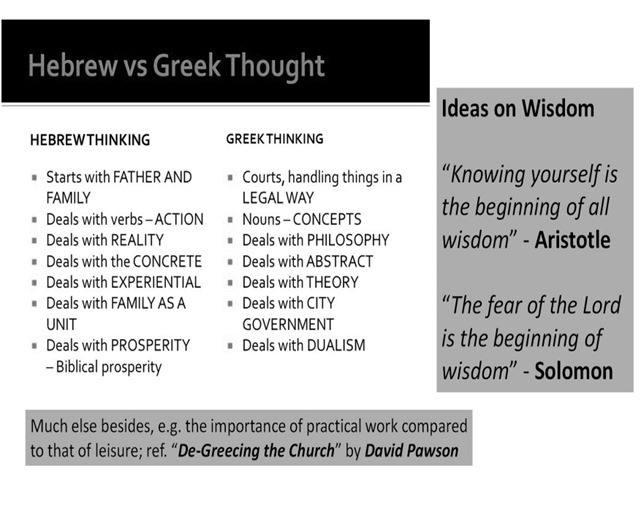
Then we come to the Greeks. While a lot is known about them through the historical record, little is said, other than what is prophesied by Daniel, in the Old Testament record, to which we might add the Apocrypha, notably the Books of Maccabees. The Persian empire continued for another 100 years after the end of the Old Testament, when it was taken over, through conquest by the Greeks, who they had been in conflict with from its early days, with the Greek empire then being ruled by Alexander the Great. Greece was, prior to Alexander’s father, Philip of Macedon, taking over, through conquest and making alliances, an array of independent city states, often forming alliances but also in conflict, and also highly sophisticated and cultured, renowned for profound philosophers, such as Socrates, Plato and Aristotle, who was Alexander’s tutor. The Greek influence continues to the present day, even affecting the church, but there were notable differences between Hebrew thinking and Greek (Hellenic) thinking, giving rise to much conflict. When Philip died, Alexander took over, aged only 20. By the time Alexander died in 323 BC, aged 31, he conquered much of the Achaemenid empire and more besides.

Alexander had no surviving heir, and his empire was split between four of his generals: Ptolemy – ruled Egypt and founded the Ptolemaic dynasty, Cassander – ruled Macedonia and Thessaly, Seleucus – ruled Persia and maintained Babylon and Antigonus – ruled Asia. Of particular interest, as far as the Bible record is concerned, were Ptolemy (Egypt, related to the King of the South) and Seleucus (Syria, related to the King of the North). Israel was wedged between the Egypt and Syria part of Alexander’s divided kingdom, coming initially under king of the South rule and later king of the North rule. There was much intrigue and action, a lot of it referred to in Daniels prophecies, when it came to Israel, and one king stood out: Antiochus Epiphanes IV. He was a cruel tyrant and can be seen as the Old Testament equivalent of the New Testament Antichrist spoken about in 2 Thessalonians 2 and Revelation 13. He came to an untimely end, partly through the Maccabean revolt and other conflicts, including a new rising power: Rome.
A detailed exposition of Daniel 7-12 is beyond the scope of this article. The best I can do for now is to share gleanings of what I have found out. This chapters contain a mishmash of prophecies relating to historically verifiable events, even down to the fine detail, usually involving one or more the four empires (Babylon, Persia, Greece, Rome) identified in Chapter 2, and this is particularly the case of Antiochus Epiphanes IV, where over 100 fulfilled prophecies can be identified in Chapter 11 alone. Since we have been considering Persia and Greece, we must consider the Ram and Goat conflict in Chapter 8. As for the eagle/lion, bear, leopard/panther, dragon/griffin vision in Chapter 7, consideration must be for another time, but methinks this does not equate to Daniel 2’s four kingdoms. Then there is what to make of end times, yet to happen events, some of which come under the “sealed till the time of the end” category. Given we have already considered the Antichrist (check out my “The Two most significant Kings of the Bible – the Antichrist” article) how to distinguish between that which relates to Antiochus and what relates to the yet to be revealed Antichrist, with arguably some text referring to both? Besides, Daniel’s dreams and visions, there is his amazing prayer found in Daniel 7, followed by “Daniel’s seventy weeks”, which gives a timeline for future happenings relating to the Messiah. Then there is Daniels encounter with the Angel Gabriel and reference to other angelic beings, notably Michael, and a glimpse of the war in the heavens, often behind happenings in the world.
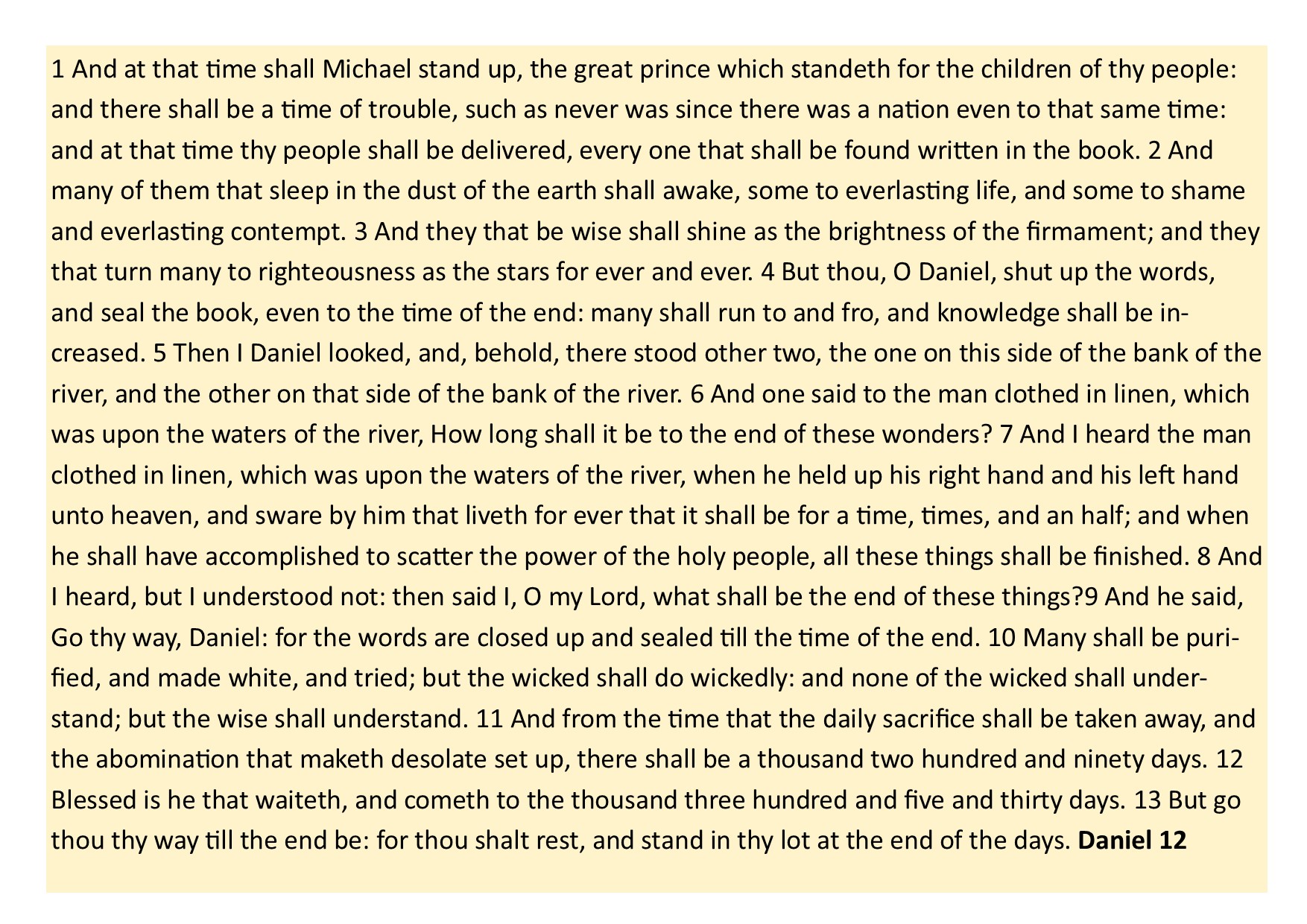
But we need now to wrap up and leave further reflections on Daniel’s prophecies for another time. But let what is said concerning Daniel and End Times, found in the final chapter of the Book of Daniel, be our last word and for it to an encouragement to those of us trying to relate Daniel’s prophecies to end times events, even if like me, despite several readings of Daniel and what respected Bible teachers have to say on the subject, there remains much we do not fully understand. Daniel had at best a glimpse into the future and while looking forward to the coming of Israel’s Messiah, he did not see there will be two comings. The second one is of particular prophetic interest as He sets up His righteous kingdom and those who along with Daniel can be there if by virtue of being among the “wise (that will) shine as the brightness of the firmament; and they that turn many to righteousness as the stars for ever and ever”.

 JRB Publications