
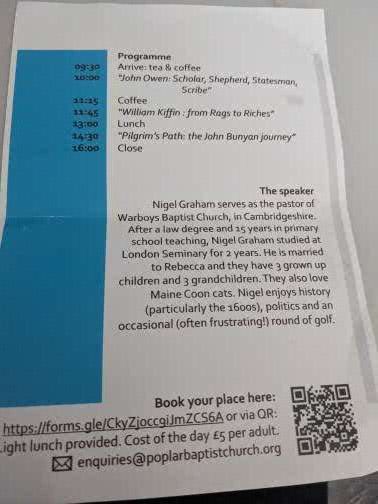
I recently attended a church history day conference titled “A Century of Faith: John Owen, William Kiffin and John Bunyan in the 1600’s” (see copy of flyer below for details). The conference was hosted by Poplar Baptist Church, London (see here for the Poplar website), and I attended along with some folk from my own Providence Baptist church. The speaker for each session was Nigel Graham, who is pastor of Warboys Baptist Church (see here for the Warboys website).
According to Wikipedia (I suggest that if you want to know all what Wikipedia usefully has to say about these men that you Google search each of the names and read the full Wikipedia article):

“John Owen (1616 – 24 August 1683) was an English Puritan Nonconformist church leader, theologian, and vice-chancellor of the University of Oxford. One of the most prominent theologians in England during his lifetime, Owen was a prolific author who wrote articles, treatises, Biblical commentaries, poetry, children’s catechisms, and other works …”
“William Kiffin (1616–1701), sometimes spelled William Kiffen, was a seventeenth-century English Baptist minister. He was also a successful merchant in the woollen trade …”
“John Bunyan (1628 – 31 August 1688) was an English writer and Puritan preacher. He is best remembered as the author of the Christian allegory The Pilgrim’s Progress, which also became an influential literary model. In addition to The Pilgrim’s Progress, Bunyan wrote nearly sixty titles, many of them expanded sermons …”
I don’t propose saying much else about these men other than point readers to the recordings (each around 40 minutes) that can be freely downloaded from the Poplar Baptist website:
- John Owen: Scholar, Shepherd, Statesman, Scribe (see here)
- William Kiffin: from Rags to Riches (see here)
- Pilgrim’s Path: the John Bunyan journey (see here)
Folk who know me will know I am a student of history, especially church history, including that relating to seventeenth century England, which just as in the sixteenth century was a period of religious turbulence yet with religion being afforded an important place in society, even if not the Bible based, God centred, call to holy living variety of the men we are considering here. Whoever was ruling at the time affected which brand of religion was in vogue or not and, given intolerance on matters of belief and practice was often a common theme, those who didn’t go along with what the secular powers that be considered as being acceptable they often ending up having to pay a heavy price for sticking to their guns.
Our three men lived through a period when their religious views concerning their various and often similar forms of Puritan belief (a term I am reluctant to define for in this case a Google search it will give confusing and often contradictory definitions and also there was a lot of variation in Puritan belief). As for my own theological perspective, the Puritan way of looking at things that was deeper than what most of us are exposed to was usually more right than wrong. Our three men and what they preached and practised was supported by Oliver Cromwell during “the Commonwealth” period from 1649 but not under Charles II from 1660, taking an opposite view, which followed, with later the more Protestant approach to religious observance after the Glorious Revolution in 1688.
Among those things that fascinated me was that they lived through times when their ministries was both welcomed and times when they were decidedly not welcomed (both Kiffin and Bunyan spent periods in prison under Charles II and James II because of the stands they made). They were first and foremost committed to the study of the Bible and carrying out what they learned. They all had pastors hearts, devoted to the spiritual and other care of others. Doctrinally, while there were differences in views on subjects like church government, open and closed communion, the prickly question of how to relate to those who rule over us which may not be sympathetic to our views, Calvinism and eschatology, many of which issues resonate today, they were devoted to pursuing godliness and truth and resisting the pressures to toe the line by those in power.
I hoped before attending that I would find out what these three men had to say that relates to my own situation and I would learn things I would not have had knowledge of. I was glad that this proved to be the case thanks to the able presentation of the speaker, although I felt there were further depths worth exploring if there had been time. I thank the folk at Poplar Baptist for putting on this event and making those who attended feel welcome. While those who attended did so because they were keen to learn, it struck me that here was a message that other members of the Baptist family and all true followers of Christ would have benefited from given the turbulent days in which we are living. There are lessons we can learn from studying the history of this period and the lives of these men so we may be encouraged to proclaim and live for Christ as a result.
 JRB Publications