
Just four days ago I posted my “Anthony Norris Groves (1795-1853) – Father of faith missions” article based on a book I had been reading by Robert Dann titled Anthony Norris Groves (1795-1853) – Father of faith missions that had dug deep telling us about the life and times of the man (ANG).

I received some positive feedback, especially concerning ANG’s India own connection and influence, notably on the Brethren movement, particularly in the southern states (Kerala, Tamil Nadu (TN) and Andhra Pradesh (AP)) where he had most input. All this is personally relevant as ANG’s India journey, particularly his first 14-month missionary fact finding one beginning at the end of 1833, after he had left Baghdad, which had certain parallels with my own, although I needed to read the book to find that out.

ANG never returned to Baghdad, even though he wanted to, and regretted he didn’t do so for reasons touched on in Dann’s book. Following his return to England at the end of ANG’s first India missionary journey, he was to spend the rest of his life ministering in India. It was a situation that he found more agreeable and more productive than the one he endured in Baghdad, although while that was his baptism of fire, given the many difficulties he faced and tried to overcome, that experience set the scene for his later work.
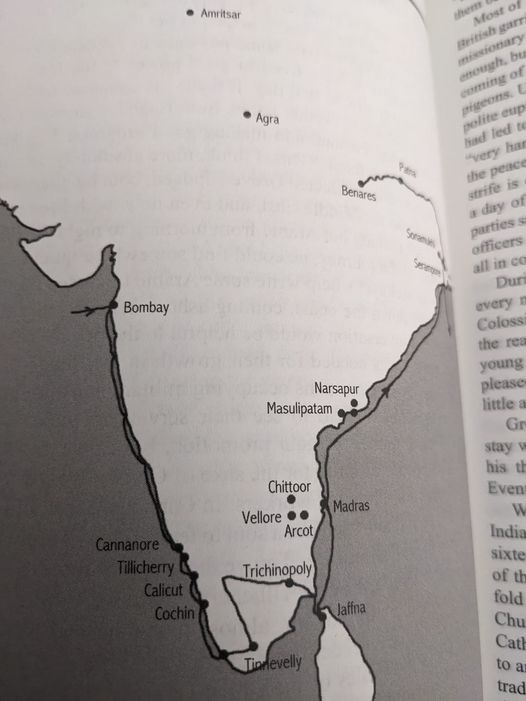
My light bulb moment that began to tie in what ANG did and my own India experience began in 1983 when I took the opportunity to explore India as a young, curious traveller, although the sub-continent had begun to fascinate me when I participated in an Operation Mobilisation summer crusade in 1970 just prior to starting out as a student at London University. I refer to the map of ANG’s first India missionary journey (from Dann’s book), relating his route to my own. My journey on that first India visit, followed by several subsequent visits, including various “Christian” involvement, covered a lot of the ground covered by ANG in his first missionary journey and some of his experiences resonated with my own.
It could be said that a lot of what ANG did on that first journey, besides meeting and encouraging Indian and expatriate Christians from different denominations, was by way of fact finding and networking. One hall mark of ANG’s approach was to associate with real Christians irrespective of church background and seeking ways to work and unite with them, although his efforts were spurned and shunned in certain quarters, notably because he refused the principle of ordination by church hierarchy, notably within Anglicanism. The knowledge he gained traveling from place to place and getting to meet Christians from different backgrounds and having different outlooks and theological perspectives was something that he was able to use when drumming up interest and support upon his return to the UK and afterward when he returned to India. During that first visit, ANG met many dedicated Christians including those who were intent on carrying out the Great Commission and making significant inroads doing so. He also saw the great need for workers and the enormous potential for mission.
With respect to the map, his India journey began in Bombay, where he traveled southwards by land and sea along the west coast unto near India’s southernmost tip before turning inland via Tinnevelly (a centre of fascinating interest that deserve its own account). He crossed the south of the eastern of India’s two Southern states, Tamil Nadu (the other being Kerala), including spending time in Ceylon (Sri Lanka), reaching and spending time in TN’s state capital (Madras). He then continued journeying, this time following India’s east coast, before ending up in Calcutta (which at the time was the capital of British India) where he established his base and from where he started his sea journey back to Britain. But not before visiting William Carey at his Serampore base just prior to the great man’s death (we find that ANG was impressed by the dedication of Carey and his Baptist associates in their missionary endeavours).

I make mention of the afore-mentioned route because it was in 1983 I landed in Bombay (Mumbai) (flying in from London). I also (as fate/divine providence had it) begun my India journey along India’s west coast (for me it was by train) ending up at Trivandrum (the capital of Kerala state), which is some 100 miles west of Tinnevelly. It was there I met my future father-in-law, Varghese Mathai (who I write about along with me early India experiences (see here)), a Brethren evangelist. One of his associates was O.J.John, who on that first visit was my guide exploring parts of Kerala and Tamil Nadu. On subsequent trips I re-visited some of the places I visited first time round and more of Kerala and Tamil Nadu. I also visited Madras and Calcutta and spent time in Andhra Pradesh and the fourth of India’s southern states, Karnataka. Throughout the many subsequent visits to India, I got to meet many wonderful Indian Christians, many possessing missionary zeal, notably within the Open Brethren set up that ANG would have been familiar with.
Today, concerning the Open Brethren (OB) assemblies in Kerala, TN and AP, each can be numbered in the several hundreds. Most, as far as I can make out, are going concerns and adopting the same principles laid out by the likes of Darby and Groves (including holding in tension the importance of being beholden to light and life in Brethren assembly life) going back to the 1830’s, functioning along more traditional OB lines but with a distinctive Indian outlook, despite importing some of the more questionable British OB fixations. One of the distinctive Indian OB traits is while each assembly is overseen by a plurality of elders, many employ (without paid salary but in accordance with ANG’s living by faith principles) evangelists, who do just that – evangelising, including unreached parts of India, notably in the Indian northern states where Christianity has had far less and impact compared to the South.
It would be impossible to say to what extent what we see today in Indian Christianity (where OBism is but a small part), can be credited to ANG and his legacy, especially as there have been many others involved, OB and others (not mentioned here due to lack of time, space and research) who have played important parts, including future generations influenced by ANG and his associates. One such was John Arulappan, an Indian who when as a young man came under ANG’s influence, who is afforded quite a lot of space in Dann’s biography and that of another ANG biographer, G.H.Lang. Arulappan was a key influencer in a revival in Tamil Nadu (we can read about in this fascinating account titled 1860 Christian Pettah Revival) that gave rise to the formation of several OB assemblies. One person that Arulappan helped to disciple was a man named Mathai who helped establish several OB Kerala assemblies.
There is much that can be said about Keralite OB Assembly life, some of which I have witnessed first hand, including attending the assembly my late father-in-law helped to establish during our recent 3-month India visit. In a short history titled HISTORY OF KERALA BRETHREN (see here) we can read about the subject, including the Groves – Arulappan – Mathai connection. Not part of the OB movement were the similar in style but stricter in practice churches established by Bahkt Singh. I recall my introduction to one of the churches in his networks, in Trivandrum, during my first India visit. When this newly converted Sikh man, now fired up to serve God, educated in the west, returned to India in the 1930’s, it was two grandsons of Arulappan that took him under their wing.
I recall visiting a number of Andhra Pradesh churches in the 1990’s and early 2000’s and noting a significant contrast with the OB assemblies I had found in Kerala. The latter, it seemed to me, had been infiltrated by western materialistic hedonism (many well educated Malayalees had gone to the UK and USA and established a comfortable life there). On that score, AP assemblies seemed less advanced and closer to their OB roots, noting it was in AP that ANG was largely based when he came to India for the second time.
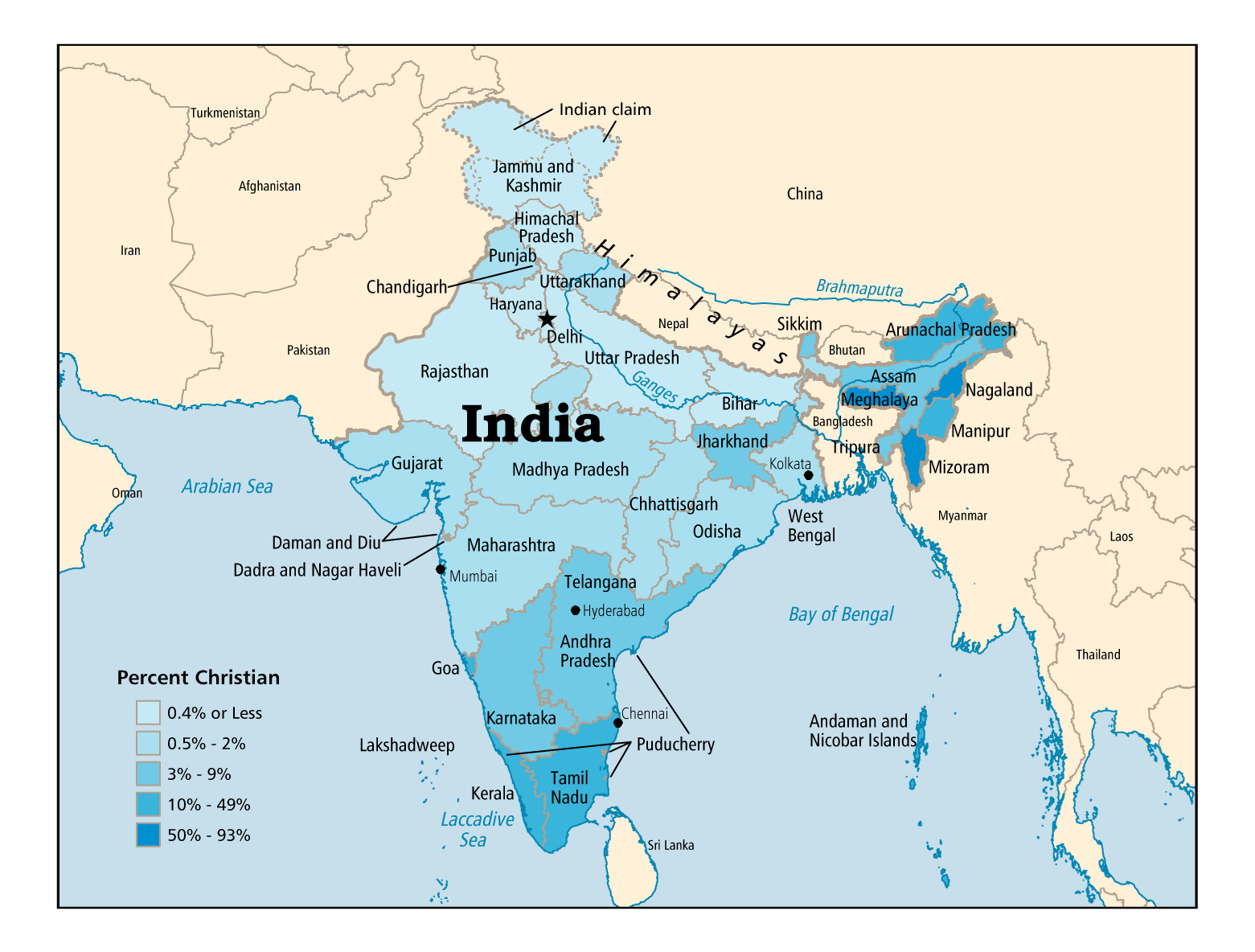
On my first day of the first of my many visits to India, I couldn’t help noticing the many people living on the streets surrounded by opulent dwellings. India is a fascinating country; it is one I have come to love; it is a land of enormous contrasts and many talented people. As for churches, the variety is as great as you might find anywhere in the world. It is a country dominated (according to government statistics) by Hindus (79.8%), followed by Muslims (14.2%) and Christians (2.3%). Often these groups peacefully co-exist, but there are many examples of minorities persecuted. Concerning Christians (Brethren and other) there are many examples, including those who followed the principles ANG laid out in his seminal writings: “Christian Devotedness” and went on to practice. Much can be said about this what is in effect a continent where 1.4 billion people live with 22 official languages besides Hindi and English, great variety of cultures and people groups as well as scenery that includes both beauty and squalor. The very helpful prayer guide, Operation World, provides many pertinent statistics and items for prayer (see here) concerning India.
It is full of useful information concerning individual states and prayer points, especially for the Christian witness. It begins: “In 2023, India surpassed China as the world’s most populous nation. India is therefore also the world’s largest democracy. Political, economic, and social challenges all place a heavy burden on the government. Pray that the government will choose to build on the progress of recent decades, especially to preserve and protect human dignity, rights, and freedoms. The current government has been operating on a Hindutva (Hindu nationalist) platform. This has brought about intensifying persecution of other religions, increasing re-Hinduization/reconversion of Dalit and tribal groups, and the introduction of many barriers of foreign Christian mission in India. The government’s aggressive stance to defend Hinduism – and persecute other faiths – has emboldened religious violence by radical Hindu groups“.
While ANG made a monumental contribution to Indian missionary endeavour, as did many, both foreigners and Indians, the need for mission remains enormous, but there are many in that great land, knowingly and unknowingly, who follow ANG’s example. As I said in my earlier ANG article, there is much we can pick up and follow from his life’s work. Three stood out for me. Firstly, was that he would look back on his life as a failure but was shown in Robert Dann’s book: the opposite was the case. Secondly, was that he practiced what he preached; he was faithful, godly and kind – the three things now in my dotage I see as being most important for Christian living. Thirdly, while he had strong and well thought out views concerning theology and while I have met many good Christians who would not have gone along with his views on ecclesiology and eschatology, he recognised the importance of true Christians showing true unity and while his overtures in that direction toward those not in his own theological stable were not always reciprocated, he sought to encourage and assist others. Speaking even more personally and having witnessed first hand numerous Christian fall outs, including in my own dealings, even among those reckoned to be in the sound and dedicated theological camp, I wonder if his greatest legacy is to do with his response to Jesus’ “pray that they will all be one” prayer found in John 17.

Two weeks ago, I delivered a 75-minute slide lecture on the life and work of Anthony Norris Groves. It was recorded, although only 40 minutes from that lecture was picked up and remains (see here).
 JRB Publications
Great article. I will share it in my Facebook profile.