
The following is the latest chapter to appear in my forthcoming book: “Priests of the Bible”.
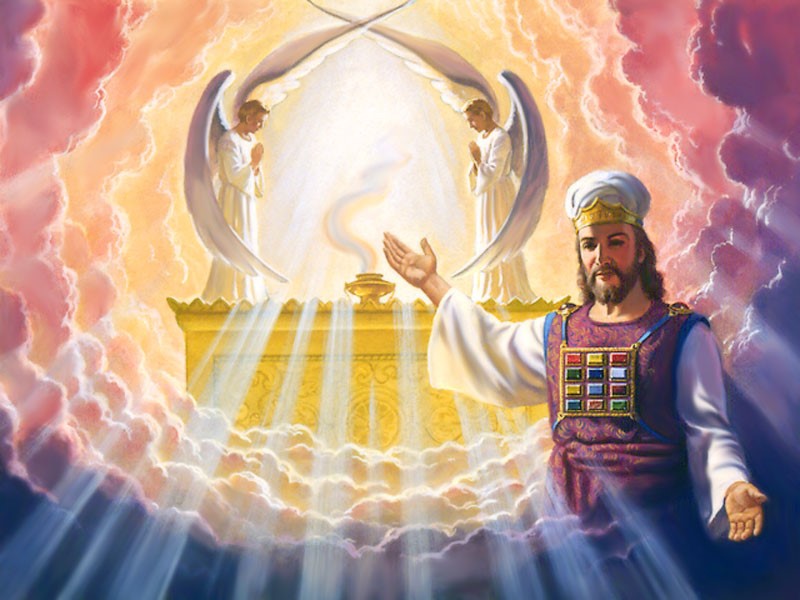
Chapter 19: Jesus our Great High Priest
In the Bible, especially the Old Testament, prophets, priests and kings played an important part and often interacted with and complemented one another. Jesus alone combined all three offices and did so perfectly, despite being rejected by His own people. He continues to do so. In both “Prophets of the Bible” and “Priests of the Bible”, “prophets, priests and kings” and relating to Jesus has been a recurring theme but in this chapter our focus is on priests, specifically Jesus our Great High Priest.
As a Prophet, Jesus called the world, particularly Israel, to turn from sin and return to God, and He was put to death for doing what all true prophets were called by God to do, which they did – which was to present the truth, which God deemed to be important, to the people, declaring what God thought and felt about what mattered, even when listeners found it to be unpalatable and then went on to reject both message and messenger. Crowds identified Him as “Jesus the prophet” (Matthew 21:11). He spoke of Himself as a Prophet: “No prophet is accepted in his own native place” (Luke 4:24). Among His prophecies, we find that a few days before His death that He foretold His death and resurrection (Matthew 16:21-28). The Olivet discourse in Matthew 24, which included predicting the destruction of the Temple, was pure prophecy. Whenever Jesus foretold the future, what he said always came to pass. Peter cited Moses when he preached Christ: “For Moses truly said unto the fathers, A prophet shall the Lord your God raise up unto you of your brethren” (Acts 3:22).
As a King, Jesus is spoken of as such in the Gospels. Gabriel announced to Mary that the Lord God would give to her son the throne of David His father, and He would rule over the house of Jacob for ever. Magi looked for a newborn King of the Jews, leading to Herod killing the baby boys in a fit of rage. When Jesus last entered Jerusalem, He fulfilled the prophecy “thy King cometh unto thee: he is just, and having salvation; lowly, and riding upon an ass” (Zechariah 9:9), as crowds hailed Him as their King. He was arrested and killed for declaring Himself to be King, and the soldiers mocked Him because of it. When Pilate asked if He was King of the Jews, Jesus replied, “You say so”. He clarified, “My kingdom does not belong to this world” (John 18:36). The charge written against Jesus was “Jesus the Nazarene, the King of the Jews”. Jesus announced the Kingdom of God. He is foretold as King: “In thy majesty ride prosperously because of truth and meekness and righteousness” (Psalm 45:4). His return is anticipated: “King of kings, and Lord of lords” (Revelation 19:16). When He returns to planet earth, we read “He shall rule them with a rod of iron” (Revelation 2:27).
In the New Testament, while we see glimpses of Jesus as Priest, for example in His prayer in John 17 that has been referred to as His High Priestly prayer, and there was another occasion a little prior to His death when Jesus prayed in the Garden of Gethsemane, we find, except for the Book of Hebrews, there is little explicitly that associates Jesus with the Priesthood. Therefore, it is to Hebrews we need to turn if we want to find out more. Here, He is presented as the Great High Priest and, through Him, believers are given direct access to God because of what He did by giving Himself as the all-sufficient, atoning sacrifice. Because of Him, man needs no other intermediary in order to approach God.
The letter to the Hebrews was written by an author unknown, to an audience unknown, although we know this was specifically to Jews who were well familiar with the Hebrew scriptures, which are frequently referred to. Hebrews can be looked upon as the New Testament counterpart to the Old Testament Book of Leviticus. The main theme of the letter is that you name it (e.g. angels, Moses) we find Jesus is better/superior. The main concern of the author of the letter was of readers falling away from their faith in Jesus, in the light of actual and threatened persecution, tempted by the prospect that if they were to renounce their faith and go back to Judaism things will become easier for them. While there are many topics covered in the letter, our focus will be on Jesus our Great High Priest, about which the epistle’s author has much to say. We will do so by considering each chapter in turn and what it has to say on the subject. Bear in mind, when making the case, the arguments used by the author are more likely to appeal to the Jewish way of thinking than to that of the Greek.
Chapter 1
Jesus is better – God’s final word
1 God, who at sundry times and in divers manners spake in time past unto the fathers by the prophets,
2 Hath in these last days spoken unto us by his Son, whom he hath appointed heir of all things, by whom also he made the worlds;
3 Who being the brightness of his glory, and the express image of his person, and upholding all things by the word of his power, when he had by himself purged our sins, sat down on the right hand of the Majesty on high:
4 Being made so much better than the angels, as he hath by inheritance obtained a more excellent name than they.
Hebrews hits the ground running as it begins by elevating Jesus as far above anyone or anything else, who is God’s Son, and by first making the point that Jesus, through whom God has spoken, is not an angel as might have been expected but, rather, someone who is better than the angels.
Chapter 2
The Salvation pioneer – Jesus made fully human
17 Wherefore in all things it behoved him to be made like unto his brethren, that he might be a merciful and faithful high priest in things pertaining to God, to make reconciliation for the sins of the people.
18 For in that he himself hath suffered being tempted, he is able to succour them that are tempted.
Jesus is fully human and can identify with His brethren. He is thus able to take on the responsibilities of the High Priest. Given He has been tempted, He is able to help others who have been tempted.
Chapter 3
The centrepiece of all what we believe – Jesus is greater than Moses
1 Wherefore, holy brethren, partakers of the heavenly calling, consider the Apostle and High Priest of our profession, Christ Jesus;
2 Who was faithful to him that appointed him, as also Moses was faithful in all his house.
3 For this man was counted worthy of more glory than Moses, inasmuch as he who hath builded the house hath more honour than the house.
Of all the characters of the Old Testament, Moses was probably considered the greatest among Jews, and for good reason, for it was through Moses the Covenant was given and the Law was received, yet Jesus is even greater, as much by virtue of Him being the Son, the ever-faithful High Priest.
Chapter 4
Jesus the Great High Priest
14 Seeing then that we have a great high priest, that is passed into the heavens, Jesus the Son of God, let us hold fast our profession.
15 For we have not an high priest which cannot be touched with the feeling of our infirmities; but was in all points tempted like as we are, yet without sin.
16 Let us therefore come boldly unto the throne of grace, that we may obtain mercy, and find grace to help in time of need.
We need to see that we have a great High Priest and take care to hold fast in matters pertaining to the faith and not to fall away. It is pertinent that Jesus can identify with our weakness but always without sin. As a result, we can always boldly approach the Throne of Grace.
Chapter 5
The High Priest who cried out in pain
1 For every high priest taken from among men is ordained for men in things pertaining to God, that he may offer both gifts and sacrifices for sins:
2 Who can have compassion on the ignorant, and on them that are out of the way; for that he himself also is compassed with infirmity.
3 And by reason hereof he ought, as for the people, so also for himself, to offer for sins.
4 And no man taketh this honour unto himself, but he that is called of God, as was Aaron.
5 So also Christ glorified not himself to be made an high priest; but he that said unto him, Thou art my Son, to day have I begotten thee.
6 As he saith also in another place, Thou art a priest for ever after the order of Melchisedec.
7 Who in the days of his flesh, when he had offered up prayers and supplications with strong crying and tears unto him that was able to save him from death, and was heard in that he feared;
8 Though he were a Son, yet learned he obedience by the things which he suffered;
9 And being made perfect, he became the author of eternal salvation unto all them that obey him;
10 Called of God an high priest after the order of Melchisedec.
Among the features of the Aaronic priesthood, these included priests needing to make offerings for their own sins as well as for the sins of the people, and since themselves were sinful by nature they could empathise with those they serve, whilst having been called to the priesthood by God. Jesus was ordained a Melchisedec priest (as foretold in Psalm 110). We are reminded how Jesus prayed “let this cup pass from me” when praying in the Garden of Gethsemane, just prior to His arrest.
Chapter 6
God gave His Word – the certainty of God’s Promise
16 For men verily swear by the greater: and an oath for confirmation is to them an end of all strife.
17 Wherein God, willing more abundantly to shew unto the heirs of promise the immutability of his counsel, confirmed it by an oath:
18 That by two immutable things, in which it was impossible for God to lie, we might have a strong consolation, who have fled for refuge to lay hold upon the hope set before us:
19 Which hope we have as an anchor of the soul, both sure and stedfast, and which entereth into that within the veil;
20 Whither the forerunner is for us entered, even Jesus, made an high priest for ever after the order of Melchisedec.
We who have run for our very lives to God have every reason to grab the promised hope with both hands and never let go. It’s an unbreakable spiritual lifeline, reaching past all appearances right to the very presence of God where Jesus, running on ahead of us, has taken up his permanent post as high priest for us, that of the order of Melchizedek. We can base this sure and steadfast hope on the fact that God has so promised and God never breaks his promises.
Chapter 7
Jesus is likened to Melchizedek, a permanent priest of God
21 (For those priests were made without an oath; but this with an oath by him that said unto him, The Lord sware and will not repent, Thou art a priest for ever after the order of Melchisedec:)
22 By so much was Jesus made a surety of a better testament.
23 And they truly were many priests, because they were not suffered to continue by reason of death:
24 But this man, because he continueth ever, hath an unchangeable priesthood.
25 Wherefore he is able also to save them to the uttermost that come unto God by him, seeing he ever liveth to make intercession for them.
26 For such an high priest became us, who is holy, harmless, undefiled, separate from sinners, and made higher than the heavens;
27 Who needeth not daily, as those high priests, to offer up sacrifice, first for his own sins, and then for the people’s: for this he did once, when he offered up himself.
28 For the law maketh men high priests which have infirmity; but the word of the oath, which was since the law, maketh the Son, who is consecrated for evermore.
In so many ways, what the priesthood Jesus represents is better than the Aaronic priesthood. Firstly, there was one oath and that was enough – that of Jesus being a priest of the order of Melchisedec. Secondly, His priesthood is permanent – Jesus never dies and always intercedes on our behalf. Thirdly, His once and for all sacrifice was all sufficient for us to be able to come before God.
Chapter 8
The High Priest of a new covenant – a new plan for Israel
1 Now of the things which we have spoken this is the sum: We have such an high priest, who is set on the right hand of the throne of the Majesty in the heavens;
2 A minister of the sanctuary, and of the true tabernacle, which the Lord pitched, and not man.
3 For every high priest is ordained to offer gifts and sacrifices: wherefore it is of necessity that this man have somewhat also to offer.
4 For if he were on earth, he should not be a priest, seeing that there are priests that offer gifts according to the law:
5 Who serve unto the example and shadow of heavenly things, as Moses was admonished of God when he was about to make the tabernacle: for, See, saith he, that thou make all things according to the pattern shewed to thee in the mount.
6 But now hath he obtained a more excellent ministry, by how much also he is the mediator of a better covenant, which was established upon better promises.
We are reminded that Jesus is the mediator of the better covenant. There was nothing wrong with the one given to Moses, who faithfully followed all God’s instructions, in the setting up an earthly tabernacle from when the priests ministered, along with gifts and offerings. But this is was a mere example and shadow of the better covenant with better promises that Jesus was a mediator of.
Chapter 9
A visible parable pointing to the realities of Heaven
11 But Christ being come an high priest of good things to come, by a greater and more perfect tabernacle, not made with hands, that is to say, not of this building;
12 Neither by the blood of goats and calves, but by his own blood he entered in once into the holy place, having obtained eternal redemption for us.
13 For if the blood of bulls and of goats, and the ashes of an heifer sprinkling the unclean, sanctifieth to the purifying of the flesh:
14 How much more shall the blood of Christ, who through the eternal Spirit offered himself without spot to God, purge your conscience from dead works to serve the living God?
15 And for this cause he is the mediator of the new testament, that by means of death, for the redemption of the transgressions that were under the first testament, they which are called might receive the promise of eternal inheritance.
24 For Christ is not entered into the holy places made with hands, which are the figures of the true; but into heaven itself, now to appear in the presence of God for us:
25 Nor yet that he should offer himself often, as the high priest entereth into the holy place every year with blood of others;
26 For then must he often have suffered since the foundation of the world: but now once in the end of the world hath he appeared to put away sin by the sacrifice of himself.
27 And as it is appointed unto men once to die, but after this the judgment:
28 So Christ was once offered to bear the sins of many; and unto them that look for him shall he appear the second time without sin unto salvation.
The all sufficiency of what Jesus did was when he shed His own precious blood. When we consider the Tabernacle, the various items of furniture and what went on there concerning gifts and sacrifices, including importantly what took place on the Day of Atonement, all this is relevant when it comes to our reflecting on what Christ has done, but what took place then was never enough. His sacrifice was God’s solution to the sin problem and in making the way open for our salvation.
Chapter 10
The Sacrifice of Jesus – once and for all
19 Having therefore, brethren, boldness to enter into the holiest by the blood of Jesus,
20 By a new and living way, which he hath consecrated for us, through the veil, that is to say, his flesh;
21 And having an high priest over the house of God;
22 Let us draw near with a true heart in full assurance of faith, having our hearts sprinkled from an evil conscience, and our bodies washed with pure water.
23 Let us hold fast the profession of our faith without wavering; (for he is faithful that promised;)
In the light of all that has been said concerning Jesus our Great High Priest, it is imperative that we hang in there. Moreover, we can do what only the High Priest could do under the Old Covenant and that is to enter into the Holy of Holies. We can do so boldly because all the requirements of the Law were met by Jesus, who is our Great High Priest.
Chapter 11
Faith in action
1 Now faith is the substance of things hoped for, the evidence of things not seen.
2 For by it the elders obtained a good report.
3 Through faith we understand that the worlds were framed by the word of God, so that things which are seen were not made of things which do appear.
Chapter 12
Discipline in a long-distance race and an unshakable kingdom
12 Wherefore lift up the hands which hang down, and the feeble knees;
13 And make straight paths for your feet, lest that which is lame be turned out of the way; but let it rather be healed.
14 Follow peace with all men, and holiness, without which no man shall see the Lord:
Chapter 13
Concluding exhortations, encouragements and a final benediction
12 Wherefore Jesus also, that he might sanctify the people with his own blood, suffered without the gate.
13 Let us go forth therefore unto him without the camp, bearing his reproach.
14 For here have we no continuing city, but we seek one to come.
20 Now the God of peace, that brought again from the dead our Lord Jesus, that great shepherd of the sheep, through the blood of the everlasting covenant,
21 Make you perfect in every good work to do his will, working in you that which is well pleasing in his sight, through Jesus Christ; to whom be glory for ever and ever. Amen.
What we have done is, at best, to offer a brief exposition of a profound doctrine that has enormous practical implications. While Chapters 11 – 13 say little about Jesus the Great High Priest per se, the outstanding doctrine that is covered in the preceding chapters, we refer to these in order to present a complete albeit brief coverage of every chapter contained in the Letter to the Hebrews. The Hall of Faith chapter (11), and those giving exhortations and encouragement (12,13), and especially those words concerning going Outside the Camp that is a subject that will be covered in Chapter 56 and is a part of the author’s own testimony, are some of the applications we can find in the light of what had been written prior – all lessons to take away because of Jesus our Great High Priest.
We end on a note of praise, giving the Anglican, Irish-American, lady hymn writer, Charitie Lees Bancroft (1841–1923), the last word on this amazing subject of Jesus our great High Priest:
1 Before the throne of God above
I have a strong and perfect plea,
a great High Priest whose name is “Love,”
who ever lives and pleads for me.
My name is graven on His hands;
my name is written on His heart;
I know that while in heav’n He stands,
no tongue can bid me thence depart;
no tongue can bid me thence depart.
2 When Satan tempts me to despair,
and tells me of the guilt within,
upward I look and see Him there
who made an end of all my sin.
Because the sinless Savior died,
my sinful soul is counted free;
for God the Just is satisfied
to look on Him and pardon me;
to look on Him and pardon me.
3 Behold Him there, the risen Lamb!
My perfect, spotless Righteousness;
the great unchangeable I AM,
the King of glory and of grace!
One with Himself I cannot die;
my soul is purchased with His blood;
my life is hid with Christ on high,
with Christ my Savior and my God;
with Christ my Savior and my God!
 JRB Publications