
The following is the draft of the latest installment of my forthcoming book “Priests of the Bible”, written on this most holy of days in the Jewish calendar – The Day of Atonement. Be aware this is but one piece in the big jigsaw. For the whole, check out various chapters posted on my blog and my book when it is out.
Chapter 11: The Day of Atonement
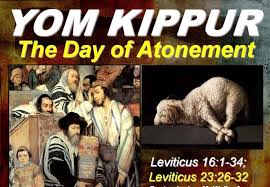
Having in Chapter 10 considered the various Jewish feasts mandated in Leviticus 23, along with others that came about since, i.e. Purim and Hanukkah, along with their prophetic significance and links with the Levitical Priesthood, in this chapter we consider one them – The Day of Atonement (Yom Kippur) in greater depth, concentrating on Leviticus 16, which details what happened on that day. It is not that the other feasts do not merit special attention but Yom Kippur is especially important here given it is this feast more than any other that the High Priest has such a prominent role. A deeper understanding of the significance of this particular feast helps us to better understand Jesus, our Great High Priest, and the plan of salvation that God had in mind ever since (and even before) the creation of man.
Before we draw lessons from our study of this subject, we must do a detailed examination of what took place on the Day of Atonement, based on what is written in Leviticus 16, and the writings of those who have insights into what happened.
SACRIFICES FOR THE DAY OF ATONEMENT (16:1-11)
- God spoke to Moses following the death of Aaron’s 2 sons in the Tabernacle (Leviticus 10) and told him to instruct Aaron not to enter the Most Holy Place except under specific conditions.
- When the time came for Aaron to enter the Most Holy Place, he was to clothe himself in the priestly garments that were specified and take a bull for a sin offering and a ram for a burnt offering to the Tabernacle.
- That priestly garment was not the beautiful attire described in our Chapter 6, which would be word on all other occasions when ministering in the Tabernacle, but rather a plainer affair, indicative that Aaron was one sinner entering God’s presence on behalf of other sinners.
- From the people, he was to take two male goats, one of which was for a sin offering, and a ram for a burnt offering.
- The bull was to be offered as a sin offering for Aaron’s house.
- Aaron was then to take the two goats and cast lots over them.
- The goat which was selected by the lot was used as a sin offering.
- The other was presented to the Lord to make atonement and then set free into the wilderness.
THE HIGH PRIEST ENTERS THE MOST HOLY PLACE (16:12-28)
- Aaron was to take fire from the bronze altar and burn two handfuls of incense in front of the Most Holy Place so that the smoke covered the mercy seat.
- He was then to take some of the bull’s blood on his finger and sprinkle it on and in front of the mercy seat.
- The goat for the sin offering was to be killed and its blood sprinkled in the same way.
- By doing this the high priest made “atonement” for the sins of himself, his house, and all the people of Israel. The fact the high priest was not killed by God, indicated God’s acceptance.
- No one but the high priest was allowed in the Tabernacle while this was happening.
- When this was complete, Aaron was to put some of the blood on the bronze altar to atone for it, just as he had atoned for the Most Holy Place and the rest of the Tabernacle.
- Then Aaron was to take the second goat, the one on which the lot had not fallen, and confess all the sins of Israel over it while his hands were on its head.
- God said: “The goat shall bear all their iniquities on itself to a remote area, and he shall let the goat go free in the wilderness.”
- Following this, Aaron was to bathe himself and put on his regular High Priestly garments and offer the burnt offering for himself and the burnt offering for the nation.
- The man who took the goat out into the wilderness was to bathe himself before he was permitted to re-enter the camp.
A STATUTE FOREVER (16:29-34)
- This day of atonement (known today as Yom Kippur) was to be observed by the Jews every year on the 10th day of the 7th month.
- They were to “afflict” themselves and become sad and mourn for all past wrongdoings.
- They were to abstain from ordinary work on that day.
- The word afflict (Hebrew anah) means to be bowed down or humbled (often associated with fasting), a recurring theme in Jewish life (e.g. Deuteronomy 8:1-3, Ezra 8:21, Psalm 36:13).
- The day was dedicated to their cleansing from sin.
It is worth mentioning the Scapegoat (see Figure x, Chapter 3). The Scapegoat is referred to in other chapters of this book. Just like the goat chosen by lot is a type of Christ (a sacrifice for sin) so is the goat released into the wilderness having had the sins of the people transferred to it. Jesus was literally made the scapegoat for our sins when He was sentenced to die. We follow Christ when we obey – “Let us go forth therefore unto him without the camp, bearing his reproach” Hebrews 13:13.
As we reflect on how we might apply the lessons taught in Leviticus 16, which are reinforced throughout the Bible, it is worth reflecting on the psalm that David wrote when the prophet Nathan came to and confronted him after David had committed adultery with Bathsheba and murdered her husband, Uriah the Hittite: “Have mercy upon me, O God, according to thy lovingkindness: according unto the multitude of thy tender mercies blot out my transgressions. Wash me throughly from mine iniquity, and cleanse me from my sin. For I acknowledge my transgressions: and my sin is ever before me … For thou desirest not sacrifice; else would I give it: thou delightest not in burnt offering. The sacrifices of God are a broken spirit: a broken and a contrite heart, O God, thou wilt not despise. Do good in thy good pleasure unto Zion: build thou the walls of Jerusalem” Psalm 51:1-3;16-18.
If we need an example of what to do and what to pray as we consider these matters, we do well to consider the prayer of the prophet Daniel that he prayed as an old man, by way of an example: “And I set my face unto the Lord God, to seek by prayer and supplications, with fasting, and sackcloth, and ashes: And I prayed unto the Lord my God, and made my confession, and said, O Lord, the great and dreadful God, keeping the covenant and mercy to them that love him, and to them that keep his commandments; We have sinned, and have committed iniquity, and have done wickedly, and have rebelled, even by departing from thy precepts and from thy judgments: Neither have we hearkened unto thy servants the prophets, which spake in thy name to our kings, our princes, and our fathers, and to all the people of the land. O Lord, righteousness belongeth unto thee, but unto us confusion of faces, as at this day; to the men of Judah, and to the inhabitants of Jerusalem, and unto all Israel, that are near, and that are far off, through all the countries whither thou hast driven them, because of their trespass that they have trespassed against thee. O Lord, to us belongeth confusion of face, to our kings, to our princes, and to our fathers, because we have sinned against thee. To the Lord our God belong mercies and forgivenesses, though we have rebelled against him; Neither have we obeyed the voice of the Lord our God, to walk in his laws, which he set before us by his servants the prophets. Yea, all Israel have transgressed thy law, even by departing, that they might not obey thy voice; therefore the curse is poured upon us, and the oath that is written in the law of Moses the servant of God, because we have sinned against him. And he hath confirmed his words, which he spake against us, and against our judges that judged us, by bringing upon us a great evil: for under the whole heaven hath not been done as hath been done upon Jerusalem. As it is written in the law of Moses, all this evil is come upon us: yet made we not our prayer before the Lord our God, that we might turn from our iniquities, and understand thy truth” Daniel 9:3-13.
It is a mistake of much of contemporary Christianity that we do not mourn over all the things going on in the world that are not what God has intended, even though He allows it and we wonder why He does. There is much else we could and ought to mourn over, e.g. broken relationships and our part in it. It is true that followers of Jesus are under Grace rather than under Law, but we would be remiss if we do not anah ourselves for what we see going on around us and where this leads (as did Daniel) and it is a probably a reason why we do not see the Shekhinah glory and the power of the Holy Ghost today. And of course, it goes beyond affliction, prayer and fasting, for it should lead us into action.
While there is no requirement for Christians, especially Gentiles, to even needing to recognise the Day of Atonement in their own practice, but when the Day of Atonement comes round (this chapter was purposefully written on that day in 2023), and even though our sins may not fall into the category of adultery and murder, it is nigh certain, nevertheless (and while this is not the place to list them, this author can think of many he has committed), we have sinned and we need to repent and ask for forgiveness. We do well to reflect and do all that is implied in anah (afflicted, humbled).
The wonderful news is while this celebration of this feast, which is anything but a feast in the commonly understood sense, is not mandated, our Great High Priest (Jesus – assuming we are one of His followers) fully atones for our sins (something we remember when we take communion). It is why we have written a chapter that is dedicated to this feast in particular, since it sets the scene for when we come to “Chapter 19: Jesus our Great High Priest”, who amazingly is both priest and sacrifice. “And if any man sin, we have an advocate with the Father, Jesus Christ the righteous: and he is the propitiation for our sins: and not for our’s only, but also for the sins of the whole world” 1 John 2:1-2.
Throughout writing “Priests of the Bible” it has been evident that even among genuine Christians there are a range of views, ranging from antipathy and indifference to enthusiasm and interest, and nowhere is this more evident than when it comes to the Feats of YHWH. Some hardly know or care about Yom Kippur or the other feasts, arguing they are New Testament people. Others pay careful attention, including being afflicted and humbled on Yom Kippur and celebrating the other Feasts of YHWH and ignoring traditional “Christian” feasts, e.g. when it comes to celebrating Christmas, Easter etc. It is not the author’s intention to persuade readers where on the spectrum of interest/indifference their actions should lie. Yet for this author, especially in the light of researching this book, it has been a time of sober reflection, not just lamenting his own sins committed since last Yom Kippur but also those of people in his orbit, including those who have hurt and wronged him and others, and his own culpability, doing so in the spirit of forgiveness and desire for reconciliation. Additionally, the manifold evil that is so evident in the world is recognised which, while he may not have been able to stop, he might have played a bigger part in resisting it – which could/should give rise to anah (afflicted).
In closing this chapter, we turn our attention to those to whom the Feast of Atonement, along with other feasts, was directed – the Jewish people. Without wanting to be over simplistic, it appears that, on this their most sacred day of the year, most celebrate Yom Kippur with the Yom (Day) but without the Kippur (Atonement), which in the eyes of many thoughtful onlookers might render whatever they put in place of what would have once taken place in the Temple, which hasn’t been around for almost 2000 years, somewhat meaningless. Which brings us to the prophet, Hosea. We argued in Chapter 10 that the Feasts had a prophetic significance. Again, without wanting to be simplistic, when considering the prophetic significance of the seven identified Feasts of YHWH, the first four, (Spring) Feasts: Passover, Unleavened Bread, First Fruits and Pentecost, were more to do with Jesus’ first coming and the last three, (Autumn) Feasts: Trumpets, Day of Atonement, Tabernacles, with His second coming. In the passage we now quote, we are reminded how Hosea was told to love his wife who had betrayed him by her promiscuity (just as Israel had betrayed God), but looking forward to the future, a time that can only occur with the Second Coming of Israel’s messiah, when Israel will return to YHWH their God. They will do so initially with weeping, as they come to realise how they have rejected their Messiah, which will be replaced with joy when they are reconciled and fall in love with Him.
“Then said the Lord unto me, Go yet, love a woman beloved of her friend, yet an adulteress, according to the love of the Lord toward the children of Israel, who look to other gods, and love flagons of wine. So I bought her to me for fifteen pieces of silver, and for an homer of barley, and an half homer of barley: And I said unto her, Thou shalt abide for me many days; thou shalt not play the harlot, and thou shalt not be for another man: so will I also be for thee. For the children of Israel shall abide many days without a king, and without a prince, and without a sacrifice, and without an image, and without an ephod, and without teraphim: Afterward shall the children of Israel return, and seek the Lord their God, and David their king; and shall fear the Lord and his goodness in the latter days” Hosea 3:1-5.
On the face of it, the prophetic fulfilment of Yom Kippur happened when Jesus died on the Cross and the Veil of the Temple was torn from top to the bottom and so revealed that His once and for all sacrifice had made full atonement for sin, for all those believe on him. But most of Israel fail/failed to see it, but one day they will, and in their time of greatest need. For this we turn to Zechariah, another prophet: “In that day shall the Lord defend the inhabitants of Jerusalem; and he that is feeble among them at that day shall be as David; and the house of David shall be as God, as the angel of the Lord before them. And it shall come to pass in that day, that I will seek to destroy all the nations that come against Jerusalem. And I will pour upon the house of David, and upon the inhabitants of Jerusalem, the spirit of grace and of supplications: and they shall look upon me whom they have pierced, and they shall mourn for him, as one mourneth for his only son, and shall be in bitterness for him, as one that is in bitterness for his firstborn … In that day there shall be a fountain opened to the house of David and to the inhabitants of Jerusalem for sin and for uncleanness.” Zechariah 12:8-10, 13:1.
Could this be the time when we see the full prophetic fulfilment of Yom Kippur? Yet that is not the end – for when we read further in Zechariah and consider Israel’s blessings in Christ’s millennial reign, it is not the sixth Feast of YHWH (Yom Kippur) that will be celebrated but the seventh (Tabernacles) and whatever some may think about celebrating feasts, this is one feast that all will celebrate: “And it shall come to pass, that every one that is left of all the nations which came against Jerusalem shall even go up from year to year to worship the King, the Lord of hosts, and to keep the feast of tabernacles. And it shall be, that whoso will not come up of all the families of the earth unto Jerusalem to worship the King, the Lord of hosts, even upon them shall be no rain” Zechariah 14:16,17.
It is by design that the three Autumn Feasts of YHWH were very close to each other timewise and just as there is a sequence with the four Spring feasts this is also the case with the three Autumn feasts.
- Trumpets (Rosh Hashanah) – 7th Month, 1st Day – Repentance
- Day of Atonement (Yom Kippur) – 7th Month, 10th Day – Forgiveness
- Tabernacles (Sukkot) – 7th Month, 15th – 21st Day – Messiah
The great theme of Rosh Hashanah is repentance, and the overarching theme is that of forgiveness. The first day of Rosh Hashanah begins a ten-day season of repentance, often called the Ten Days of Awe by the Jewish people. These ten days conclude with the observance of the Day of Atonement.
But let us end, not on a note of affliction and mourning but rather on one of joy and jubilation when consider what John saw in his Revelation as he looked into the future and what is to happen in the heavenly realm: “After this I beheld, and, lo, a great multitude, which no man could number, of all nations, and kindreds, and people, and tongues, stood before the throne, and before the Lamb, clothed with white robes, and palms in their hands; And cried with a loud voice, saying, Salvation to our God which sitteth upon the throne, and unto the Lamb. And all the angels stood round about the throne, and about the elders and the four beasts, and fell before the throne on their faces, and worshipped God, Saying, Amen: Blessing, and glory, and wisdom, and thanksgiving, and honour, and power, and might, be unto our God for ever and ever. Amen. And one of the elders answered, saying unto me, What are these which are arrayed in white robes? and whence came they? And I said unto him, Sir, thou knowest. And he said to me, These are they which came out of great tribulation, and have washed their robes, and made them white in the blood of the Lamb. Therefore are they before the throne of God, and serve him day and night in his temple: and he that sitteth on the throne shall dwell among them. They shall hunger no more, neither thirst any more; neither shall the sun light on them, nor any heat. For the Lamb which is in the midst of the throne shall feed them, and shall lead them unto living fountains of waters: and God shall wipe away all tears from their eyes” Revelation 17:9-17
 JRB Publications