
What follows is the latest instalment of my “Priests of the Bible” project, where we consider our subject from a New Testament perspective.

We have come a long way from the time of Adam and Eve in the Garden of Eden, when there was no need for priests and they were able to access God directly. We have considered the time before God instructed Moses to set up the priestly system overseen by the tribe of Levi, when the likes of Noah, Job, Abraham, Isaac and Jacob all offered animal sacrifices and while there was a brief interlude as we are introduced to the Melchizedek priesthood, the main focus as far as the Old Testament was concerned was Aaron and his descendants that served as priests in the Tabernacle and later Temple.
While priests and the priesthood dominated the Jewish religion, it had undergone huge changes by the time we get to the New Testament. When we began our priesthood journey, having considered the Law and the Covenant (Chapter 4), we find in Chapters 5 through to 11 that things appeared to be simpler and more straightforward during the time when Israel travelled in the Wilderness and settled in Caanan under the leadership of Joshua, with the Priests who were assisted by the Levites being the central “religious” figures and the Tabernacle being the principal place of worship.
Then there was the building of the First Temple (Chapter 14) and, after a period of exile with the priesthood temporarily suspended (given there was no Temple), that of the Second Temple (Chapter 15) when there was a lot more to take note of when it came to religious practice and the way priests and Levites operated and new players, such as Scribes and various religious factions. There is also the prospect of a to be built Third Temple (Chapter 18). The various extensions to the way Judaism was carried out and the divergence seen at the end of the Old Testament continued during the Inter-Testament period (Chapter 16), bringing us to the time of Jesus, of whom we read: “But when the fulness of the time was come, God sent forth his Son, made of a woman, made under the law, to redeem them that were under the law, that we might receive the adoption of sons” Galatians 4:4-5.
The first thing that might strike us was that Jesus, all of His disciples and most of His followers while on earth were faithful Jews who did what was required by the Jewish Law, starting with his parents: Joseph and Mary. We read soon after Jesus birth and His circumcision on the eighth day “And he came by the Spirit into the temple: and when the parents brought in the child Jesus, to do for him after the custom of the law” Luke 2:37 and when He was 12 and went with His parents to Jerusalem to celebrate the Passover: “And it came to pass, that after three days they found him in the temple, sitting in the midst of the doctors, both hearing them, and asking them questions” Luke 2:47.
Concerning Jesus followers, following Jesus ascended into heaven and the pouring out of the Holy Spirit on the Day of Pentecost we read: “And they, continuing daily with one accord in the temple, and breaking bread from house to house, did eat their meat with gladness and singleness of heart” Acts 2:46 and “Now Peter and John went up together into the temple at the hour of prayer, being the ninth hour” Acts 3:1. Notwithstanding that synagogues were to have a greater role, a trend that began when the Jews were in exile in Babylon, the Temple was still the main place of religious devotion, at least until the time it became clear Christ followers were no longer welcomed.
One point that we will return to in Chapter 54, for example, is in order to have a complete understanding of the purposes of God, we need to be familiar with the contents of both Old and New Testament and take up the counsel offered in Chapter 2 concerning background and context. While somewhat simplistic, there is nevertheless certain truth in the claim that the Old Testament is a Jewish book and the New Testament is a Christian book. While Jews are encouraged to study the New Testament, not just because it tells us things necessary for salvation, but it answers many of the questions raised in the Old Testament. Similarly, for Christians to come to a fuller understanding and appreciation of the Gospel, they do well to go back to its root that is found in the Old Testament.
But back to the question what had changed by the time we get to the New Testament, we do well to consider changes listed under “Point 6” at the end of Chapter 16, which opened up this subject:
Priests
While Priests like Caiaphas and Ananias are given a bad press because of their opposition to Jesus and Paul respectively, others such as Zacharias (father of John the Baptist) can be looked on more positively as discussed in Part 3 of this book. Moreover, we read that “a great company of the priests were obedient to the faith” Acts 6:7. Because of the power exercised by secular authorities, such as King Herod, to appoint priests, they chose those they could control. Those who became High Priest were generally of a low calibre spiritually when it came to being aligned with the will of God. Chief priests, along with scribes, just like Pharisees and Sadducees, not only tended to oppose Jesus and His disciples that later followed, but they had the political clout to carry out their threats.
Scribes
The organization of scribes, referred to several times in the New Testament, can be seen as far back as the time of Ezra (who is referred to both as a priest and scribe). Baruch, Jeremiah’s faithful assistant, was also a scribe (Jeremiah 36:32). They were highly educated men, trained to write. At first, they were merely transcribers of God’s law and synagogue readers, but later they became interpreters of God’s law whose responsibility was to teach the Torah and received prominence as Judaism became more pre-occupied with applying the Law rather than the system of Tabernacle / Temple worship laid out in the Books of Exodus and Leviticus and later Chronicles. Scribes produced legal documents, recorded deeds, and acted as notary public and court secretary.
Rome
Judah, after having been under the control of Babylon, Persia and Greece, ended up under the control of Rome. While Rome could be ruthless when it came to putting down rebellion and insisting its subjects adhere to its laws e.g. paying taxes (something we find Jesus, Peter and Paul exhorting Christ followers to do) they, in the main, allowed its Jewish subjects considerable freedom when it came to the practice of their religion, and delegated certain powers to Jewish religious authorities when it came to regulating its own affairs. They also brought in a measure of peace and stability, along with roads and major infrastructure projects, which proved beneficial in spreading the Word.
The Herod dynasty
While Israel was ruled from Rome, under a succession of Roman governors, notably Pontius Pilate, who condemned Jesus to death, they also installed their own puppet kings, who were given power and authority over the people and land they reigned over – as long as they were in line with their Roman overlords. This was done through the Herod dynasty, beginning with Herod the Great (72BC – 4BC). The Herod dynasty were Edomites that had converted to Judaism and were able to gain favour from the Romans. There were several Herods mentioned in the Bible and all undertook acts of wickedness, starting with killing baby boys when Jesus was born. While not trusted by the Jewish inhabitants, they undertook several building projects, notably the re-building of the Second Temple, which took place during the period 20 BC to 63 AD, in order to help to placate their subjects.
The Sanhedrin
The term Sanhedrin is from a Greek word that means “assembly” or “council” and dates from the Hellenistic period, but the concept is one that goes back to the Torah when God commanded Moses: “bring me seventy of Israel’s elders who are known to you as leaders and officials among the people. Have them come to the Tent of Meeting, that they may stand there with you” (Numbers 11:16). Also, “You shall appoint for yourselves judges and officers in all your towns which the Lord your God is giving you, according to your tribes and they shall judge the people with righteous judgment” Deuteronomy 16:18. Within the land there were local courts, also referred to as Sanhedrin. The Great Sanhedrin was the supreme court during the Second Temple period, made up of 70 men and the high priest. In the Second Temple period, the Great Sanhedrin met in the Temple in Jerusalem. The court convened every day except festivals and on the Sabbath. As far of the New Testament is concerned this Sanhedrin played a major role in the condemnation of Jesus and later Stephen.
Religious groupings
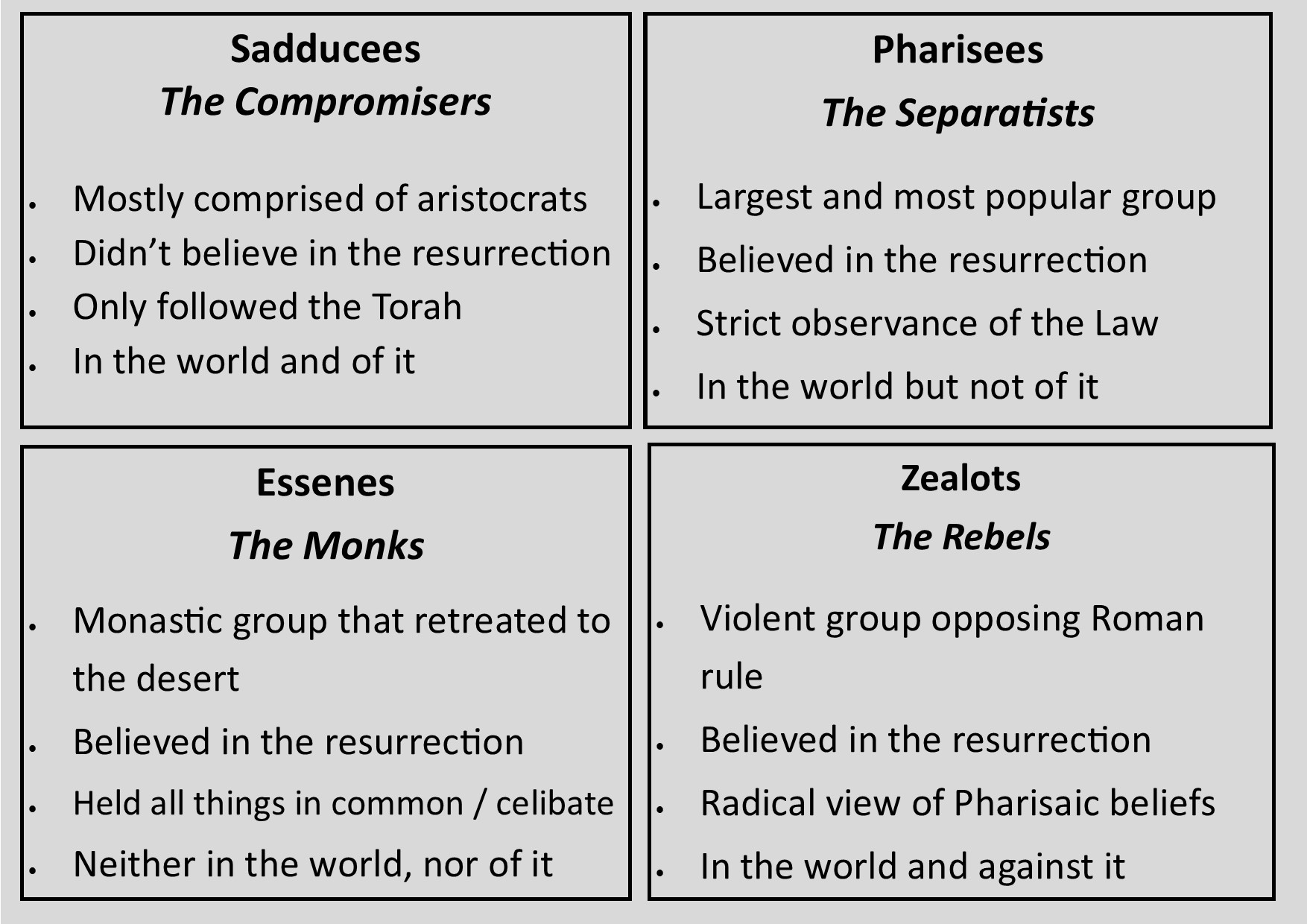
In Chapter 16, we identified the emergence of four groupings within Judaism (check out Chapter xx, Figure xx for what these each stood for): Pharisees, Sadducees, Zealots and Essenes. We read in the New Testament Jesus frequently coming in contact with two of these groups. While certain contact was positive, e.g. in the case of Nicodemus, much of it was antagonistic, both groups seeing Jesus as a threat despite strongly disagreeing theologically and eventually ganging up together to see Jesus removed. One cannot help but see parallels with today’s religious situation and see their emergence as a response to successively being ruled by Babylon, Persia, Greece and Rome. While not much is said about the Zealots and Essenes, these two groups played an important part in Judaism.
The Temple
Despite the religious activities going on, the Temple was the centre of Jewish religious life and the priests still continued to make a very important contribution to that life. The New Testament records several occasions when Jesus and His disciples entered the Temple and partook of the services held there. The rebuilt Second Temple under the Herod dynasty was a magnificent construction, although its destruction by the Romans in AD 70, in response to a Jewish led revolt, proved a major turning point in the way Judaism operated. The Priesthood and the sacrificial system ceased, although other religious leaders continued. Prayer took the place of sacrifice, and worship was rebuilt around rabbis who acted as teachers and leaders of individual communities, often based around synagogues.
The Synagogue
According to one definition, a synagogue is a building in which Jewish people worship and study their religion, in much the same way that churches are seen to do in Christianity and mosques in Islam. We see the emergence of synagogues during the period of Exile when there was no Temple and their numerical growth on return from exile and during Inter-Testament times, which brings us to New Testament times. We see several accounts of Jesus and His disciples, notably Paul, preaching the ”Good News” in synagogues and engaging with the people. While this was an opportunity to share the Gospel message, there was also sometimes a hostile reaction. We read in Luke 4:16 how early on in Jesus’ ministry, when he preached at his home synagogue in Nazareth on Isaiah 61, this caused an angry reaction from among those who listened, who sought to throw Him out of the city.
The Samaritans
According to Wikipedia: “Samaritans are an ethnoreligious group who originate from the ancient Israelites. They are native to the Levant and adhere to Samaritanism, an Abrahamic and ethnic religion similar to Judaism, but differing in several important aspects. Samaritan tradition claims the group descends from the northern Israelite tribes who were not deported by the Neo-Assyrian Empire after the destruction of the Kingdom of Israel. They consider Samaritanism to be the true religion of the ancient Israelites and regard Judaism as a closely related but altered religion. Samaritans also regard Mount Gerizim (near both Nablus and biblical Shechem), and not the Temple Mount in Jerusalem, to be the holiest place on Earth”.
We will touch on Samaritans with respect to those Jews returning from exile to settle back in their land, also occupied by Samaritans, when we consider Eliashib in Chapter 34 and Ezra in Chapter 35. When it comes to the New Testament there are many references to Samaritans and these are not accidental, especially in the light of the antipathy Jews and Samaritans had for each other. Three incidents involving Jesus show us how He reached out to Samaritans when fellow Jews failed to do so. There was his encounter with the woman at the well, which begins “Then cometh he to a city of Samaria, which is called Sychar, near to the parcel of ground that Jacob gave to his son Joseph. Now Jacob’s well was there. Jesus therefore, being wearied with his journey, sat thus on the well: and it was about the sixth hour”. Then there was the Parable of the Good Samaritan (Luke 10:29-37). It wasn’t the priest or Levite who helped the chap who had been mugged but rather the Samaritan. Then there was the healing of the ten lepers (Luke 17:11-19), where it was the Samaritan that gave thanks. It is noteworthy that when Jesus told His disciples: “But ye shall receive power, after that the Holy Ghost is come upon you: and ye shall be witnesses unto me both in Jerusalem, and in all Judaea, and in Samaria, and unto the uttermost part of the earth” (Acts 1:8) that between telling the good news to the Jews and other Gentiles they needed to go to Samaria – which the disciples did!
A Personal Perspective
We have deliberately written chapters in this Part 1 and Part 2 to follow in the third person so as not to personalise matters and help us focus on God and what He thinks. But having elaborated on those points raised in Chapter 16 the author requests reader forbearance when it comes to sharing a personal perspective. When the Preacher declared “there is nothing new under the sun” Ecclesiastes 1:9, it seems in a strange way many of these observations can be seen in today’s church and world.
Consider the four stand-out religious groupings: Pharisees, Sadducees, Zealots and Essenes. We see their like today. As a “conservative” Christian, it is easy to be dismissive of the Sadducee liberal equivalent that have both compromised by following the way of the world and dismissing essential beliefs and, if it weren’t for the fact Pharisees are also portrayed as the bad guys, we would admire their sticking to their guns regarding fundamental doctrine. Their problem and one that also helps to give today’s conservatives a bad press is they were legalistic and not loving, including adding stuff not in the scriptures and neglecting the Spirit of the Law as seen in the command to “Love Thy Neighbour”. When we consider Jesus and the interactions He had with the Pharisees and Sadducees of His day, His biggest complaint was their replacing the more important Spirit of the Law with the less important Letter of the Law, including adding laws, to the point of obsession, not in the Torah.
As for today’s zealots, many have been rightly accused of being overzealous when a more winsome approach might be more appropriate but, even so, zeal (for God’s glory) is much lacking and needed. As for Essenes, the history of the church contains many accounts of the Christian equivalent – monks and the like, who chose a life of quiet contemplation and withdrawal from worldly pre-occupations and at the same time were able to serve the poor and vulnerable in their communities. But as in all things, while spirituality is better than worldliness, we are left in the world in order to do good.
In order to apply the lessons to today’s fractured Christian community, we might conclude every faction has something of merit to offer and none of them get everything right, whether those more conservatively inclined with their entrenched positions in the light of an anti-God culture and a church establishment intent on appeasing the powers that be, along with those zealous, even more conservative types, and today’s Essenes who do their utmost to withdraw from the world. As for the Liberals, including those once labelled Evangelical, a religion of pick and mix is not the way to go!
“In for a penny, in for a pound” – having ventured a personal perspective, another pertinent one that is related to the subject matter of this chapter is that of Jewish verses Greek mindset. David Pawson, who has already been cited as a helpful source for research purposes, even though there will be points that the author and some readers would rightly take issue with, often lamented concerning the extent of Greek influence on today’s church, and this to the detriment of Jewish influence. The seed had already been sown before the church, when the Greek empire emerged during the Inter Testament period. The object as far as this particular personal perspective goes is not to go into ins and outs of what the author recognises as being a valid concern but rather to make two main points.
Firstly, while it is regrettable that Jews, especially those of the Orthodox variety, who go to great pains to maintain their cultural identity, being prepared and having had to pay the price for that identity, have also been barking up the wrong tree when it comes to their fixation on practices not mandated by the Torah and failing to recognise their Messiah, as identified in Isaiah 53. Secondly, there is understandably a backlash by those in the minority Messianic, Evangelical Christian camp against those in the majority, who typically do not give Israel and its religious observances much credence, Christian camp, who uncritically take on board an assortment of Hellenistic influences. YHWH is more interested that we adopt His ways and there is nothing in the Bible to insist men, for example, wear Kippah/Yarmulke head caps or adopt Jewish speak in their communications. As for Christmas/Easter verses Passover/Tabernacles, freedom of choice ought to be the watchword.
Transitioning for Judaism to Christianity
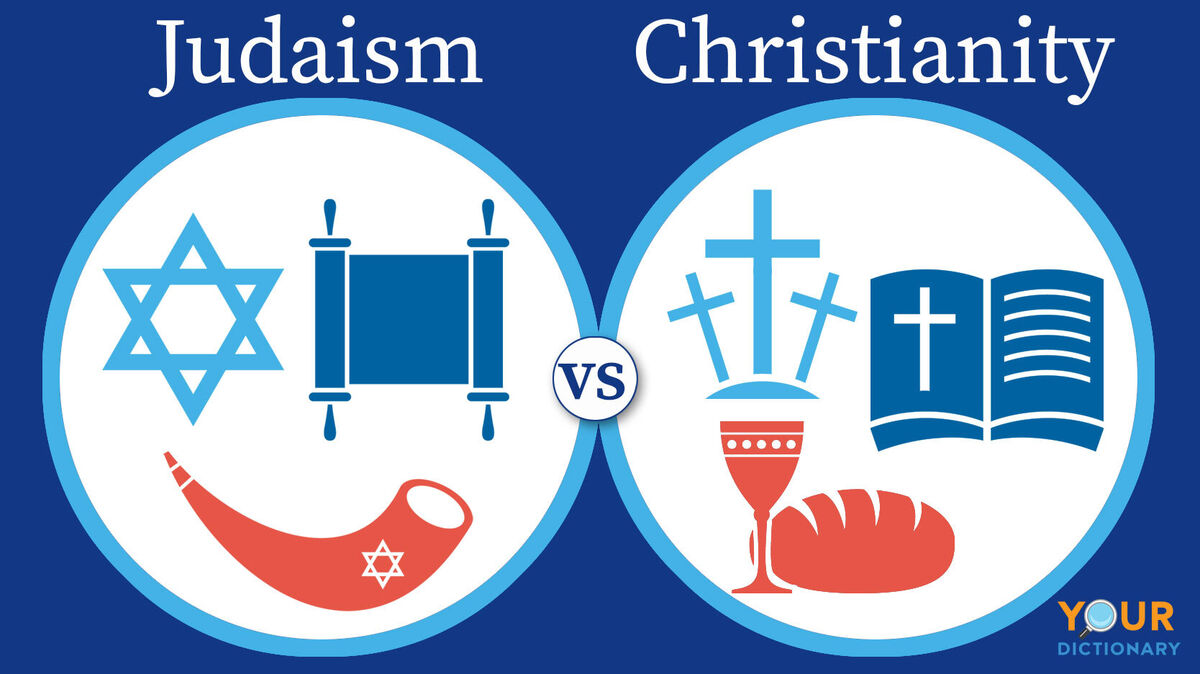
We end this chapter by considering the question that the Early Church needed to deal with and one which Paul wrestled with, for example in his letter to the Galatians: whether or not in order to become a Christian one first needs to become a Jew? This question has huge ramifications and it would be easy to go off on several tangents. To prevent doing so, we need to be brought back to the main focus of this book: The Priesthood (Part 1), The Priests (Part 2) and A Priestly People (Part 3).
When the Church was supposed to have begun, on that first Day of Pentecost, following Jesus’ Ascension, it was almost exclusively Jewish in composition. But Jesus had commanded His disciples to preach the Gospel to the whole world, which was almost all Gentile. Peter needed a vision from God in order to get on with the task and making his first Gentile convert, Cornelius, detailed as in Acts 10. But controversy soon followed when it was argued that in order to be a faithful Christian one needed to first be a faithful Jew. Even today, the extent to which Gentile believers need to adopt Jewish ways has remained a contentious one and as with all subjects a right balance is needed, remembering Paul’s words on the subject: “Stand fast therefore in the liberty wherewith Christ hath made us free, and be not entangled again with the yoke of bondage” Galatians 5:1.
It is the author’s belief that a lack of understanding of “Jewish ways” (as well as Hebrew scriptures), and adapting to a culture more in line with Greek thinking, has been to the church’s detriment. But back to that early controversy, this led to the Council of Jerusalem, as detailed in Acts 15, which following prayerful deliberation, culminated in a declaration by the Apostles and leaders of the church, followed by a letter to “whoever it may concern”, which included the words “For it seemed good to the Holy Ghost, and to us, to lay upon you no greater burden than these necessary things; That ye abstain from meats offered to idols, and from blood, and from things strangled, and from fornication: from which if ye keep yourselves, ye shall do well” Acts 15:28,29.
The trend from then onwards was instead of the Church comprising pre-dominantly of Jewish believers, it would become dominated by Gentile believers, and increasingly those having little connection with Jewish culture and Hebrew scriptures, which is overwhelmingly the position today. Also, from early in church history there was a move toward leading church figures, e.g. Justin Martyr, Marcion and Augustine of Hippo advocating replacement theology, the Church has replaced Israel. This is not the platform to reflect deeply on Israel other than to refer readers to the author’s book “Prophets of the Bible”, which includes several examples of yet to be fulfilled prophecy concerning Israel and to declare Israel has not been replaced and still has an important place in God’s plans, especially when it comes to “Last Things” prophecy and events (also discussed in Chapter 46).
Attitudes to Israel vary considerably among Christians, including a view of perhaps the majority of Christendom that Israel has been replaced by the Church. How this author sees things is that the Church is distinct from Israel but has not replaced it. There are Jews who follow Jesus, and might be seen as being in both camps, but most do not. Others are religious, but often it is an empty shell that is unacceptable to YHWH, and all need the Gospel (Romans 1:16). As for the good and bad guys on the world stage, the situation is complex – neither is it Israel can do no wrong as some have us believe, especially given the unprovoked onslaughts it has had to face from many of the world powers, nor is it that Israel are purely targets/victims given their oppression of the Palestinians.
While outside the scope of this book, the author has argued in his other writings, such as the blog section of his website, that world affairs are often orchestrated by a satanic inspired, tiny, cabal, some of who are highly placed Jews (in name only, in the mould of King Herod). His belief is that while unbelieving Israel will be subject to even more trials and tribulations (e.g. “the time of Jacob’s trouble” (Jeremiah 30:6-8)) its future is nevertheless a bright one and he shares Paul’s concern, who wrote: “my heart’s desire and prayer to God for Israel is, that they might be saved” Romans 10:1.
Related to this and partly covered in “Prophets of the Bible” is the place of Israel in today’s world. The author has noted a range of views among thoughtful, sincere Christians, ranging from Israel being replaced by the church to Israel occupying centre stage in God’s plans and purposes, especially after the Church has been raptured. Another consideration where there are extremes of views is at one extreme there are those who hold to the notion that Israel can do no wrong to others who when it comes to contentious questions, such as the Palestinian one, Israel are the wrong doers.
The author can only re-iterate his views and concerns that most of today’s Jews are unsaved and like unsaved Gentiles they are sinners needing to repent else face God’s judgment, for they have also rejected Yeshua their mashiach, who “came unto his own, and his own received him not” John 1:11. As well as corrupt elements who pass as Jews but are more like those who we read of who are of “the synagogue of Satan”, Revelation 3:9, there are many non-believing Jews who seek to do the right thing, often inspired by their religious traditions and Hebrew scriptures. Also, Jews have both had to suffer unspeakable and undeniable persecution down the last two millennia and, while antisemitism still exists, some accused of being antisemitic for political reasons have merely criticised Israel (often for valid reasons), in the same way others might concerning other nations.
Besides believing there will be a time of Jacob’s trouble the author believes the rebirth of Israel as a nation in 1948 was a fulfilment of prophecy, opening the way for many other end time prophecies to be fulfilled. Israel’s ability to withstand aggression, typically from surrounding Arab nations, often against great odds, was in part as a result of divine protection. Israel taking centre stage in future wars to take place before Jesus returns and their suffering under the Antichrist are to be expected. As for present day Israel, the author’s observation is that it is largely characterised by unbelief.
When it comes to religious observance, it is not Gods Law (the Torah) that the religiously inclined Jew typically gravitates toward but rather it is man’s flawed interpretation of that Law, led by the post Temple replacement to the priests (rabbis) – the Talmud. The system in place today is not so dissimilar to one that Jesus encountered – religion without YHWH or a distorted view of Him. As far as most of today’s Jews are concerned, a spiritual blindness has fell upon them and the historical tragedy has been that many elements of the professing church have failed to reach Jews for Jesus.
Besides looking forward to the fulfilment of Paul’s “they might be saved” prayer there are the words of the prophet “And I will pour upon the house of David, and upon the inhabitants of Jerusalem, the spirit of grace and of supplications: and they shall look upon me whom they have pierced, and they shall mourn for him, as one mourneth for his only son, and shall be in bitterness for him, as one that is in bitterness for his firstborn” Zechariah 12:10. And of course, there is Israel taking centre stage during Jesus’ millennial reign, which will bring in a time of peace, righteousness and justice and for the first time, following the Fall (of Adam), the good guys will be in the ascendancy.
In winding up this particular section, we point to the teaching of Paul to the Romans. Having, in chapters 1 to 8, brilliantly set out many of the great doctrines of the Christian faith that were beloved of the Reformers, for example, he turns his attention to Israel, something many of those same Reformers tended to downplay and even rationalise with notions of “Replacement theology”. While we live in the time of the Gentiles, God has not forgotten or replaced the descendants of Abraham or reneged on His promised, and their time will surely come.
“Boast not against the branches. But if thou boast, thou bearest not the root, but the root thee. Thou wilt say then, The branches were broken off, that I might be grafted in. Well; because of unbelief they were broken off, and thou standest by faith. Be not highminded, but fear: For if God spared not the natural branches, take heed lest he also spare not thee. Behold therefore the goodness and severity of God: on them which fell, severity; but toward thee, goodness, if thou continue in his goodness: otherwise thou also shalt be cut off. And they also, if they abide not still in unbelief, shall be grafted in: for God is able to graft them in again. For if thou wert cut out of the olive tree which is wild by nature, and wert grafted contrary to nature into a good olive tree: how much more shall these, which be the natural branches, be grafted into their own olive tree? For I would not, brethren, that ye should be ignorant of this mystery, lest ye should be wise in your own conceits; that blindness in part is happened to Israel, until the fulness of the Gentiles be come in. And so all Israel shall be saved: as it is written, There shall come out of Sion the Deliverer, and shall turn away ungodliness from Jacob: For this is my covenant unto them, when I shall take away their sins” Romans 11:18-27.
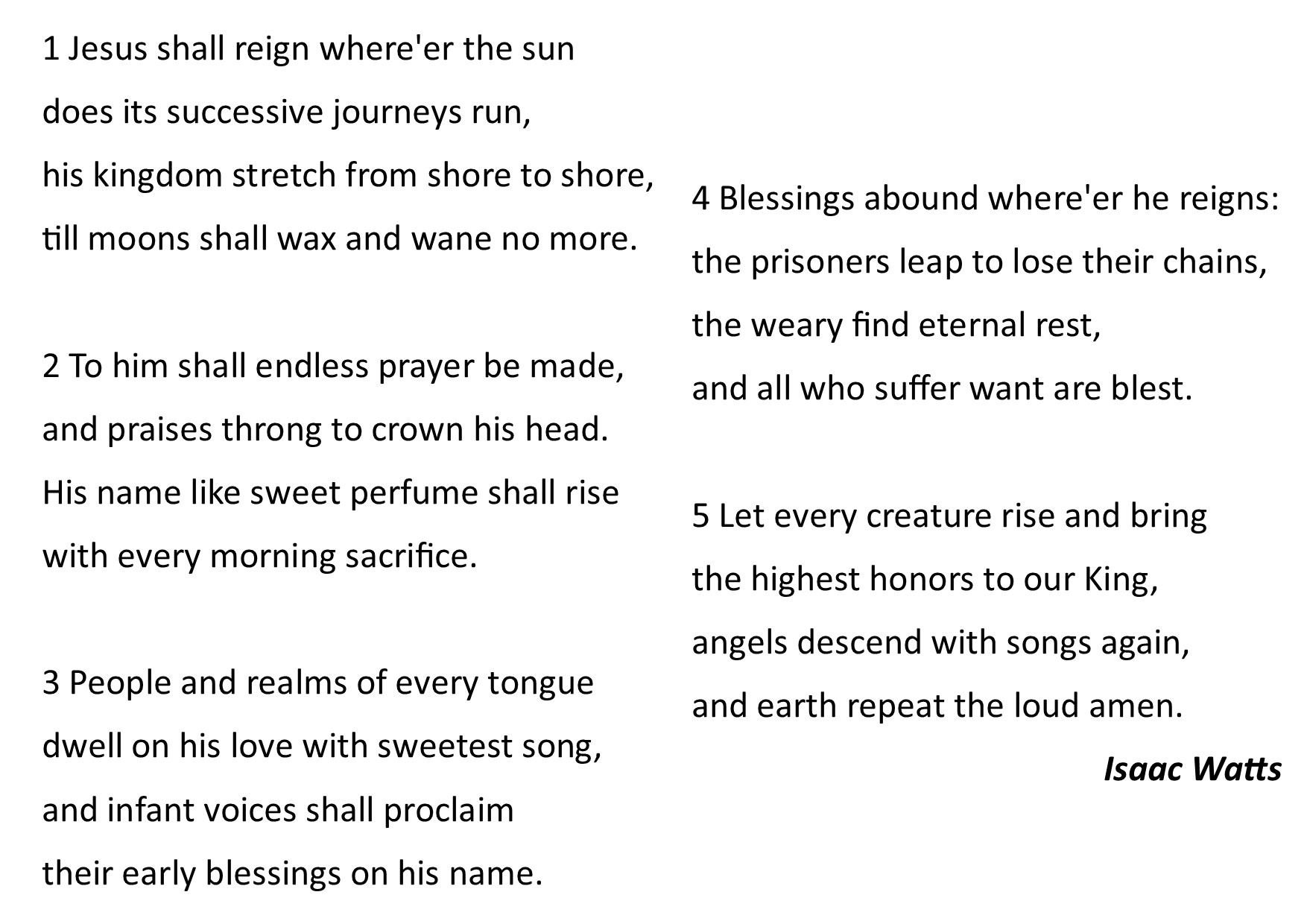
The point to make here is that those of us who are Gentile believers have been grafted into our Jewish roots partakers of the promise God made to Abraham, Isaac and Jacob and have NOT replaced them. How all this pans out in the future is addressed partly in “Prophets of the Bible”. The next big event in God’s calendar, that we can look forward to, is the Second Coming of the Lord Jesus Christ and after that the millennium, when Israel plays a major part. We can join the hymn writer:
In short, the future of Israel is a bright one and the promises made to Abraham 4000 years ago will be fully fulfilled and for that we give God all the glory.
 JRB Publications