
Today, I want to talk about an elephant that could have been found in many of the rooms I have been in.

But as often is the case when, as often I do, I tread where angels fear to go, something has energised my soul, in this case to write on this awkward subject of hell. I recently posted a meme on my Facebook page that got three friends to react strongly because it brought up the subject of hell, even though the meme was about a lot more than this. As is my custom, I often share stuff that strikes me as pertinent I invite folk who follow me to ponder, even though another friend (maybe wisely) suggested in this case I would have been better advised not to have brought up this subject on social media.
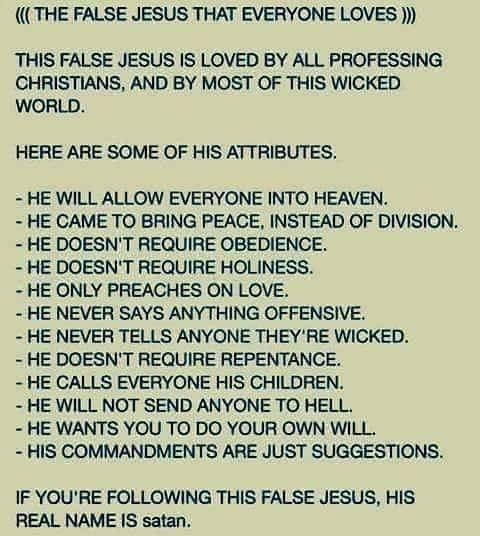
My point, and I find it relates to a thought process I sense in many people who claim to be Christians subscribe to, is they have a false understanding of what the true Jesus taught, why He went to the Cross to die for our sins, and why it is of paramount importance to preach the good news of the Gospel to all nations, given what they believe is contrary to what the Bible teaches. I take the Bible to be the Word of God, notwithstanding errors in translation and many interpretations by the great and learned, and is therefore true and binding. The meme lists twelve attributes of the false Jesus (which the meme writer calls Satan) but only one of these statements makes mention of Hell. Ironically, the one that did, on reflection, I found I did not entirely agree with. Rather than “He will not send anyone to Hell”, a more accurate way of stating the truth might be “God doesn’t send anyone to Hell; we send ourselves to Hell, he allows us free choice”. I believe Hell is a real place, and one to be avoided. I suspect too that, unlike with previous generations, the modern one finds the notion of Hell particularly disagreeable.
The word “Hell” is mentioned 54 times in the King James Bible and covers more than one word in the original Hebrew and Greek. There are many more mentions of that which alludes to Hell and words and phrases that may be taken as being related, like condemnation, judgement and “Lake of Fire”. What I am not going to do is a deep dive into what I believe is a correct theological understanding of what the Bible teaches about Hell. It is not that I can’t or I am afraid to “go there” (given I am writing on a sensitive subject, if spoken about in some polite Christian circles could get me thrown out, being proof). I would need to spend a lot more time and effort to do the theology justice, yet the subject is important as it relates to the most important subject I have ever written about on my website – the “Gospel”. As Christians, we should be in the truth business, and we should not ignore this elephant in the room
Before I get going, I want to share a personal experience that I don’t recall having ever written about, and yet it is pertinent to this particular elephant in the room. I remember clearly the day, forty years ago, when I was informed my dad had died in a road accident. I loved my dad and my dad loved me. Hardly a day goes by when I don’t think about him. I think of someone who had his struggles with such things as alcohol and low self-esteem, and some of this has been passed onto me. But most of all, I wonder if he was a true follower of Jesus, which my early mentors insisted was an essential pre-requisite to enter heaven. The thought of me going there and not seeing dad I found and still find abhorrent. I also recall the first service I attended after my dad’s death. In it, the well-meaning and popular preacher preached on the subject of heaven. I don’t recall the details of what was said but I do the preacher’s statement along the lines “heaven is something to look forward to because there we will be reunited with the late dear Uncle Bert and Aunt Doris”. The resultant effect was the very opposite to what the preacher had intended in his sermon. As for comforting me, he definitely did not.
One of my favourite ever preachers, widely considered sound in his preaching, was John Stott. My understanding was he believed in annihilationism, which is the belief that after the Last Judgment, all damned humans and fallen angels, including Satan, will be totally destroyed. Checking up on what Stott believed, I found the statement (see here) “Emotionally, I find the concept {of eternal conscious torment} intolerable and do not understand how people can live with it without either cauterizing their feelings or cracking under the strain. But our emotions are a fluctuating, unreliable guide to truth and must not be exalted to the place of supreme authority in determining it . . . my question must be—and is—not what does my heart tell me, but what does God’s word say?” Another all-time favourite preacher, J.I.Packer (see here), while not sharing Stott’s views on annihilationism, wrote sympathetically.
I am seeing a wide discrepancy in what Christians believe, even to the extent of there being two distinct camps. Some have a literal, orthodox understanding, as encapsulated in the Apostle’s Creed and the Nicene Creed (camp 1) and others who differ in many regards, including beliefs that are depicted in the meme that sparked off this article (camp 2). The accusation against camp 1 is they are prickly, judgemental, intolerant, narrow-minded and unloving, whereas those in camp 2 are the opposite. Here, I confess there is some truth in the assertion and I would take the criticism to heart personally. Yet, I have seen plenty of evidence of true followers of Jesus who combine strict adherence to truth to being the best people who I have ever come across in my short sojourn here on planet earth.
If I were God and it was down to me, I would make what happens after we die dependent on what we do while alive, on how well we lived. Like Buddhism, we get reincarnated into something else, according to how well we have fared. I have attended many funerals (and even taken some). Most have been Christian leaning where, regardless of what the deceased person believed etc., it included them going to a better place (heaven). I have a certain respect though for humanist types, who hold to the idea when one is dead that is it but something of the essence of the deceased persons character lives on, even affecting those yet to be born. I also have some respect for arguments like those put forward by the likes of Richard Dawkins in his book “The God Delusion” whereby the God, portrayed in the Bible, does not make sense morally. An argument, I don’t recall Dawkins making, was David’s choice of punishment when it became evident he had called for a census against God’s wishes. David chose three days of a pestilence from which many died, most having had nothing to do with David’s sin.
There is a lot about God I do not understand and neither did Abraham. We read how God shared with Abraham how He was going to destroy Sodom and Gomorrah. In the discussion that followed, Abraham tried to beat God down such that He would not destroy the two cities if a certain number of righteous people were to be found living in them. In the end Abraham had to conclude “Shall not the Judge of all the earth do right?” And here I leave it, despite holding to traditional church teaching on the subject of Hell, insofar it is what the Bible teaches. Whether my dad, those who have never heard the gospel, the innocent (especially minors), adherents to other religions, people who have lived selflessly for others etc. but without any religious belief, or everyone else, I can only go along with what Abraham concluded and end with the well-known and well-loved verse often quoted by Christian preachers …

 JRB Publications
It is so good to hear something that is rarely quoted, Genesis 18: 25.
I love this verse. It is always good to remind myself that yes, the Judge of all the earth will ALWAYS do right.