
Chapter 4: Moses, the Law and the Covenant
In the last chapter, we find the Children of Israel encamped around Mount Sinai, and would do so for the best part of a year. That period is covered right through the Book of Exodus, onto the Book of Leviticus and into the first ten chapters of the Book of Numbers. Then they move on toward their destination, occupying the Promised Land. The rest of Numbers describes the rest of their journey. Deuteronomy, right at the end is by way of a recap of what Israelites did and needed to do going forward. For the story of what happened when possessing the land, we turn to the Book of Joshua. The journey should have taken them less than a year but instead it took them thirty-eight and a bit years and meant a whole generation being first wiped out, all because of Israel’s disobedience.
We can summarize some of the timeline of some of salient events during the Wilderness journey:
- Passover (Exodus 12) – (1st year, 1st month, 15th day)
- Arrive at Sinai (Exodus 19:1) – (1st year, 4th month, 1st day)
- Leave Sinai (Numbers 10:11) – (2nd year, 2nd month, 20th day)
- Cross Jordan (Joshua 4:19) – (41st year, 1st month, 10th day)
Moses went up on Mount Sinai several times to meet God and receive instructions, as recorded in Exodus 19 and through to the end of the book. Depending on what we can deduce from the text, Moses climbed Sinai some eight times to meet with the Lord. During which time we read of:
The giving of the Law, which covered principles, such as:
- the rule and norm for God’s holiness was God’s Law
- the need for moral purity, actual and ritual
- everyone, high and low, were considered as equal under the Law
- penalties for breaking the Law
- governing all aspects of life for Israel
- providing for ways to settle disputes
- addressing issues like hygiene, social justice, sexual morality, family life, dealing with the poor and foreigners
- how to treat employees who are fellow Hebrews
- how to deal with people (and animals) who inflict various kinds of personal injury
- how to deal with thefts and negligence concerning other people’s property
- how to act responsibly towards women, widows, orphans and aliens
- how to ensure justice, especially for the poor and for foreigners
- how to celebrate God’s involvement in community life by leaving the land uncultivated every seventh year so that the poor could benefit
The establishment of the Covenant in which promised God would look after, protect and bless His special people – Israel, provided they obeyed the Law that God gave to them, all of which Israel agreed to do.
The establishment of the Priesthood (elaborated upon in Chapters 8, 9 and 10).
The commissioning of the Tabernacle (elaborated upon in Chapters 5, 6 and 7).
At the end of Exodus, we read of the glory of God entering the Tabernacle and soon after that, at the beginning of Leviticus, God calls Moses from the Tabernacle, where he received further instructions.
Moses first ascent of Sinai is described in Exodus 19:2-7. He ascends the mountain in verse 3 and comes back down in verse 7. On the mountain God tells Moses that He is offering a covenant to the people of Israel: if they will keep the covenant, God will make them His own “treasured possession” and “a kingdom of priests and a holy nation” (verses 5-6). Moses reports this message to the people, and the people respond by saying, “We will do everything the Lord has said” (Exodus 19:8).
In his second ascent, Moses returns to the top of Sinai in Exodus 19:8 in order to relay the people’s response to the offer of a covenant. God then tells Moses that He will speak audibly to Moses in a thick cloud so that all the people will put their trust in Moses as God’s chosen leader. Moses descends the mountain in verse 9 in order to relay this information to the children of Israel.
In his third ascent, in Exodus 19:10, God is speaking to Moses again. Moses is said to descend the mountain again in verse 14. Moses consecrates the people in preparation for the Lord’s appearance on the mountain on the third day (verses 10-11). On the third day, “there was thunder and lightning, with a thick cloud over the mountain, and a very loud trumpet blast” (Exodus 19:16). The people of Israel were frightened. Then “Mount Sinai was covered with smoke, because the Lord descended on it in fire. The smoke billowed up from it like smoke from a furnace, and the whole mountain trembled violently. As the sound of the trumpet grew louder and louder” (verses 18-19).
Moses’ fourth ascent is described in Exodus 19:20-25. God summons Moses to the top of the mountain in order to have him warn the people not to draw near the mountain while His presence is on Sinai. He also tells Moses to bring his brother, Aaron, up the mountain with him. Moses descends the mountain in verse 25. God then delivers the Ten Commandments audibly in Exodus 20:1-17. In fear, the people of Israel plead with Moses not to let God speak directly to them. Instead, they ask Moses to be their intercessor and they would listen to him (verses 18-19). Moses tells them to not be afraid but that God is testing them so that they would fear Him and not sin (verse 20).
In Moses’ fifth ascent, he returns to Mt. Sinai in Exodus 20:21 as he “approached the thick darkness where God was.” At this time, God gives Moses various laws, recorded in chapters 21-23, along with a promise to give the land of Canaan to the children of Israel (Exodus 23:20-33).
In Moses sixth ascent, in Exodus 24:1, Moses is told to bring Aaron, Aaron’s sons Nadab and Abihu, and seventy of the elders of Israel with him. The next morning, Moses “built an altar at the foot of the mountain and set up twelve stone pillars representing the twelve tribes of Israel” (verse 4). He offered burnt offerings and fellowship offerings and read the Book of the Covenant to the people, who responded, “We will do everything the Lord has said; we will obey” (verse 7). To ratify the covenant, Moses sprinkled the people with the blood of the sacrifice (verse 8).
After the ceremony, Moses, Aaron, Nadab, Abihu, and the elders ascend the mountain, and there they “saw the God of Israel. Under his feet was something like a pavement made of lapis lazuli, as bright blue as the sky” (Exodus 24:10). God allows these men to live, even though they had seen God; in fact, they “ate and drank” on the mountain (verse 11). God then commands Moses to continue up Sinai in order to receive the stone tablets that God had prepared (Exodus 24:12). Moses takes Joshua with him and sends the others down to the foot of Sinai. While Joshua waits, Moses continues the ascent. For six days, a cloud covers the top of the mountain. On the seventh day, God calls Moses to enter the cloud and approach the top of the mountain.
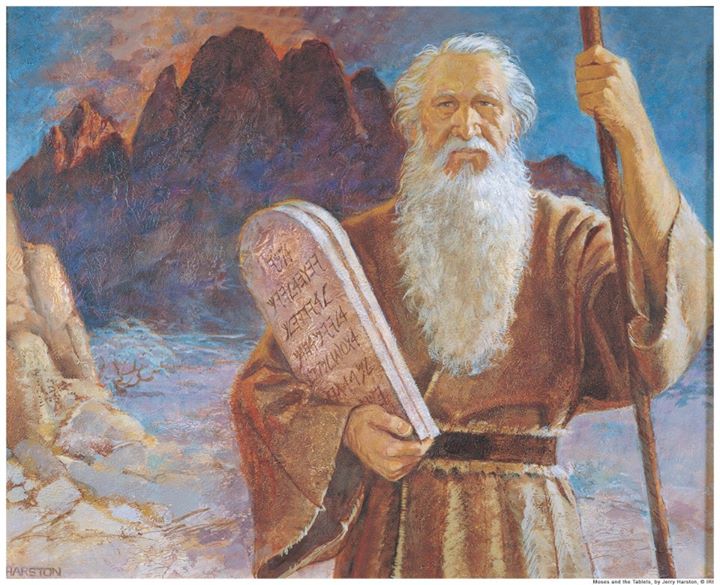
Moses stays there for 40 days and 40 nights (verse 18). During this meeting on the mountain, God gives Moses much information. This included the Ten Commandments written on tablets of stone by God Himself. Moses also receives complete instructions on how to build the tabernacle, the ark of the covenant, and the altar, specifications for the priestly garments, etc. (Exodus 24-31). At the foot of the mountain, the Israelites had Aaron build the golden calf and were committing idolatry. When Moses and Joshua descend the mountain in Exodus 32:19 and see what the people are doing, Moses breaks the stone tablets in anger. He then destroys the golden calf and disciplines the people.
In his seventh ascent, Moses goes back to the Lord in Exodus 32:32 to intercede on behalf of Israel. Moses offers his own life in exchange for that of Israel (verse 32). God’s response was: “Whosoever hath sinned against me, him will I blot out of my book. Therefore now go, lead the people unto the place of which I have spoken unto thee: behold, mine Angel shall go before thee: nevertheless in the day when I visit I will visit their sin upon them. And the Lord plagued the people, because they made the calf, which Aaron made. And the Lord said unto Moses, Depart, and go up hence, thou and the people which thou hast brought up out of the land of Egypt, unto the land which I sware unto Abraham, to Isaac, and to Jacob, saying, Unto thy seed will I give it” Exodus 32:33-33:1.
In his eighth (and final) ascent, in Exodus 34:1–2, the Lord says to Moses, “Chisel out two stone tablets like the first ones, and I will write on them the words that were on the first tablets, which you broke. Be ready in the morning, and then come up on Mount Sinai. Present yourself to me there on top of the mountain.” Moses is to come alone. On top of the mountain, the Lord reveals Himself to Moses and describes Himself this way: “The Lord, the Lord, the compassionate and gracious God, slow to anger, abounding in love and faithfulness” (verse 6). Moses worships the Lord and receives a repetition of the covenant, which he writes on the stone tablets.
Moses remains on Mount Sinai for another 40 days and 40 nights, “without eating bread or drinking water” (verse 28). When Moses comes back down to the people, “he was not aware that his face was radiant because he had spoken with the Lord. When Aaron and all the Israelites saw Moses, his face was radiant, and they were afraid to come near him” (verses 29–30).
 JRB Publications