
Chapter 41: Chronicles – a Book worth studying
1 and 2 Chronicles in the Christian Bible and Chronicles in the Hebrew Bible (this treating it as one book), are often neglected compared with other books of Bible and competes with the Book of Leviticus as books that are not read by even those who claim that understanding the Bible is something they consider important. But like Leviticus, Chronicles is especially relevant to our study of priests, and for several of our named priests it is the main source for information about their lives and work.
While Chronicles covers the same period as Kings and Samuel and many of the same events, there are significant differences as the table below illustrates and we need to study all of Samuel, Kings and Chronicles to get a complete picture. Moreover, there are many exceptions to what this table suggests regarding differences, including Chronicles talking about the bad acts of otherwise good kings and Samuel / Kings talking about the good acts of otherwise bad kings, and where Chronicles discusses prophets and their acts that are not mentioned in Samuel / Kings, while Samuel / Kings discusses priests and their acts that are not mentioned in Chronicles. We need all three for the sake of balance!
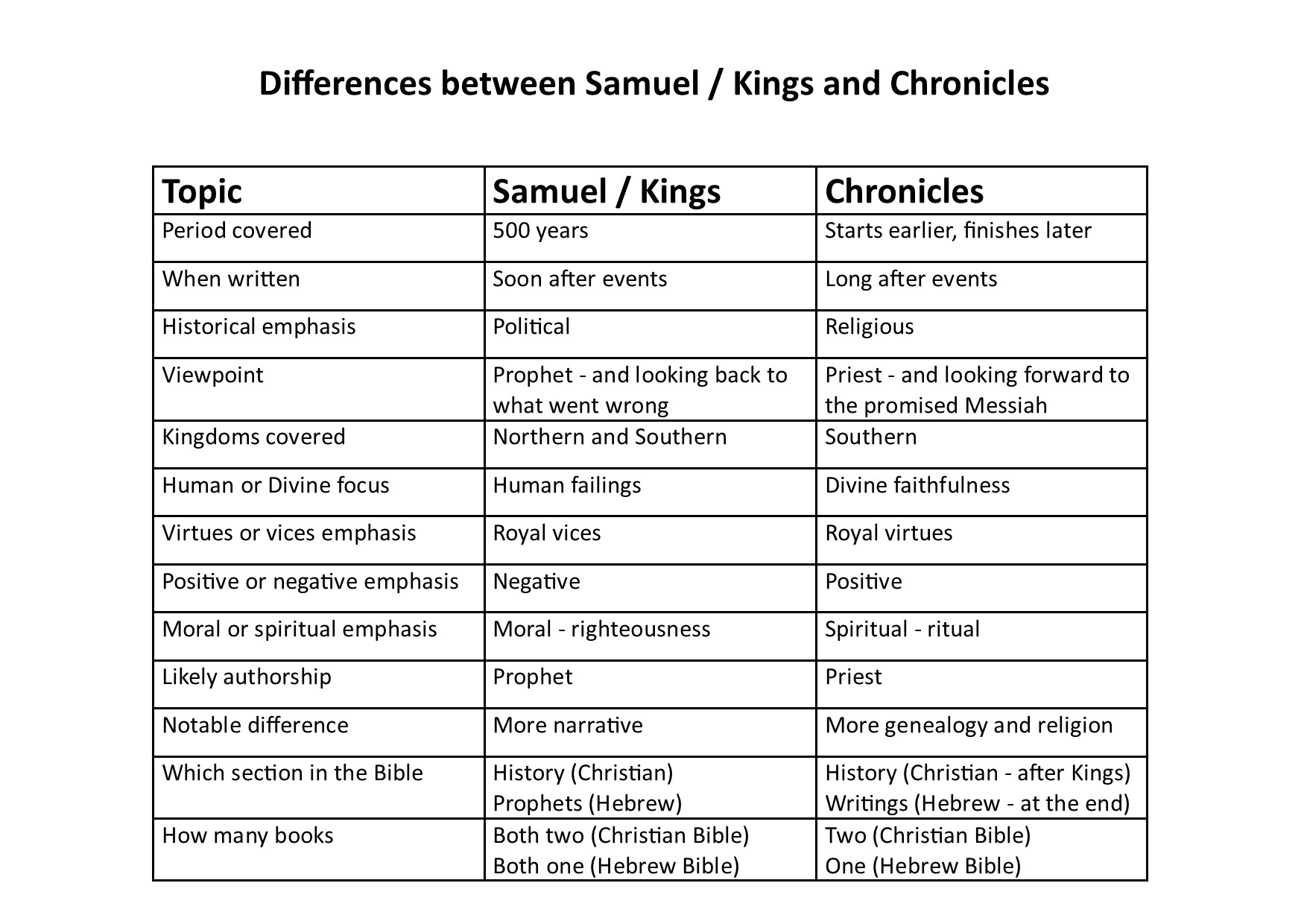
Given 1 and 2 Chronicles follows after 2 Kings in the Christian Bible and might appear to be a cut down version with some of the less interesting bits added on to what can be found in the Books of Samuel and Kings and some of the more interesting bits left out, there is a temptation to ignore it. I suspect even among Bible savvy Christians, with the exception of verses like “If my people, which are called by my name, shall humble themselves, and pray, and seek my face, and turn from their wicked ways; then will I hear from heaven, and will forgive their sin, and will heal their land” 2 Chronicles 7:14, many would be hard pressed when it comes to being able to quote from Chronicles. Barriers may be erected from the outset, since the first eight chapters are devoted to a never ending, so it seems, list of genealogies, and this is a feature seen throughout the Book. Even when we do come to narrative, there is a pre-occupation with religious ritual and Temple worship, which for some Christians not interested in such matters, seeing in Jesus the embodiment of the Temple, this might not be ignored.
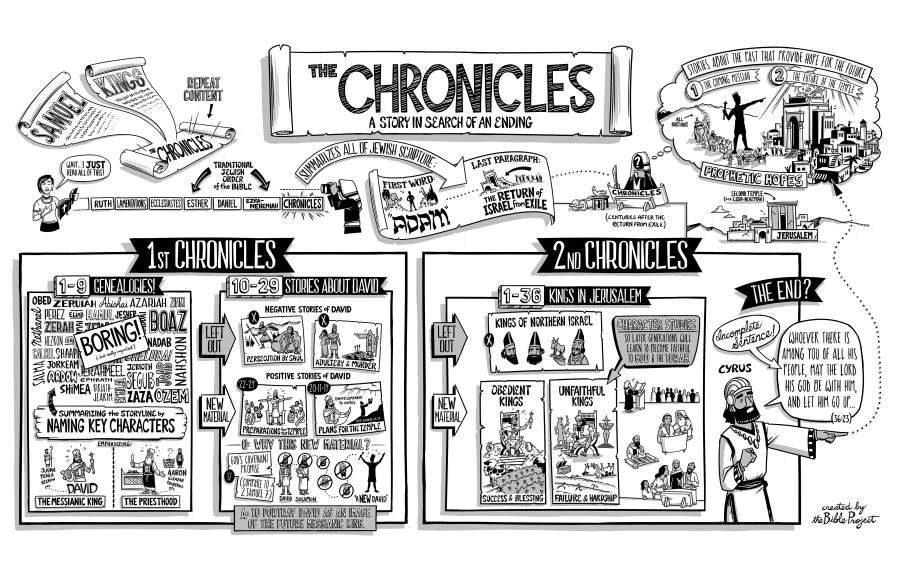
I would argue such dismissiveness is mistaken and we miss out when we do. Chronicles is different to Kings for several reasons as indicated above, but rather than repeat, it complements it. It is notable that its position in the Hebrew Bible differs to that in the Christian Bible. While the Christian Bible has Kings and Chronicles next to each other in the section referred to as History, in the Hebrew Bible, Kings is included in its Prophets section, specifically Former Prophets as opposed to the Later Prophets that in the Christian Bible cover just major and minor prophets. Chronicles comes at the very end of the Hebrew Bible, in a section known as the Writings covering the whole period of Jewish history, starting from Adam, ending with the return from Exile. It begins: It begins “Adam, Sheth, Enosh” 1 Chronicles 1:1. It ends with a message of hope (that should have been realised in Jesus) once they are back in their land: “Thus saith Cyrus king of Persia, All the kingdoms of the earth hath the Lord God of heaven given me; and he hath charged me to build him an house in Jerusalem, which is in Judah. Who is there among you of all his people? The Lord his God be with him, and let him go up” 2 Chronicles 36:33.
Given Chronicles was written centuries after Samuel and Kings, the content of which would have been well known to the readership and referred to by the author, possibly the priest, Ezra, one might ask what the intention was behind this writing. To understand this better, we should put ourselves in the shoes of the Jewish readership. They had returned from Exile to the Promised Land, it is true. But things were far from what might have been expected, as seen when reading through the Books that cover the period following the Exile: Ezra, Nehemiah, Haggai, Zechariah and Malachi. They were looking for the awaited descendant of David to come as its Messiah, and to restore the land to its former glories and better, as had been prophesied. The Temple, that David was so involved in, even though he was not allowed to build it, represented the Messianic hope that God would dwell among His people and all the promises made, going back to Abraham would be fulfilled. The lineage of David and the importance of Temple worship were two themes emphasized in Chronicles but not in Kings. The various offices of the priests, including the various activities of gatekeepers and musicians and the use of lots to decide who were to be on duty and when are among its outstanding features.
In my studies of Chronicles, I was blown away by gems that could so easily have been missed. In going through the first eight genealogy chapters, for example, I found these two nuggets: “And Jabez was more honourable than his brethren: and his mother called his name Jabez, saying, Because I bare him with sorrow. And Jabez called on the God of Israel, saying, Oh that thou wouldest bless me indeed, and enlarge my coast, and that thine hand might be with me, and that thou wouldest keep me from evil, that it may not grieve me! And God granted him that which he requested” 1Chronicles 4:9-10. And “The sons of Reuben, and the Gadites, and half the tribe of Manasseh, of valiant men, men able to bear buckler and sword, and to shoot with bow, and skilful in war, were four and forty thousand seven hundred and threescore, that went out to the war. And they made war with the Hagarites, with Jetur, and Nephish, and Nodab. And they were helped against them, and the Hagarites were delivered into their hand, and all that were with them: for they cried to God in the battle, and he was intreated of them; because they put their trust in him” 1 Chronicles 5:18-20. While on the subject of genealogies, with the line of David as the most important, many other lines are listed in Chronicles. We note other family lines, also encountered in our Old Testament journey, are provided, showing the readers that as far as God was concerned the importance of such families and why families still matter.
As we have already noted, Chronicles is placed right at the very end of Hebrew scriptures, and for a good reason. It was written primarily to encourage the Jewish people, notably those returning from Exile. While they were God’s specially chosen people, a “rooted, royal and religious” people, their situation upon return was often not a particularly happy one. While they, or at least the small remnant, who had returned from exile, by God’s hand, they were still subject to a foreign power. While the Persians were benevolent, the Greeks and Romans who were to take over were not and things were a far cry from what ought to have been. Moreover, when it came to zeal for God, their response was often topsy-turvy, with the last book of the Bible, Malachi, indicating that in many ways they had lost the plot and with God’s call “Bring ye all the tithes into the storehouse, that there may be meat in mine house, and prove me now herewith, saith the Lord of hosts, if I will not open you the windows of heaven, and pour you out a blessing, that there shall not be room enough to receive it” Malachi 3:10.
In the four-hundred-year period between Old and New Testaments, when their Messiah did come, only to be rejected, the story of Israel was largely having to live under foreign tyranny with the hopes raised under Abraham, Moses and David being a distant memory. But their history and ways needed to be recalled and celebrated, along with the hope that the long-expected Messiah from the line of David would set up His everlasting Kingdom of righteousness, peace and justice, and this is something the Book of Chronicles sets out to do. While Israel, the physical descendants of Abraham, needed to be reminded of these things, so do his spiritual descendants (the Church) and why studying it matters. We need to be thankful the Book of Chronicles to help remind us of these important truths.
Finally, the following is a suggested breakdown of the content of the Book of Chronicles:
Genealogies: Creation to Restoration (1Chr 1-9)
- The Patriarchs (ch. 1)
- The 12 Sons of Jacob/Israel (2:1-2)
- The Family of Judah (2:3;4:23)
- The Sons of Simeon (4:24-43)
- Reuben, Gad and the Half-Tribe of Manasseh (ch. 5)
- Levi and Families (ch. 6)
- Issachar, Benjamin, Naphtali, Manasseh, Ephraim and Asher (chs. 7-9)
The Reign of David (1Chr 10-29)
- Death of Saul (ch. 10)
- Capture of Jerusalem; David’s Power Base (chs. 11-12)
- Return of the Ark; Establishment of David’s Kingdom (chs. 13-16)
- Dynastic Promise (ch. 17)
- David’s Conquests (chs. 18-20)
- The Census (ch. 21)
- Preparations for the Temple (ch. 22)
- Organization of the Temple Service (chs. 23-26)
- Administrative Structures of the Kingdom (ch. 27)
- David’s Final Preparations for Succession and the Temple (28:1;29:20)
- Succession of Solomon; Death of David (29:21-30)
The Reign of Solomon (2Chr 1-9)
- The Gift of Wisdom (ch. 1)
- Building the Temple (2:1;5:1)
- Dedication of the Temple (5:2;7:22)
- Solomon’s Other Activities (ch. 8)
- Solomon’s Wisdom, Splendor and Death (ch. 9)
The Schism, and the History of the Kings of Judah (2Chr 10-36)
- Rehoboam (chs. 10-12)
- Abijah (13:1;14:1)
- Asa (14:2;16:14)
- Jehoshaphat (17:1;21:3)
- Jehoram and Ahaziah (21:4;22:9)
- Joash (22:10;24:27)
- Amaziah (ch. 25)
- Uzziah (ch. 26)
- Jotham (ch. 27)
- Ahaz (ch. 28)
- Hezekiah (chs. 29-32)
- Manasseh (33:1-20)
- Amon (33:21-25)
- Josiah (34:1;36:1)
- Josiah’s Successors (36:2-14)
- Exile and Restoration (36:15-23)
 JRB Publications