
Unnamed and other named priests
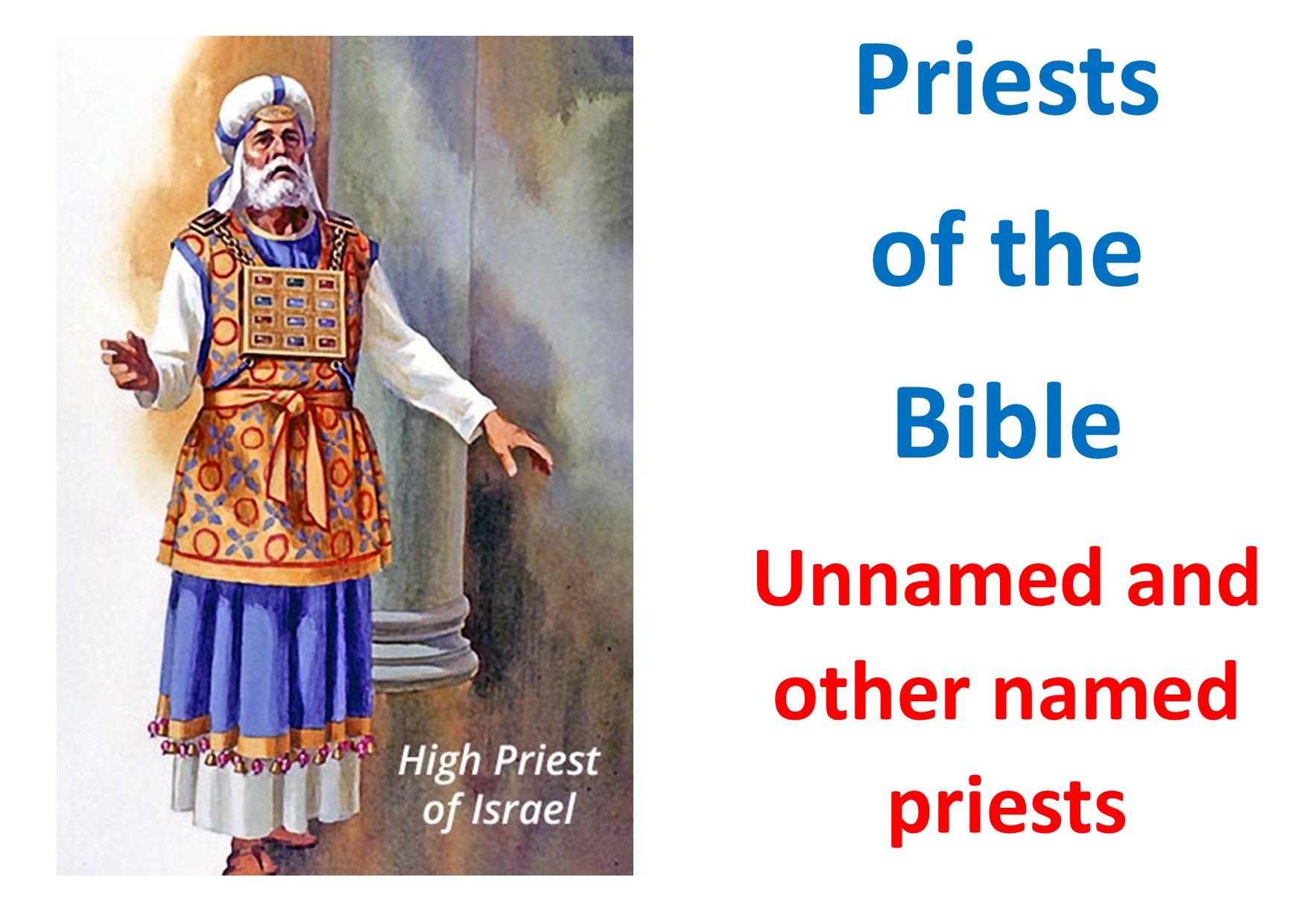
We have named and discussed 17 priests in detail so far and while we were at it we have referred to other priests. But many more priests functioned up to the time of the Exile and after that up to the destruction of the Temple in AD 70. Many, we don’t know their names (more so than in the case with the prophets)!
An attempt to consider every priest from the time when the Levitical priesthood was instituted during the Exodus from Egypt to Canaan until the destruction of the Temple in AD 70 would be beyond the scope of this book. However, it is a matter worth reflecting on; not just the priests of Israel that were of YHWH and from the Aaronic line, right up to New Testament times, as far as we can make out, but also the Levites, who duties complemented those of the priests. What we will do here is consider priests functioning from the time of King David until the time of King Jehoshaphat.
That period is covered in the Books of Samuel, Kings and Chronicles. While matters pertaining to priests are included in the Samuel and Kings accounts, most of the information we need is to be found in the Books of Chronicles. This is unsurprising as one of the main differences between the Books of Kings and Chronicles was the former was written from a prophets’ viewpoint and focused on how Israel came to be in the position they were in and the latter from a priests’ viewpoint, looking both long back in religious Israel’s history, even before priests, and looking forward to the coming of its future Messiah, and it included details concerning genealogies and religious life. In doing so, we bridge the gap between Zadok and Jehoiada who, as we have already discussed, were outstanding priests and exemplars of how priests should be. In this period, priests were very active.
One featuOne feature, often overlooked when studying the life of David, whose life was fraught with conflict and war, was the priority he gave to the religious life of Israel in a way that honoured the God with whom they were in covenant with and promoted the worship of YHWH, the one true God, evidenced already when describing the prominent roles of Abiathar and Zadok, the High Priests of his time. The bringing back to Jerusalem of the Ark of the Covenant was one notable act where David played a leading role. Among his significant acts was detailed preparation of the building of the Temple (he was disqualified from building it) helping ensure carrying out what needed to happen, e.g. regarding the duties of the Priests and Levites, once the Temple had been built. Moreover, he also contributed through the writing of his Psalms; many were meant to be and were sung as part of Temple worship. (In the final chapter of this book, we share Psalm 105, one of the Psalms sung.)
A lot of coverage is given in 1 Chronicles as to how David planned to use and organise priests and Levites their important contribution to the life of Israel, not just religious but other functions and, in the reigns of the kings who followed – in the judiciary, as teachers, civil servants, musicians and gatekeepers, supported by the Levites, who were organised according to their lineage corresponding to the sons of Levi: Gershon, Kohath and Merari. Something picked up centuries later in our New Testament studies of Zacharias and Caiaphas were the 24 divisions of priest, led by the descendants of the two surviving sons of Aaron (16 from the line of Eleazar and 8 from the line of Ithamar), who operated what could be seen as a shift system when it came to carrying out the duties in the Temple.
- The Ark Brought to Jerusalem (chapter 15)
- Ministering Before the Ark (chapter 16)
- Preparation for the Temple (chapter 22)
- The Levites (chapter 23)
- The Division of Priests (chapter 24)
- The Rest of the Levites (chapter 24)
- The Musicians (chapter 25)
- The Gatekeepers (chapter 26)
- The Treasurers and Other Officials (chapter 26)
- David’s Plans for the Temple (chapter 28)
When we consider the kings between David and Jehoshaphat, we must begin with Solomon, David’s son, who began well, and this included following the blueprint set out by David when it came to the building of the Temple, Temple activities and the functions of priests, but finished badly. This laid the way open for many of the troubles that followed, starting with the division of the Kingdom into the ten tribes to the South (Judah), under his son, Rehoboam, and the two tribes to the North (Israel), under Jeroboam, who like all the kings of Israel that were to follow was considered bad. The Book of Chronicles, unlike that of Kings, focuses just on Judah, for it is there that the true worship of YHWH, along with His priests, can be mostly found. Even so, there was always a remnant in Israel that followed the true God and even up to 722 BC when Israel fell and were taken into captivity by the Assyrians there were prophets like Elijah, Elisha, Amos and Hosea that spoke the word of YHWH and sought to turn the people back to Him. But we do find whenever YHWH was not worshipped in the right way this often brought on priests that were not of YHWH, which we considered in Chapter 9.
Both Rehoboam and his son, Abijah, would be seen as bad kings of Judah, in contrast to the two kings that followed them: Asa and Jehoshaphat who would be seen as good kings. But it is never that straight forward for even these two bad kings did good things and the two bad kings did bad things (a theme we will develop when we get to Kings of the Bible). The good thing that all four kings did was to encourage the true priests, who appeared to have flourished in that period and from what we can make out did all that was required of them carrying out their duties as they were allowed.
It was not just Israel that strayed from the Covenant God made with them at Mount Sinai, but it was to be a recurring with Judah too. We read under Rehohoam: “And Judah did evil in the sight of the Lord, and they provoked him to jealousy with their sins which they had committed, above all that their fathers had done. For they also built them high places, and images, and groves, on every high hill, and under every green tree” 1 Kings 14:22,23, and even under the good kings we often we find that High Places continued to function. Another aspect of Rehoboam’s reign, however, was that following the ten to two tribal division, the true Priests and Levites, intent no doubt on the true worship of YHWH, were prepared to relocate from the Northern to Southern Kingdom, at a cost: “And the priests and the Levites that were in all Israel resorted to him out of all their coasts. For the Levites left their suburbs and their possession, and came to Judah and Jerusalem: for Jeroboam and his sons had cast them off from executing the priest’s office unto the Lord” 2 Chronicles 11:13,14.
We read concerning Abijah (Abijam) “Now in the eighteenth year of king Jeroboam the son of Nebat reigned Abijam over Judah. Three years reigned he in Jerusalem. and his mother’s name was Maachah, the daughter of Abishalom. And he walked in all the sins of his father, which he had done before him: and his heart was not perfect with the Lord his God, as the heart of David his father. Nevertheless for David’s sake did the Lord his God give him a lamp in Jerusalem, to set up his son after him, and to establish Jerusalem” 1 Kings 15:1-4. Other than its negative portrayal, the Book of Kings says little about Abijah’s deeds, but Chronicles devotes a whole chapter on the war between Abijah and Jeroboam, with priests playing an important part: “Have ye not cast out the priests of the Lord, the sons of Aaron, and the Levites, and have made you priests after the manner of the nations of other lands? so that whosoever cometh to consecrate himself with a young bullock and seven rams, the same may be a priest of them that are no gods. But as for us, the Lord is our God, and we have not forsaken him; and the priests, which minister unto the Lord, are the sons of Aaron, and the Levites wait upon their business … And when Judah looked back, behold, the battle was before and behind: and they cried unto the Lord, and the priests sounded with the trumpets … And Abijah and his people slew them with a great slaughter: so there fell down slain of Israel five hundred thousand chosen men. Thus the children of Israel were brought under at that time, and the children of Judah prevailed, because they relied upon the Lord God of their fathers” 2 Chronicles 13:9-10,17-18.
When Abijah died, Asa, his son, reigned in his stead. The best thing that can be said about Asa is “And Asa did that which was right in the eyes of the Lord, as did David his father” 1 Kings 15:11, although toward the end, he made wrong alliances rather than trust in the Lord and it proved to be his undoing. There is one significant mention of priests during his 41 years: “And the Spirit of God came upon Azariah the son of Oded: And he went out to meet Asa, and said unto him, Hear ye me, Asa, and all Judah and Benjamin; The Lord is with you, while ye be with him; and if ye seek him, he will be found of you; but if ye forsake him, he will forsake you. Now for a long season Israel hath been without the true God, and without a teaching priest, and without law. But when they in their trouble did turn unto the Lord God of Israel, and sought him, he was found of them” 2 Chronicles 16:1-4. We see here the importance of the role of the priest as a teacher, and this was to continue under Jehoshaphat, his son, and later, as we have already considered, under the priests: Jehoiada and Ezra.
When Asa died, Jehoshaphat, his son, reigned in his stead. Again, the commentary on his reign was a positive one despite, as with his father, he instigated some acts of folly toward the end of his reign and he was duly rebuked: “And Jehoshaphat his son reigned in his stead, and strengthened himself against Israel … And the Lord was with Jehoshaphat, because he walked in the first ways of his father David, and sought not unto Baalim; But sought to the Lord God of his father, and walked in his commandments, and not after the doings of Israel” 2 Chronicles 17:1,3-4. The priest as teacher was a priority that continued under Jehoshaphat: “And with them he sent Levites, even Shemaiah, and Nethaniah, and Zebadiah, and Asahel, and Shemiramoth, and Jehonathan, and Adonijah, and Tobijah, and Tobadonijah, Levites; and with them Elishama and Jehoram, priests. And they taught in Judah, and had the book of the law of the Lord with them, and went about throughout all the cities of Judah, and taught the people. And the fear of the Lord fell upon all the kingdoms of the lands that were round about Judah, so that they made no war against Jehoshaphat” 2 Chronicles 17:8-10
Another role of priests that came to the fore during Jehoshaphat’s reign was that of judges, and while we know little else, the part that Amariah, the chief priest, played was an important one, and doing so courageously had its own rewards: “Moreover in Jerusalem did Jehoshaphat set of the Levites, and of the priests, and of the chief of the fathers of Israel, for the judgment of the Lord, and for controversies, when they returned to Jerusalem. And he charged them, saying, Thus shall ye do in the fear of the Lord, faithfully, and with a perfect heart. And what cause soever shall come to you of your brethren that dwell in your cities, between blood and blood, between law and commandment, statutes and judgments, ye shall even warn them that they trespass not against the Lord, and so wrath come upon you, and upon your brethren: this do, and ye shall not trespass. And, behold, Amariah the chief priest is over you in all matters of the Lord; and Zebadiah the son of Ishmael, the ruler of the house of Judah, for all the king’s matters: also the Levites shall be officers before you. Deal courageously, and the Lord shall be with the good” 2 Chronicles 19:8-11.
 JRB Publications